
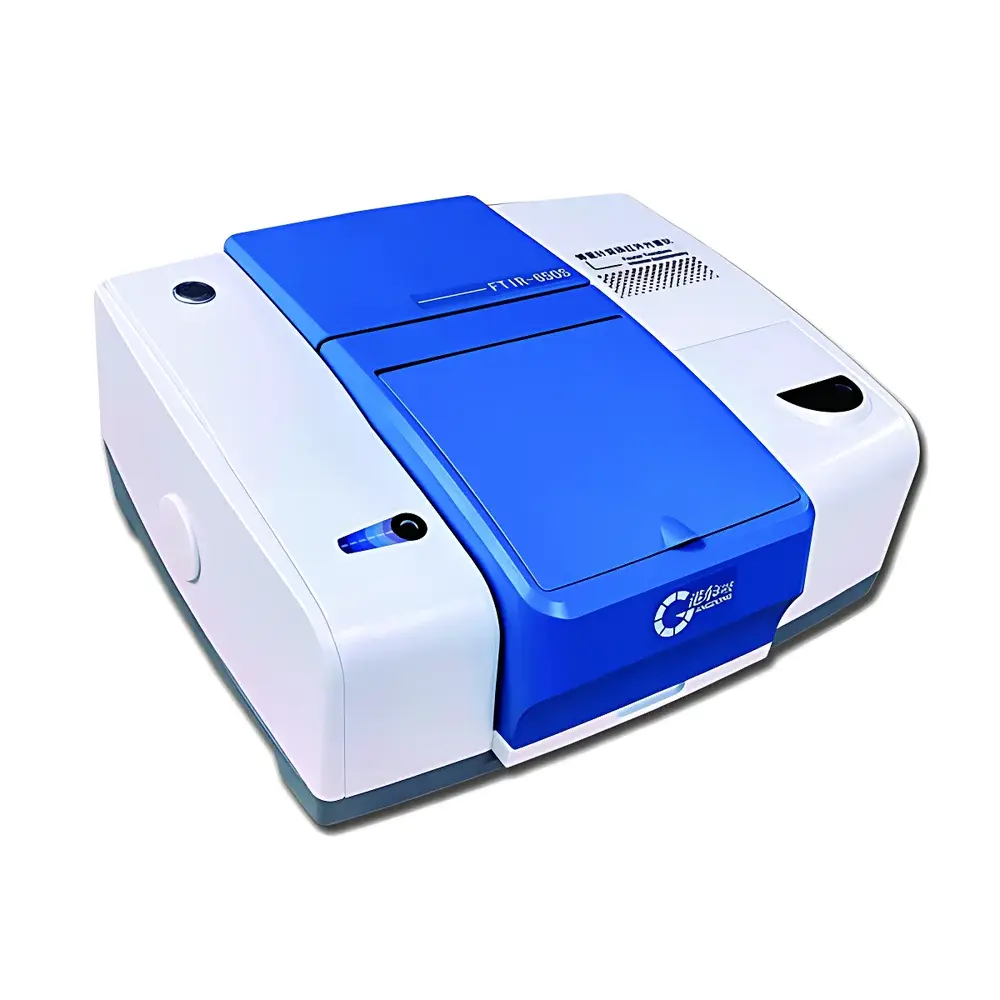
Gangdong FTIR-650S Fourier Transform Infrared Spectrometer
| Brand | Gangdong |
|---|---|
| Origin | Tianjin, China |
| Manufacturer Type | Direct Manufacturer |
| Instrument Type | Laboratory FTIR Spectrometer |
| Spectral Range | 7800–350 cm⁻¹ |
| Resolution | Better than 1 cm⁻¹ |
| Scan Speed | 1 scan/sec |
| Signal-to-Noise Ratio | 45,000:1 (peak-to-peak, 4 cm⁻¹, 1-min background + sample scan, at 2100 cm⁻¹) |
| Detector | Imported High-Sensitivity DTGS or MCT (configurable) |
| Beamsplitter | Ge-coated KBr substrate |
| Source | Long-life Air-Cooled High-Intensity IR Source |
| Linearity | 0.1% |
| Dimensions | 430 × 360 × 200 mm |
| Weight | 15 kg |
| Interface | USB 2.0 |
| OS Support | Windows 7 Professional, Windows 10 Professional |
Overview
The Gangdong FTIR-650S Fourier Transform Infrared Spectrometer is a laboratory-grade analytical instrument engineered for high-fidelity molecular identification and quantitative analysis across organic, inorganic, polymeric, and pharmaceutical materials. Based on Michelson interferometry and the mathematical foundation of the Fourier transform, the FTIR-650S converts time-domain interferograms into frequency-domain infrared absorption spectra with high spectral fidelity. Its core optical architecture integrates a precision corner-cube interferometer, a long-life air-cooled broadband infrared source, and a high-sensitivity DTGS (deuterated triglycine sulfate) detector—optionally upgradable to liquid-nitrogen-cooled MCT for enhanced mid- to far-IR sensitivity. Designed for routine use in regulated and research environments, the system delivers robust performance across the full mid-infrared range (7800–350 cm⁻¹), supporting applications from raw material verification to structural elucidation and process monitoring.
Key Features
- Optimized optical path design: Enhanced infrared source output increases baseline energy by up to 50% compared to predecessor models, improving signal uniformity across both high- and low-wavenumber regions (e.g., C–H stretching >2800 cm⁻¹ and fingerprint region <1500 cm⁻¹).
- High-stability corner-cube interferometer: Engineered for minimal alignment drift and thermal hysteresis; achieves better-than-1 cm⁻¹ nominal resolution with reproducible wavenumber accuracy ≤±0.02 cm⁻¹ over extended operation.
- Industry-leading signal-to-noise ratio: 45,000:1 (P–P, 4 cm⁻¹, 1-minute co-addition, measured at 2100 cm⁻¹), enabling reliable detection of trace functional groups and weak absorptions in complex matrices.
- Integrated environmental protection: Dual-stage desiccant chamber with high-capacity refillable cartridge; hermetically sealed interferometer and detector compartments with hydrophobic coatings on KBr beamsplitters and optical windows to mitigate moisture-induced degradation.
- EMC-compliant electromagnetic design: Meets IEC 61326-1:2013 requirements for laboratory equipment—low radiated emissions (<30 dBµV/m @ 30–230 MHz) and high immunity to conducted disturbances (IEC 61000-4-6 Level 3), ensuring stable operation near centrifuges, RF sealers, or other industrial instrumentation.
- Ergonomic user interface: Front-access power switch with LED status indicator; tool-free top-hinged sample compartment door facilitating rapid ATR, transmission, or reflectance accessory changes without realignment.
Sample Compatibility & Compliance
The FTIR-650S supports standard sampling modalities including transmission (KBr pellets, films, solutions), attenuated total reflection (ATR), diffuse reflectance (DRIFTS), and specular reflectance. It is compatible with commercially available accessories such as diamond ATR crystals (single-bounce, 45° geometry), liquid cells (CaF₂ or BaF₂ windows), and gas cells (path lengths 1–10 cm). From a regulatory standpoint, the instrument’s digital architecture supports audit-trail-enabled data acquisition when paired with compliant third-party software (e.g., OMNIC Enterprise or GRAMS/AI with 21 CFR Part 11 add-ons). While the base firmware does not include electronic signature or role-based access control, its USB 2.0 interface and deterministic scan timing allow integration into GLP/GMP workflows where raw interferogram files (.DPT or .SPA) are archived alongside metadata (operator ID, date/time stamp, instrument serial number, and parameter log).
Software & Data Management
The FTIR-650S operates via Gangdong’s proprietary Windows-based acquisition and processing suite (v3.2+), supporting real-time interferogram visualization, apodization selection (Happ-Genzel, Blackman-Harris), phase correction, and atmospheric compensation (H₂O/CO₂ subtraction). Spectral libraries—including polymer, pharmaceutical, and EPA reference sets—are embedded and searchable by functional group, CAS number, or similarity matching (Pearson correlation ≥0.95). All processed spectra export to ASTM E131-compliant JCAMP-DX format (.dx), enabling interoperability with LIMS platforms and third-party chemometric tools (e.g., MATLAB, Unscrambler X). Raw interferogram data is stored unprocessed, preserving full traceability for reprocessing under revised calibration or baseline algorithms.
Applications
This spectrometer serves as a primary analytical tool in quality control laboratories for identity testing (USP ), assay validation, and excipient compatibility studies in pharmaceutical development. In materials science, it characterizes crosslink density in elastomers, oxidation states in metal oxides, and crystallinity in semicrystalline polymers (e.g., PET, PP). Environmental labs apply it to microplastic identification (per ISO 24005:2023), while electronics manufacturers verify conformal coating integrity and solder flux residue composition. Its stability and repeatability make it suitable for method transfer between R&D and QC sites, and its compact footprint (430 × 360 × 200 mm) allows deployment in shared instrumentation cores or mobile analytical vans.
FAQ
What is the recommended maintenance schedule for the FTIR-650S?
Dry air purge or desiccant replacement every 3–6 months depending on ambient humidity; optical alignment verification annually using NIST-traceable polystyrene film standard.
Does the instrument support automated sample changers?
Not natively—but the USB 2.0 interface and command-line API (provided under NDA) enable integration with third-party autosamplers via LabVIEW or Python-based control scripts.
Is the detector cooled during operation?
The standard DTGS detector operates at ambient temperature; optional liquid-nitrogen-cooled MCT detector requires separate dewar and cryogen handling protocol.
Can spectral data be exported for multivariate analysis?
Yes—absorbance or transmittance spectra export as ASCII, CSV, or JCAMP-DX; derivative and vector-normalized formats are supported for PCA or PLS regression input.
What calibration standards are supplied with the system?
NIST-traceable polystyrene film (for wavenumber accuracy), potassium bromide pellet (for intensity linearity), and water vapor reference spectrum (for atmospheric correction validation).
Related Products





