
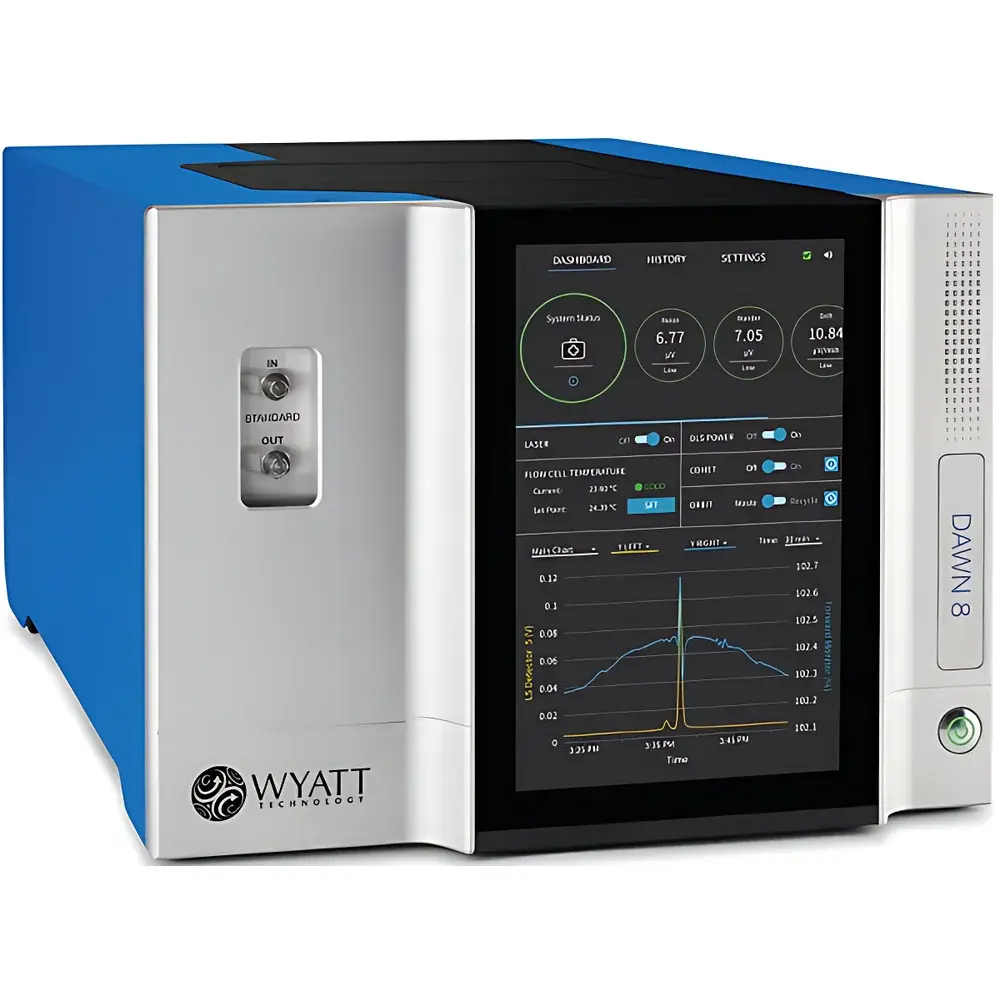
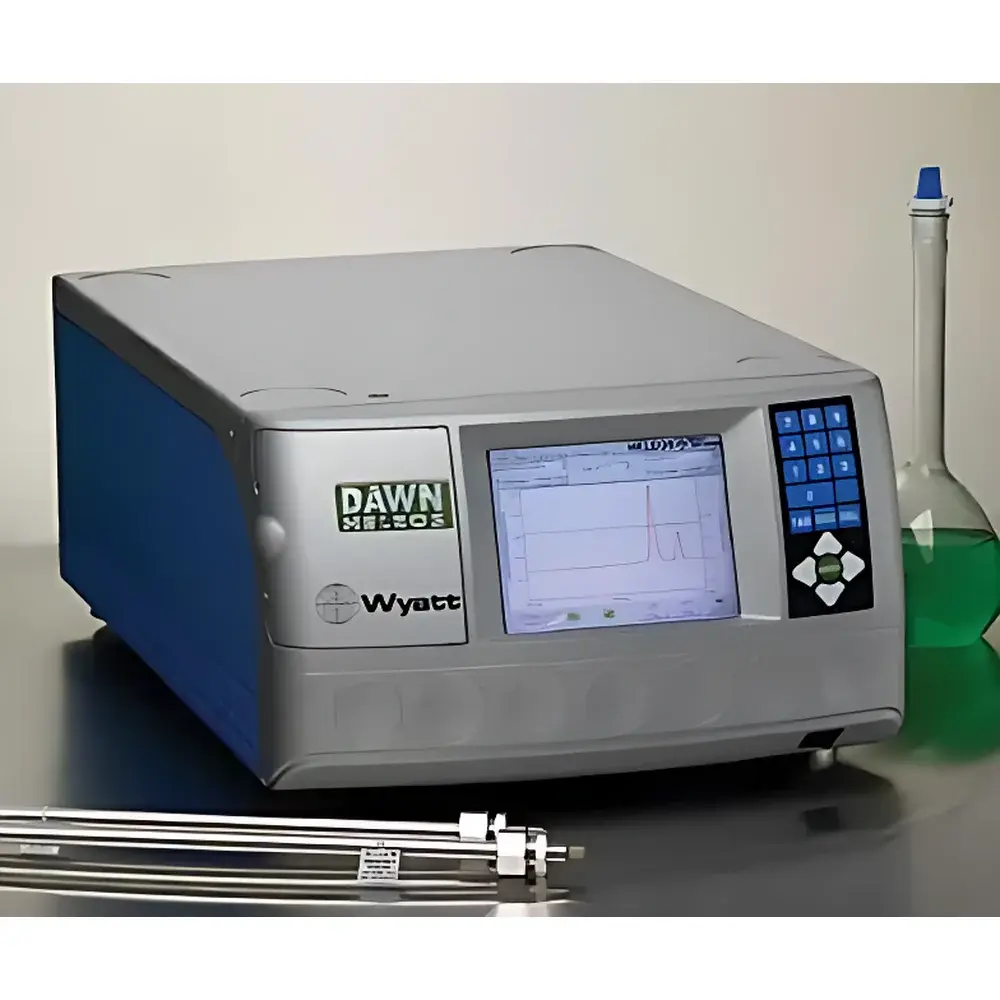
Wyatt DAWN 8 Multi-Angle Light Scattering (MALS) Instrument
| Brand | Wyatt |
|---|---|
| Origin | USA |
| Manufacturer Type | Original Equipment Manufacturer (OEM) |
| Origin Category | Imported |
| Model | DAWN 8 |
| Pricing | Available Upon Request |
| Angular Range | 23°–155° (8 fixed angles) |
| Molecular Weight Range | 10³–10⁷ Da |
| Root-Mean-Square Radius (Rg) Measurement Range | 10–300 nm |
| Laser Source | 50 mW GaAs linearly polarized laser, 658 nm |
| Data Interface | Ethernet |
| Display | Full-color LCD touchscreen |
Overview
The Wyatt DAWN 8 is a benchtop multi-angle light scattering (MALS) instrument engineered for absolute, assumption-free characterization of macromolecules and nanoparticles in solution. Operating on the fundamental principles of static light scattering (SLS) and angular-dependent intensity analysis, the DAWN 8 measures scattered light intensity at eight precisely calibrated angles—ranging from 23° to 155°—enabling simultaneous determination of weight-average molar mass (Mw), root-mean-square radius (Rg), and second virial coefficient (A2) without reliance on calibration standards or conformational assumptions. Unlike single-angle detectors, its multi-angle architecture eliminates extrapolation errors inherent in Zimm or Debye analyses, delivering high reproducibility across diverse sample classes—from synthetic polymers and biologics to colloidal dispersions and protein complexes. The instrument is designed for both standalone operation and seamless integration with size-exclusion chromatography (SEC/GPC), field-flow fractionation (FFF), or HPLC systems, supporting orthogonal detection strategies required for regulatory-compliant characterization under ICH Q5E, USP , and ISO 22412 guidelines.
Key Features
- Eight fixed-angle detection geometry with optimized angular spacing for robust Mw and Rg determination across 10–300 nm hydrodynamic size range
- High-sensitivity photodiode-based detector array with low-noise amplification and real-time analog-to-digital conversion
- Integrated 50 mW, linearly polarized 658 nm GaAs laser source with thermoelectric stabilization for long-term power consistency
- Real-time data acquisition and visualization via built-in full-color LCD touchscreen interface
- Ethernet-enabled communication protocol compatible with third-party chromatography data systems (CDS) and laboratory information management systems (LIMS)
- Simultaneous output of Mw, Rg, and A2 per elution slice in SEC-coupled mode—critical for assessing aggregation propensity, branching architecture, and solution thermodynamics
Sample Compatibility & Compliance
The DAWN 8 accommodates aqueous and organic solvent-based samples—including buffers, DMF, THF, and chloroform—with minimal volume requirements (typically 50–200 µL per injection in SEC mode). Its optical design minimizes multiple scattering artifacts through precise collimation and stray-light rejection, enabling reliable measurements for moderately turbid samples (up to ~100 NTU). The system supports GLP- and GMP-aligned workflows via optional audit-trail logging, electronic signatures, and 21 CFR Part 11–compliant software modules. All measurement protocols align with ASTM D7252 (light scattering for polymer molecular weight), ISO 13321 (photon correlation spectroscopy), and IUPAC recommendations for absolute molar mass determination.
Software & Data Management
Controlled by ASTRA software (v8.x or later), the DAWN 8 provides comprehensive data processing including batch analysis, baseline correction, band broadening deconvolution, and conformation plot generation (Rg vs. Mw). Raw intensity files (.DAT) are stored in vendor-neutral formats compliant with FAIR data principles. ASTRA supports automated report generation in PDF/HTML with embedded metadata (instrument ID, operator, timestamp, environmental conditions), traceable to NIST-traceable reference standards (e.g., pullulan, bovine serum albumin). Data export options include CSV, Excel, and XML for integration into statistical process control (SPC) platforms used in QC laboratories.
Applications
- Quantitative assessment of monoclonal antibody aggregation and fragment formation during formulation development
- Determination of branching ratio and long-chain branching frequency in polyolefins and ethylene copolymers
- Monitoring time-resolved structural evolution during thermal degradation, photo-crosslinking, or pH-induced phase separation
- Characterization of liposome, exosome, and polymeric nanoparticle size distribution and stability under shear or storage stress
- Validation of SEC column calibration using universal calibration curves derived from first-principles MALS data
- Supporting comparability studies for biosimilar development per FDA and EMA guidance documents
FAQ
Can the DAWN 8 be used without coupling to SEC?
Yes—it operates in batch mode for direct solution analysis, enabling rapid screening of molar mass and conformational parameters without chromatographic separation.
Is temperature control available for the flow cell?
The standard DAWN 8 does not include integrated temperature regulation; however, it is compatible with externally thermostatted SEC systems or custom-built flow cells equipped with Peltier elements.
What sample concentration range is recommended for optimal signal-to-noise?
Typical concentrations range from 0.1–2 mg/mL for proteins and 0.5–5 mg/mL for synthetic polymers—optimized based on refractive index increment (dn/dc) and expected Mw.
Does the system support dynamic light scattering (DLS) measurements?
No—the DAWN 8 is dedicated to static light scattering. For combined SLS/DLS analysis, Wyatt recommends coupling with a separate DLS detector such as the DynaPro NanoStar or integrating with the Dawn HELEOS II platform.
How is calibration performed?
The DAWN 8 requires no user calibration; angular alignment and photometric response are factory-set and verified using NIST-traceable angular standards and certified reference materials. Routine verification uses toluene or filtered water for intensity stability checks.



