
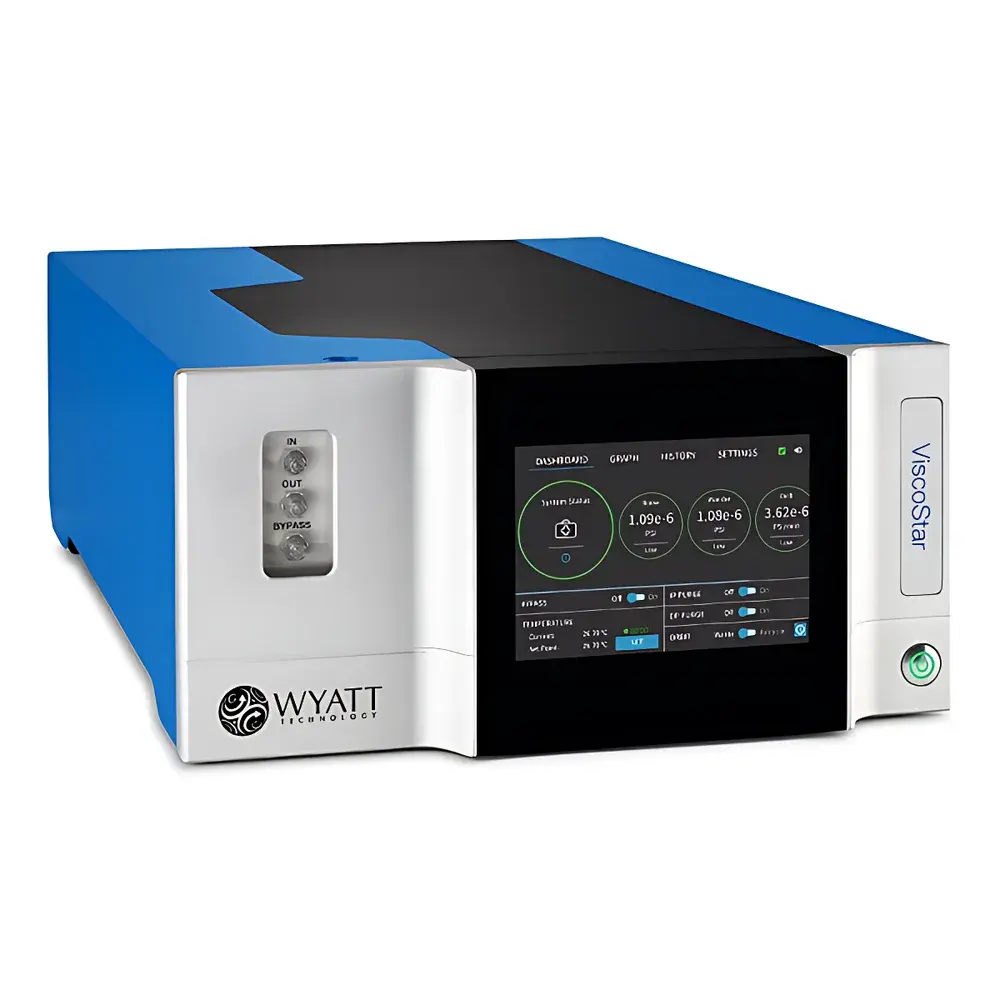
Wyatt ViscoStar Viscometer Detector
| Brand | Wyatt |
|---|---|
| Origin | USA |
| Manufacturer | Wyatt Technology Corporation |
| Model | ViscoStar |
| Wavelength | 658 nm |
| Detection Principle | Four-Arm Capillary Bridge |
| Flow Rate | 1–3 mL/min |
| Delay Volumes | 4 mL, 12 mL, 27 mL (user-selectable) |
| Cell Volume | 33 µL per bridge arm |
| Operating Temperature Range | 4–60 °C |
| Temperature Stability | < 0.01 °C |
| Cooling Method | Air-cooled Peltier |
| Dimensions (H×W×D) | 168 mm × 357 mm × 595 mm |
| Weight | 11.5 kg |
| Analog Outputs | 2 channels (inlet pressure & differential pressure) |
| Display | Full-color LCD |
| Data Interface | Ethernet |
Overview
The Wyatt ViscoStar Viscometer Detector is a high-precision, four-arm capillary bridge-based viscometer engineered for integration into high-performance liquid chromatography (HPLC), size-exclusion chromatography (SEC), and multi-angle light scattering (MALS) systems. It operates on the fundamental principle of measuring the pressure differential across two parallel capillary bridges as a sample solution flows through them under laminar conditions. This differential pressure is directly proportional to the intrinsic viscosity of the analyte, enabling absolute determination of hydrodynamic volume, branching ratio, and conformational parameters without reliance on calibration standards. Designed and manufactured in Santa Barbara, California by Wyatt Technology Corporation, the ViscoStar delivers exceptional baseline stability and signal-to-noise performance—critical for detecting subtle viscosity changes in dilute macromolecular solutions, such as proteins, polysaccharides, synthetic polymers, and gene therapy vectors.
Key Features
- Four-arm capillary bridge architecture optimized for wide dynamic range viscosity measurement—from low-viscosity solvents to highly entangled polymer solutions—with inherently high sensitivity and minimal shear-induced degradation.
- Integrated sensor protection system safeguards the delicate piezoresistive diaphragm from mechanical shock or overpressure events during column priming or system upsets.
- Dedicated pulse-damping mechanism suppresses residual pump pulsations not canceled by the bridge geometry, ensuring stable baselines even at low flow rates (1 mL/min) and with high-pressure gradient systems.
- User-configurable delay volumes (4 mL, 12 mL, 27 mL) enable seamless compatibility with microbore, analytical, and preparative SEC columns—no recalibration required when switching column formats or flow paths.
- Air-cooled Peltier temperature control provides precise thermal regulation from 4 °C to 60 °C with stability better than ±0.01 °C, eliminating dependency on external chillers or water baths while maintaining consistent eluent viscosity and column retention behavior.
- Real-time data visualization via built-in full-color LCD display; simultaneous analog outputs for inlet pressure and differential pressure support third-party DAQ integration and hardware synchronization.
- Ethernet-enabled digital communication ensures interoperability with industry-standard chromatography data systems (CDS), including Empower, Chromeleon, and Wyatt’s ASTRA software, with support for TCP/IP and Modbus protocols.
Sample Compatibility & Compliance
The ViscoStar is compatible with aqueous and organic mobile phases commonly used in SEC and HPLC—including PBS, sodium acetate buffers, THF, DMF, and chloroform—provided they are filtered (≤0.1 µm) and degassed. Its stainless-steel wetted path and chemically resistant seals meet USP Class VI biocompatibility requirements. The instrument supports GLP/GMP workflows through audit-trail-capable software interfaces and complies with FDA 21 CFR Part 11 when operated within validated CDS environments. It is routinely employed in applications governed by ASTM D5225 (polymer intrinsic viscosity), ISO 16014-4 (SEC characterization), and ICH Q5E (comparability of therapeutic proteins).
Software & Data Management
When paired with Wyatt’s ASTRA software, the ViscoStar enables real-time viscosity calculation, automatic zeroing, and synchronized data acquisition with MALS, UV, and dRI detectors. ASTRA supports batch processing, conformational analysis (e.g., Mark–Houwink–Sakurada plots), and export to CSV, HDF5, or vendor-neutral .chdf formats. All detector events—including manual zero commands, cleaning cycles, and temperature setpoint changes—are timestamped and logged with user attribution. Raw analog signals are digitized at 100 Hz with 16-bit resolution, and metadata (flow rate, temperature, delay volume) is embedded in every data file to ensure traceability and reproducibility across laboratories.
Applications
- Determination of intrinsic viscosity [η] and hydrodynamic radius (Rh) for synthetic and natural polymers in quality control and R&D settings.
- Conformational analysis of monoclonal antibodies, AAV capsids, and mRNA-LNPs—detecting aggregation, fragmentation, or structural perturbations induced by formulation stress.
- Branching characterization of polyolefins and dendrimers using universal calibration with SEC-MALS-ViscoStar tri-detector systems.
- Monitoring viscosity shifts during in-line enzymatic digestion or chemical modification reactions coupled to SEC.
- Validation of column performance and mobile phase consistency across method transfer and equipment qualification (IQ/OQ/PQ) protocols.
FAQ
Does the ViscoStar require solvent degassing or inline filtration before use?
Yes. To prevent bubble formation in the capillary bridges and protect the pressure transducers, mobile phases must be filtered through ≤0.1 µm filters and degassed via vacuum or helium sparging prior to injection.
Can the ViscoStar operate independently of a light-scattering detector?
Yes. While commonly deployed in multi-detector SEC systems, the ViscoStar functions autonomously as a standalone viscometer with analog output and Ethernet data streaming capabilities.
Is temperature calibration traceable to NIST standards?
The internal Pt1000 temperature sensor is factory-calibrated against NIST-traceable references; users may perform verification using certified thermostatted baths per ASTM E74 or ISO/IEC 17025 guidelines.
What maintenance is required for long-term baseline stability?
Routine maintenance includes quarterly inspection of capillary bridge integrity, annual verification of zero offset, and replacement of inlet frits every 6–12 months depending on mobile phase cleanliness.
How does the ViscoStar handle gradient elution in reversed-phase HPLC?
Although primarily designed for isocratic SEC, it can accommodate shallow gradients (<5% B/min) if viscosity changes remain within its linear response range; however, full gradient compatibility requires post-column mixing or dedicated low-viscosity mobile phase optimization.





