
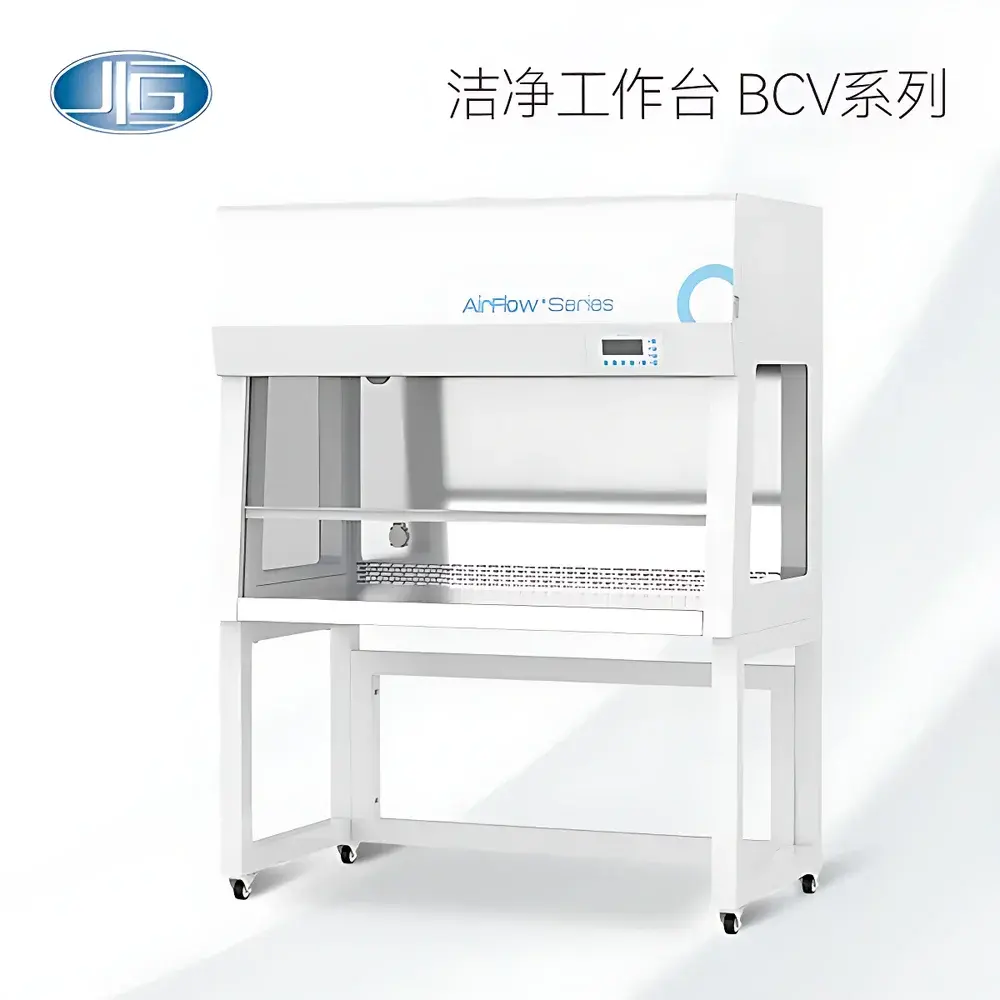
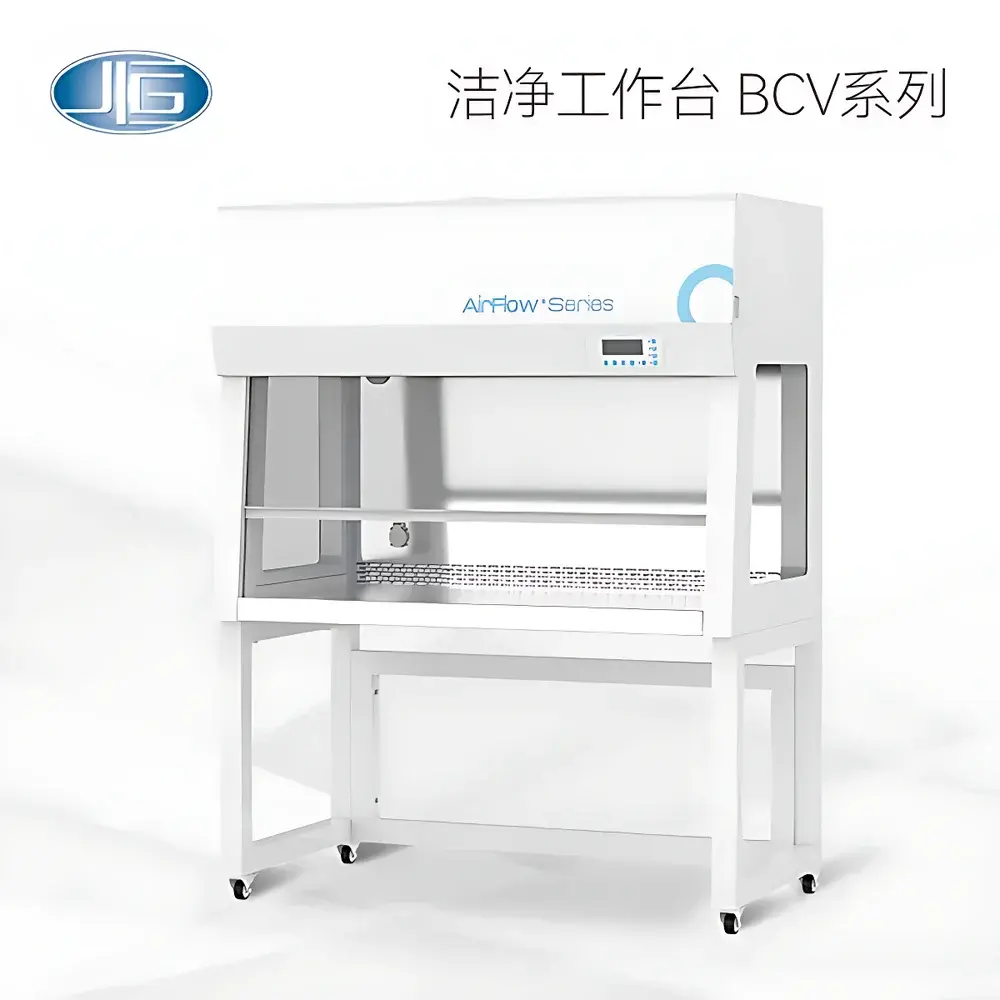
Yiheng BCV Series Vertical Laminar Flow Clean Bench
| Brand | Yiheng |
|---|---|
| Origin | Shanghai, China |
| Manufacturer Type | Direct Manufacturer |
| Product Category | Domestic |
| Models | BCV-3S1, BCV-4S1, BCV-5S1, BCV-6S1 |
| Price Range | USD 2,300 – 3,900 (FOB Shanghai) |
| Instrument Type | Vertical Laminar Flow Clean Bench |
| Cleanliness Class | ISO 5 (Class 100) |
| Noise Level | ≤62 dB(A) |
| User Capacity | Single-user single-face, Dual-user single-face, Triple-user single-face |
| Airflow Pattern | Vertical downward laminar flow |
| HEPA Filter Efficiency | ≥99.99% @ 0.3 µm |
| Adjustable Air Velocity Range | 0.30–0.50 m/s (0.01 m/s resolution) |
| Pre-filter Included | Yes |
| UV Lamp Timer Function | Yes |
| Illumination | Backlit LED lighting |
| Work Surface | Stainless steel, splash-resistant |
| Front Window | Counterbalanced tempered glass, infinitely positionable |
| Control Interface | LCD display showing real-time airflow velocity, clock, and filter status |
| Filter Runtime Monitoring | Cumulative operational hour counter |
| Safety Interlocks | UV–lighting interlock, filter failure/pre-failure alarm (audible & visual), password-protected settings |
| Power Outlet | 1 × 1000 W grounded socket |
Overview
The Yiheng BCV Series Vertical Laminar Flow Clean Bench is an ISO 5 (Class 100) certified laboratory containment system engineered for personnel protection and sample integrity in non-hazardous microbiological, pharmaceutical, and cell culture applications. Unlike biosafety cabinets, the BCV series operates as a unidirectional vertical laminar flow workstation—drawing ambient air through a pre-filter and high-efficiency particulate air (HEPA) filter, then delivering particle-free airflow vertically downward across the work surface at precisely controlled velocities. This airflow architecture minimizes turbulence and cross-contamination, ensuring consistent particle removal and maintaining a sterile microenvironment compliant with ISO 14644-1 and EU GMP Annex 1 requirements for Grade A environments. Designed for routine aseptic procedures—including media preparation, plate pouring, reagent handling, and sterile packaging—the BCV bench does not recirculate air to the operator; all exhaust is safely discharged into the laboratory environment.
Key Features
- Ergonomic 5° forward tilt of the work surface reduces operator fatigue during extended procedures.
- Backlit LED illumination provides uniform, glare-free lighting across the entire work area—reducing visual strain without generating thermal load.
- Tempered glass side panels maximize natural light penetration while maintaining structural integrity and optical clarity.
- Counterbalanced vertical sliding front sash enables smooth, tool-free positioning at any height—ensuring optimal ergonomics and consistent airflow dynamics.
- Electropolished stainless steel work surface resists corrosion, facilitates rapid decontamination, and withstands repeated exposure to alcohols, hydrogen peroxide, and other common disinfectants.
- Microprocessor-controlled variable-speed fan delivers stable laminar flow between 0.30 and 0.50 m/s, adjustable in 0.01 m/s increments—enabling precise adaptation to procedural requirements or environmental conditions.
- LCD interface displays real-time airflow velocity, system clock, HEPA filter status, and cumulative filter runtime—supporting preventive maintenance planning per ISO 14644-3 and manufacturer-recommended service intervals.
- Dual-stage filtration: washable aluminum pre-filter extends HEPA service life; certified HEPA filter (EN 1822-1 H14) achieves ≥99.99% retention efficiency for 0.3 µm particles.
- Integrated safety interlocks include UV–lighting mutual exclusion (UV lamp deactivates automatically when sash is raised) and password-protected parameter modification to prevent unauthorized configuration changes.
Sample Compatibility & Compliance
The BCV Series accommodates standard Petri dishes, test tubes, flasks, pipette racks, and modular incubation accessories without airflow disruption. Its vertical laminar design ensures compatibility with open-vessel operations where aerosol generation is minimal and biological hazard level is low (BSL-1 or BSL-2 agents handled under non-aerosolizing conditions). The unit complies with ISO 14644-1:2015 (Cleanrooms and associated controlled environments), IEST-RP-CC002.3 (HEPA/ULPA Filter Testing), and EN 12464-1:2021 (Lighting of indoor work places). While not certified for chemical or toxic aerosol containment, it meets GLP documentation standards for equipment qualification (IQ/OQ/PQ) and supports audit-ready records via its built-in runtime logging and alarm history.
Software & Data Management
The BCV Series features embedded firmware—not PC-dependent software—with local data retention for critical operational parameters. Filter runtime is logged continuously and displayed on the LCD panel; alarm events (e.g., filter degradation, sash mispositioning, UV timer expiration) are timestamped and retained in non-volatile memory for up to 1,000 entries. No external connectivity (USB/Ethernet/Wi-Fi) is provided, aligning with secure lab infrastructure policies. All configuration changes require administrator-level password entry—a design aligned with FDA 21 CFR Part 11 principles for access control and accountability in regulated environments.
Applications
- Aseptic transfer of microbial cultures and mammalian cells in academic and industrial research labs.
- Preparation and dispensing of sterile culture media, buffers, and reagents in QC/QA laboratories.
- Assembly of diagnostic kits, sterile packaging of medical devices, and fill-finish operations for non-sterile intermediates.
- Handling of sensitive electronic components requiring particulate-free assembly environments.
- Supporting ISO/IEC 17025-accredited testing workflows where environmental contamination control is documented and verified.
FAQ
What ISO class does the BCV Series achieve, and how is it verified?
The BCV Series is validated to ISO 5 (Class 100) under dynamic operating conditions per ISO 14644-3:2019, using discrete particle counters calibrated to NIST-traceable standards.
Can the BCV be used for handling hazardous biological agents?
No—it is not a biosafety cabinet and provides no personnel or environmental protection against aerosols or vapors. It is intended solely for non-hazardous, low-risk aseptic tasks.
How often should the HEPA filter be replaced?
Filter replacement interval depends on usage intensity and ambient air quality; typical service life ranges from 12 to 24 months, guided by real-time pressure differential monitoring and cumulative runtime data.
Is the UV lamp germicidal wavelength compliant with ISO 15714?
Yes—the integrated UV-C lamp emits at 253.7 nm with irradiance ≥100 µW/cm² at 15 cm distance, meeting ISO 15714:2019 requirements for surface decontamination efficacy validation.
Does the BCV Series support integration into a centralized lab monitoring system?
No native network interface is included; however, analog voltage outputs (0–10 V) for airflow velocity and digital relay contacts for alarm states can be configured for third-party building management systems (BMS) upon request.



