
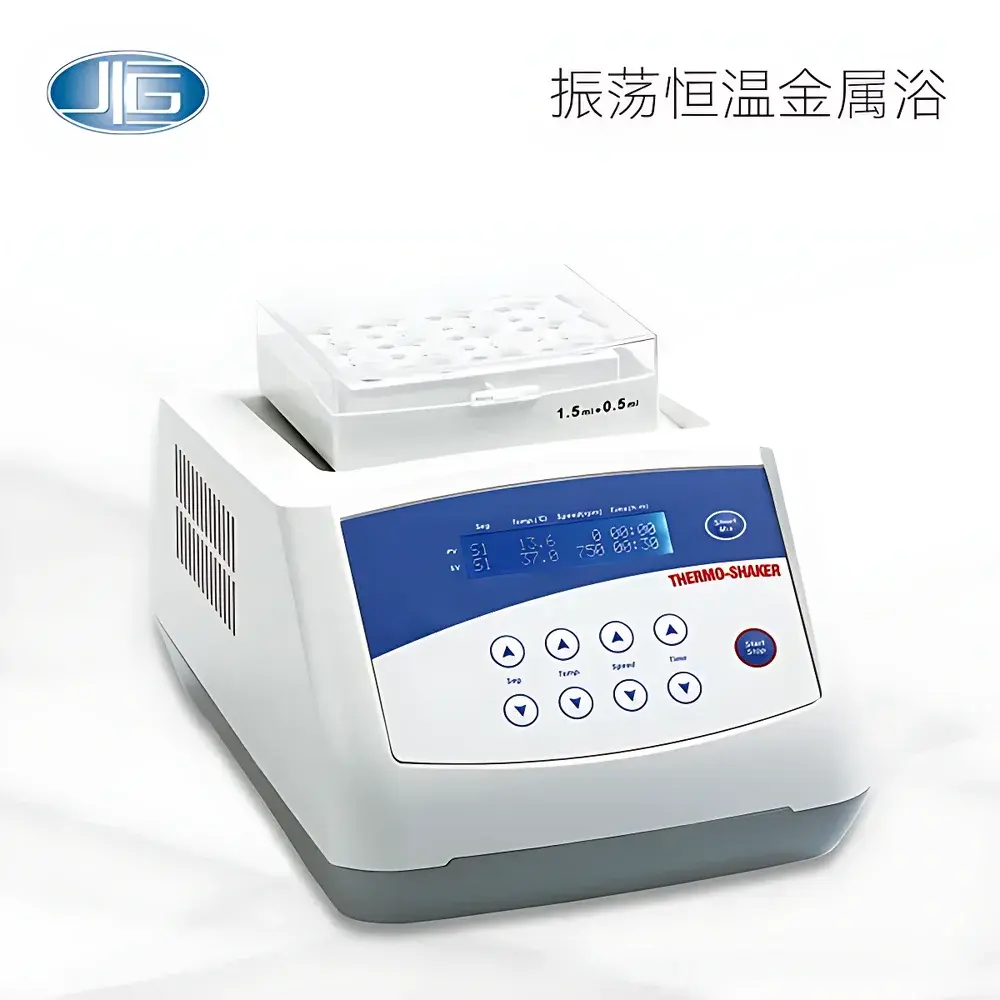
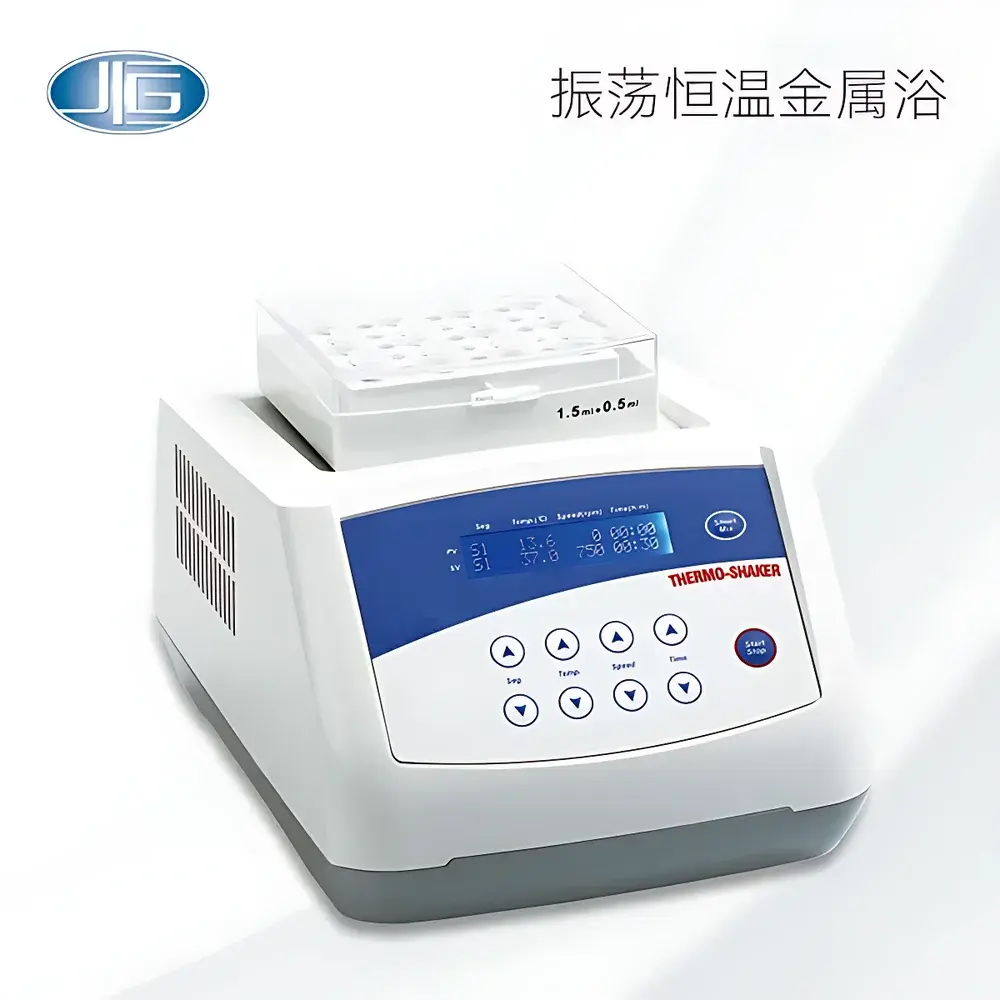
YIHENG TUS Series Oscillating Constant-Temperature Metal Bath
| Brand | YIHENG |
|---|---|
| Origin | Shanghai, China |
| Manufacturer Type | Direct Manufacturer |
| Country of Origin | China |
| Model | TUS Series |
| Price | USD 1,160 (approx.) |
| Temperature Range | RT + 5°C to 100°C |
| Temperature Accuracy | ±0.1°C |
| Heating Time | <20 min (20°C to 100°C) |
| Net Weight | 7 kg |
| Control Interface | LCD Menu-Driven Display |
| Oscillation Drive | Brushless DC Motor |
| Timer Range | 0–100 h with Audible End-of-Timer Alert |
| Power Recovery Function | Yes |
| Module Compatibility | Interchangeable Standard Sample Blocks (Custom Blocks Available) |
Overview
The YIHENG TUS Series Oscillating Constant-Temperature Metal Bath is an engineered thermal platform designed for precise, uniform heating and controlled orbital agitation of multiple sample vessels simultaneously. Unlike water baths, this metal-block-based system employs solid-state aluminum heating blocks with high thermal conductivity and low thermal inertia, enabling rapid temperature equilibration and exceptional spatial uniformity across the block surface. The device operates on Peltier-free resistive heating coupled with PID-controlled feedback loops—ensuring stable setpoint maintenance within ±0.1°C across the full operating range (RT + 5°C to 100°C). Its oscillation mechanism delivers consistent, low-shear orbital motion (typically 200–1,000 rpm, configurable per model variant), optimized for applications requiring both thermal activation and homogeneous mixing—such as enzyme reactions, DNA denaturation/annealing, cell lysis, and reagent incubation in molecular biology, clinical diagnostics, and pharmaceutical QC labs.
Key Features
- High-resolution LCD display with intuitive menu-driven interface—supports simultaneous visualization of set temperature, real-time temperature, timer status, and oscillation speed.
- Microprocessor-based dual-loop control architecture: independent regulation of thermal output and motor speed ensures minimal drift (<±0.1°C) and oscillation stability (±2 rpm).
- Auto-recovery function preserves user-defined protocols after power interruption; resumes operation at original setpoints without manual reconfiguration.
- Precision timer with 1-minute resolution, programmable from 1 minute to 100 hours; audible alarm triggers at endpoint with optional visual indicator.
- Modular block design accommodates standard configurations for 0.2 mL, 0.5 mL, 1.5 mL, and 2.0 mL tubes—including PCR strip compatibility—and supports OEM-specific block geometries upon request.
- Brushless DC motor drive eliminates carbon brush wear, ensuring >20,000 hours of continuous operational life with zero lubrication or scheduled maintenance.
- Short-pulse oscillation mode allows momentary agitation (e.g., “tap” or “shake” function) for quick resuspension without altering thermal or timing parameters.
Sample Compatibility & Compliance
The TUS series is compatible with a broad spectrum of laboratory consumables, including polypropylene, polyethylene, and glass vials/tubes up to 15 mL capacity, provided mechanical fitment is verified via selected block inserts. Block surfaces are anodized for corrosion resistance and ease of decontamination using 70% ethanol or 0.1% sodium hypochlorite solutions. While not certified for IEC 61000-4 electromagnetic immunity or UL/CSA safety listing, the unit conforms to general laboratory equipment safety expectations under GB 4793.1–2007 (Chinese equivalent of IEC 61010-1). It supports GLP-compliant workflows through deterministic protocol execution and reproducible thermal/agitation profiles—though it does not include electronic audit trail or 21 CFR Part 11–compliant data logging natively.
Software & Data Management
The TUS series operates as a standalone instrument with no embedded software stack or network connectivity. All configuration and monitoring occur locally via the front-panel interface. No proprietary drivers, firmware updates, or cloud synchronization are required or supported. For laboratories requiring traceable recordkeeping, external data capture can be achieved using third-party USB-connected thermocouple loggers or time-lapse imaging systems synchronized manually with timer endpoints. The absence of onboard memory or export functionality aligns with ISO/IEC 17025 Clause 7.7.1 requirements for equipment used in accredited testing where data integrity is maintained externally.
Applications
- Molecular biology: PCR pre-incubation, restriction digestion, ligase reactions, and plasmid miniprep elution steps.
- Clinical microbiology: Blood culture bottle warming prior to subculture, antigen extraction from whole blood or sputum samples.
- Pharmaceutical QA/QC: Dissolution media conditioning, stability study sample equilibration per USP <724>, and excipient solubility testing.
- Biochemistry: Enzyme kinetics assays requiring concurrent heating and gentle mixing to prevent sedimentation of particulate substrates.
- Environmental testing: Extraction of organic pollutants from soil/sediment matrices using solvent-assisted thermal agitation per EPA Method 3540C analogues.
FAQ
Does the TUS series support remote monitoring or computer control?
No—this is a stand-alone benchtop instrument with no RS-232, USB device, or Ethernet interface. All operation is local via the front panel.
Can the oscillation speed be calibrated or adjusted beyond factory settings?
Oscillation speed is fixed per module configuration and cannot be user-calibrated; however, multiple speed options (e.g., 300 rpm, 600 rpm) are available across TUS submodels—consult technical specifications for your specific variant.
Is the metal block interchangeable between different TUS models?
Blocks are mechanically and thermally matched to individual TUS chassis designs; cross-model interchangeability is not supported without validation by YIHENG engineering.
What is the maximum recommended load per block position?
Maximum safe loading is 15 g per well when operating above 80°C; lower mass limits apply for high-speed oscillation (>800 rpm) to minimize resonant vibration.
How often should the unit undergo preventive maintenance?
No scheduled maintenance is required. Wipe exterior and block surface regularly with lint-free cloth and isopropyl alcohol; inspect ventilation grilles quarterly for dust accumulation.



