
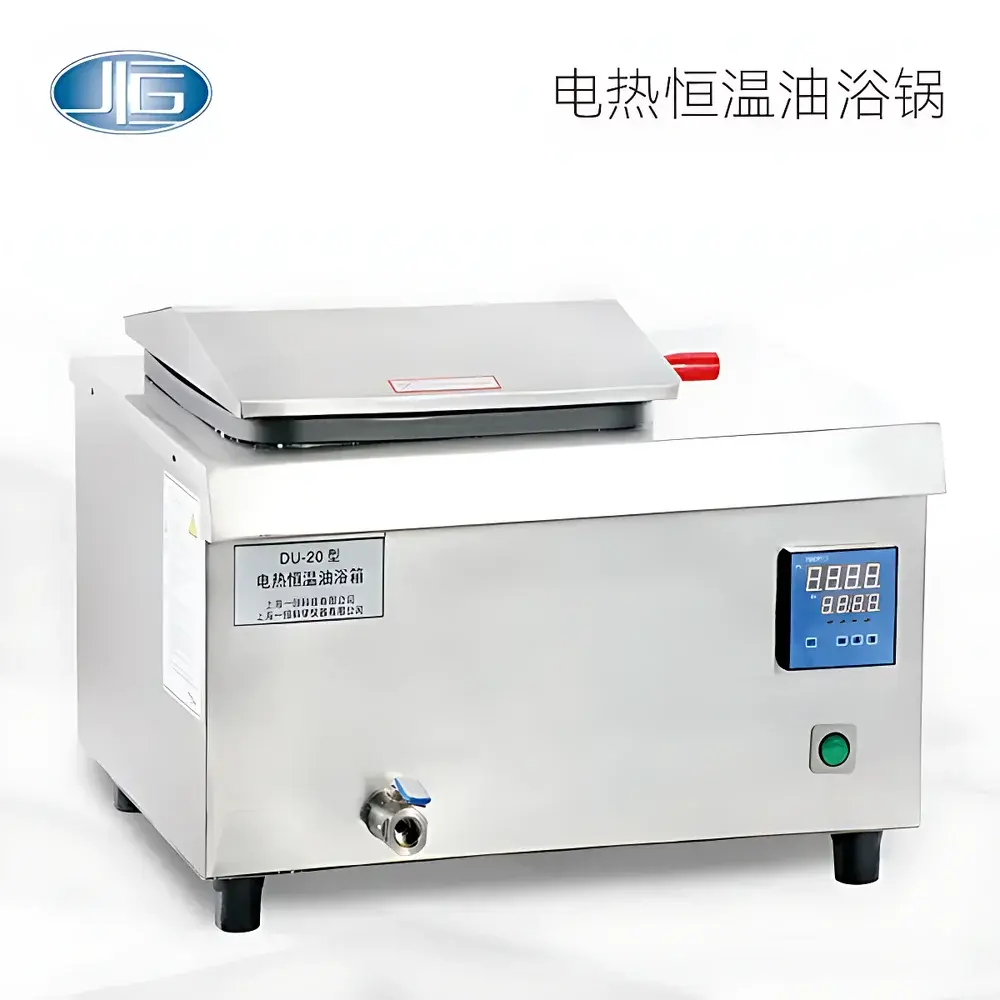
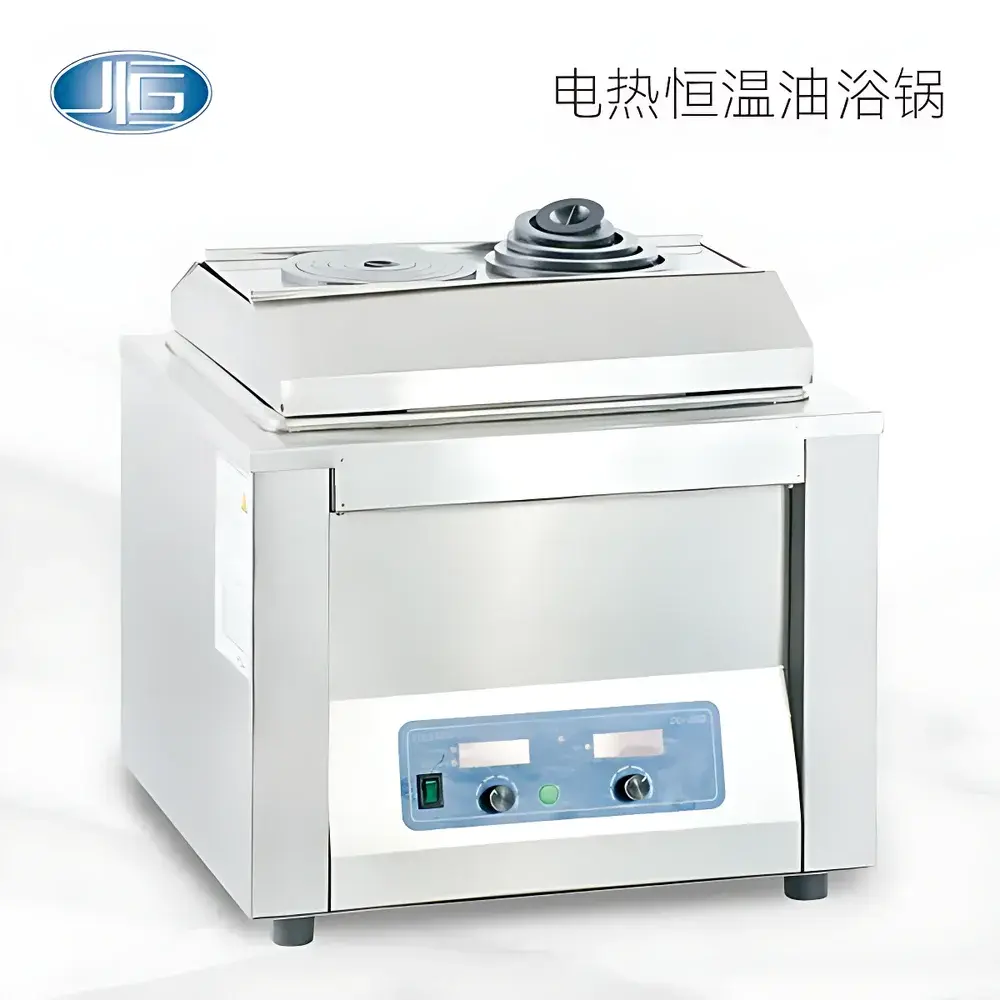
Yiheng DU-20 / DU-20G / DU-30 / DU-30G Electrically Heated Oil Bath Circulator
| Brand | Yiheng |
|---|---|
| Origin | Shanghai, China |
| Manufacturer Type | Direct Manufacturer |
| Product Category | Domestic |
| Models | DU-20, DU-20G, DU-30, DU-30G |
| Instrument Type | Water/Oil Bath Thermostatic Bath |
| Circulation Mode | Internal Recirculation |
| Temperature Control | Heating-Only |
| Bath Volume | 12–18 L |
| Temperature Range | RT+20°C to 200°C |
| Temperature Stability | ±0.5°C |
| Input Power | 1000 W / 1600 W |
| Voltage Supply | AC 220 V, 50 Hz |
| Construction | Stainless Steel Inner Chamber & Outer Casing |
| Controller | Microprocessor-Based PID with Timer |
| Safety | Over-Temperature Audio-Visual Alarm |
| Optional Feature | Integrated Magnetic Stirring (Models with “G” suffix) |
Overview
The Yiheng DU-series Electrically Heated Oil Bath Circulators are precision-engineered thermostatic baths designed for stable, uniform, and controllable heating of samples immersed in silicone oil, heat-transfer fluids, or high-boiling-point solvents. Operating on resistive heating principles with forced internal fluid recirculation, these units maintain consistent thermal environments across laboratory-scale reaction vessels, distillation setups, and calibration standards. Unlike water baths, the DU-series supports operation up to 200°C—enabling applications requiring elevated temperature stability without evaporation concerns. The bath’s stainless steel construction ensures chemical resistance against common organic solvents and thermal oils, while its sealed internal circulation path minimizes fluid loss and oxidation over extended duty cycles.
Key Features
- Microprocessor-based PID temperature controller with digital display, adjustable timer function, and real-time setpoint tracking for repeatable thermal protocols.
- Stainless steel inner tank and outer housing—electropolished for corrosion resistance, ease of cleaning, and long-term durability in demanding lab environments.
- Integrated over-temperature protection system with simultaneous audible alarm and visual indicator, automatically cutting power when deviation exceeds safety thresholds to safeguard samples and equipment.
- Optional magnetic stirring (standard on “G” models) with high-torque DC motor and speed feedback control—maintaining consistent rotational velocity regardless of viscosity changes during heating.
- Internal recirculation pump ensures homogeneous temperature distribution throughout the bath volume, minimizing axial and radial thermal gradients (<±0.3°C typical at 150°C).
- Modular well plate design allows flexible positioning and resizing of sample vessel openings to accommodate various flask geometries (e.g., round-bottom flasks, graduated cylinders, custom reactors).
Sample Compatibility & Compliance
The DU-series accommodates standard laboratory glassware including 50–1000 mL round-bottom flasks, jacketed reactors, and immersion probes. Its open-bath configuration supports direct insertion of thermocouples, reflux condensers, and inert gas inlets. Units comply with IEC 61010-1:2010 for electrical safety in laboratory equipment and meet GB/T 25915.1–2010 (Chinese national standard equivalent to ISO 14644-1 Class 8 for cleanroom-compatible auxiliary devices). While not certified for GMP or GLP environments out-of-the-box, the PID controller’s programmable ramp/soak profiles and event logging capability support traceability requirements under ISO/IEC 17025-accredited testing laboratories.
Software & Data Management
These analog-digital hybrid units do not feature USB or Ethernet connectivity; however, the PID controller provides RS-232 output (optional accessory) for integration with SCADA systems or data acquisition software such as LabVIEW or MATLAB via third-party interface modules. All models record operational events—including start/stop timestamps, temperature deviations >±1.0°C, and alarm triggers—in non-volatile memory for post-run audit. The timer function supports unattended operation up to 99 hours 59 minutes, with automatic shutdown upon completion—a critical feature for overnight synthesis or thermal aging studies.
Applications
- Controlled-temperature reactions: Grignard preparations, esterifications, and metal-catalyzed couplings requiring sustained 120–180°C environments.
- Calibration of temperature-sensitive instrumentation, including RTDs, thermistors, and infrared sensors against NIST-traceable references.
- Viscosity measurement pre-conditioning per ASTM D445 and ISO 3104, where sample equilibration at precise shear-invariant temperatures is mandatory.
- Distillation and reflux setups using high-boiling solvents (e.g., diphenyl ether, Dowtherm A) where water baths are unsuitable.
- Accelerated stability testing of pharmaceutical intermediates per ICH Q1A(R2), maintaining thermal stress conditions within ±0.5°C for defined durations.
FAQ
What is the maximum recommended operating temperature for silicone oil in the DU-30G bath?
Silicone oil (e.g., Dow Corning 200 Fluid, 50 cSt) may be used up to 200°C; however, continuous operation above 180°C requires periodic oil replacement every 3–6 months depending on usage frequency and ambient humidity.
Can the bath be used with flammable heat-transfer fluids like terpenes or limonene?
No—only non-flammable, thermally stable heat-transfer media compliant with UL 94 HB or better shall be used. Flammable fluids pose unacceptable fire risk due to the absence of explosion-proof enclosure certification.
Is external temperature probe input supported for cascade control?
Not natively—the PID controller accepts only internal Pt100 sensor feedback. External probe integration requires a separate process controller with analog output relay (e.g., Watlow F4T) configured in master-slave mode.
How often should the stainless steel tank be passivated to maintain corrosion resistance?
Passivation per ASTM A967 is recommended annually or after exposure to halogenated solvents, strong acids, or salt solutions—even with routine wiping using ethanol or isopropanol.
Does the “G” suffix indicate compliance with FDA 21 CFR Part 11?
No—these units lack electronic signature capability, audit trail generation, or user access controls required for Part 11 compliance. They are intended for R&D and QC screening—not regulated production environments.



