
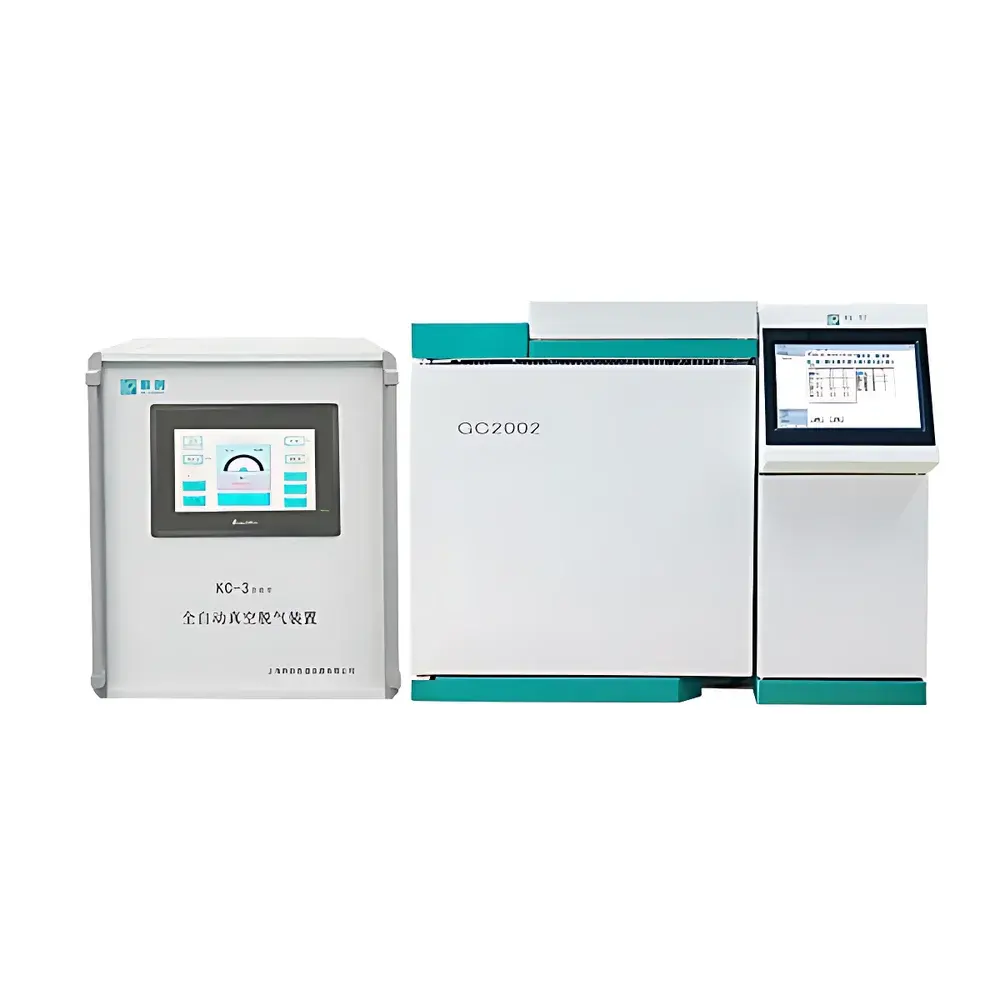
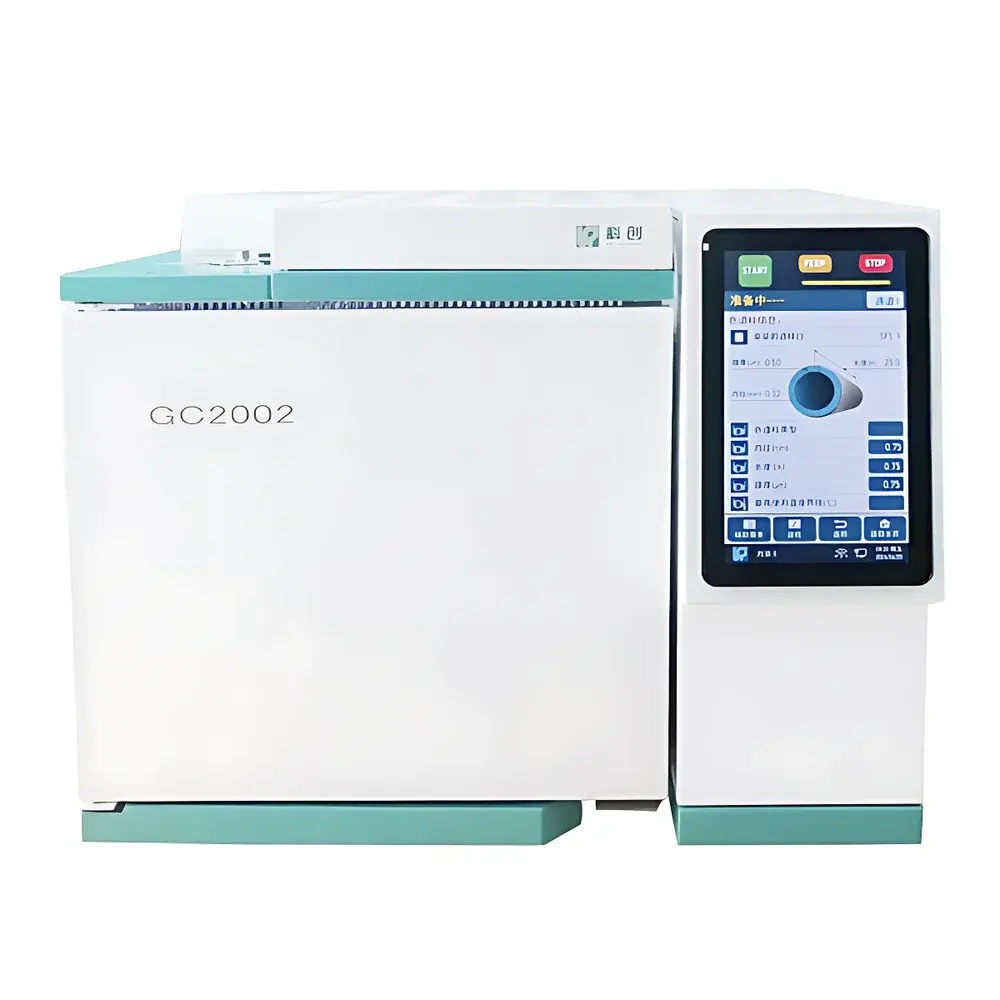
Kechuang GC2002 Power Transformer Oil Dissolved Gas Analysis (DGA) Gas Chromatograph
| Brand | Kechuang |
|---|---|
| Origin | Shanghai, China |
| Manufacturer Type | Direct Manufacturer |
| Instrument Type | Laboratory Gas Chromatograph |
| Application Field | High-Purity Gas Analysis & Transformer Oil DGA |
| Oven Temperature Range | 8 °C above ambient to 400 °C |
| Temperature Stability | ≤ ±0.1 °C (programmed ramping) |
| Max Ramp Rate | 400 °C to 50 °C in 4 min |
| Cooling Rate | Ambient to 40 °C (forced air) |
| Carrier Gas Flow Range | 0–100 mL/min (digital mass flow control) |
| Carrier Gas Pressure Range | 0–250 kPa (electronic pressure control) |
| Injector Max Temp | 300 °C |
| Injector Pressure Setpoint Range | 0–250 kPa |
| Total Injector Flow Range | 0–1200 mL/min |
| Detection Limits | H₂ ≤ 2 µL/L, CO/CO₂ ≤ 3 µL/L, C₂H₂ ≤ 0.1 µL/L |
| TCD Baseline Noise | ≤ 0.01 mV |
| Drift | ≤ 0.06 mV/30 min |
| FID Baseline Noise | ≤ 1×10⁻¹³ A |
| Drift | ≤ 6×10⁻¹³ A/30 min |
| Retention Time RSD (n=6) | ≤ 2% |
| Peak Area RSD (n=6) | ≤ 3% |
Overview
The Kechuang GC2002 is a dedicated laboratory gas chromatograph engineered for dissolved gas analysis (DGA) of mineral insulating oils used in power transformers, instrument transformers, circuit breakers, and other high-voltage substation equipment. It implements a robust dual-detection configuration—featuring a high-sensitivity TC-1H thermal conductivity detector (TCD) and two flame ionization detectors (FIDs)—to quantify nine key fault gases: H₂, O₂, N₂, CO, CO₂, CH₄, C₂H₄, C₂H₆, and C₂H₂. The system operates on standardized ASTM D3612 and IEC 60567 methodologies, enabling early detection of incipient faults—including partial discharge, thermal degradation (>300 °C), and arcing—by correlating gas ratios and concentrations with recognized Duval triangle and Rogers ratio interpretations. Its column oven supports both packed and capillary columns, with microprocessor-controlled temperature programming, automatic back-flush, and forced-air cooling to ensure reproducible retention times and minimal carryover between analyses.
Key Features
- Dual-FID + high-stability TCD architecture optimized for simultaneous detection of hydrogen (low-concentration, high-diffusivity) and hydrocarbons (ppb-level acetylene sensitivity)
- Full microprocessor-based control via tactile keypad interface—no external PC required for basic operation
- Electronic pressure control (EPC) and digital mass flow meters for carrier, make-up, and fuel gases—ensuring ±0.5% flow accuracy and long-term retention time stability
- Intelligent self-diagnostic system: real-time monitoring of Pt100 sensor integrity, overtemperature cutoff, and automatic parameter backup during power interruption
- Programmable timed startup/shutdown and detector activation—enabling unattended overnight operation under GLP-compliant conditions
- Column oven with large-volume chamber, automatic rear door opening, and precision PID heating—achieving ±0.1 °C isothermal stability and linear ramp control from 8 °C above ambient to 400 °C
- Modular gas routing: configurable for single-injection full-profile analysis, dual-column parallel separation, or sequential two-injection workflows per IEC 60567 Annex B
Sample Compatibility & Compliance
The GC2002 accepts headspace vials (10–20 mL) prepared via vacuum degassing or mechanical agitation per ASTM D3612 Method A/B. It accommodates standard 1/8″ stainless steel packed columns (e.g., Porapak Q + Molecular Sieve 13X) or fused-silica capillaries (e.g., Al₂O₃/KCl PLOT) for optimal resolution of permanent gases and C₁–C₂ hydrocarbons. All hardware components comply with CE electromagnetic compatibility (EMC) Directive 2014/30/EU and Low Voltage Directive 2014/35/EU. Software-generated reports meet audit trail requirements for ISO/IEC 17025-accredited laboratories and support 21 CFR Part 11–compliant electronic signatures when paired with HL-3000 DGA workstation (optional).
Software & Data Management
The optional HL-3000 Insulating Oil DGA Workstation provides automated peak integration, retention time alignment, gas concentration calculation using response factor calibration curves, and generation of standardized IEC 60567–compliant reports—including Duval pentagon plots, Rogers ratios, and fault classification summaries. Raw data files (.cdf) are stored with full metadata (operator ID, sample ID, injection time, method version, detector voltages, flow parameters). Audit logs record all user actions, method modifications, and calibration events—supporting traceability in GxP environments. Data export is available in CSV, PDF, and XML formats for integration into enterprise LIMS platforms.
Applications
- Preventive maintenance of oil-immersed power transformers (≥110 kV) in utility transmission networks
- Condition assessment of generator step-up (GSU) transformers in thermal and hydroelectric plants
- Commissioning verification of new transformer installations per IEEE C57.104
- Root cause analysis following abnormal relay operations or Buchholz alarm events
- Research-grade studies on oil aging kinetics, oxidation byproducts, and inhibitor depletion profiles
- Third-party testing services accredited to ISO/IEC 17025 for DGA certification
FAQ
What standards does the GC2002 comply with for transformer oil DGA?
It adheres to ASTM D3612 (Type A and B), IEC 60567 (Edition 3.0), and IEEE C57.104–2019 for sampling, analysis, and interpretation protocols.
Can the instrument analyze both permanent gases and hydrocarbons in a single run?
Yes—using the optional dual-column, dual-FID configuration with backflush capability, it resolves H₂, O₂, N₂, CO, CO₂, CH₄, C₂H₂, C₂H₄, and C₂H₆ in one 25-minute chromatogram.
Is method validation support available?
Kechuang provides IQ/OQ documentation templates, system suitability test procedures, and certified reference gas mixtures traceable to NIST SRM 1650b for method transfer and regulatory audits.
What maintenance intervals are recommended for routine operation?
Detector cleaning every 6 months, column trimming every 12 months, and annual calibration verification using certified gas standards—consistent with ISO/IEC 17025 Clause 6.4.
Does the GC2002 support remote monitoring or networked data transfer?
When equipped with the HL-3000 workstation and optional Ethernet module, it enables secure FTP upload of results to centralized SCADA or asset health management systems.




