
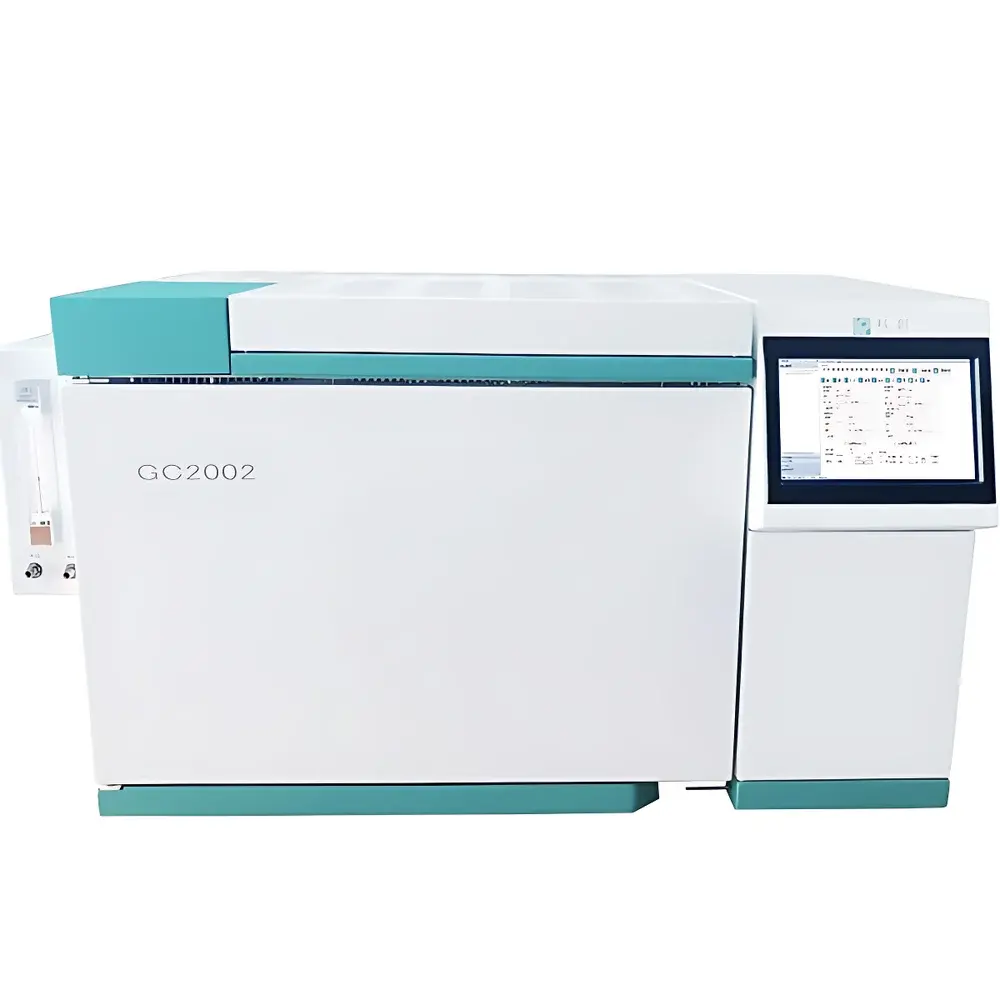
Kechuang GC2002 High-Purity and Ultra-High-Purity Gas Analysis Dedicated Gas Chromatograph
| Brand | Kechuang |
|---|---|
| Origin | Shanghai, China |
| Manufacturer Type | Original Equipment Manufacturer (OEM) |
| Instrument Type | Laboratory Gas Chromatograph |
| Model | GC2002 |
| Price Range | USD 21,000 – 42,000 (FOB Shanghai) |
| Detection Principle | Pulsed Discharge Helium Ionization Detection (PDHID) |
Overview
The Kechuang GC2002 is a purpose-built gas chromatograph engineered for trace impurity analysis in high-purity (HP) and ultra-high-purity (UHP) industrial gases—including hydrogen, nitrogen, argon, helium, oxygen, neon, krypton, xenon, and specialty process gases. It operates on the principle of capillary gas chromatography coupled with pulsed discharge helium ionization detection (PDHID), a non-destructive, universal detection method offering exceptional sensitivity for permanent gases and light hydrocarbons without requiring radioactive sources. The system employs a multi-valve, multi-column configuration with carrier gas purging protection—ensuring minimal dead volume, thermal stability, and robust baseline integrity during extended unattended operation. Designed to meet the stringent analytical demands of semiconductor fabrication, photovoltaic manufacturing, fiber optic preform production, and advanced materials R&D, the GC2002 delivers reproducible quantification of impurities at sub-ppb (parts-per-quadrillion equivalent) levels across critical matrices.
Key Features
- Original VICI PDHID detector with helium-based ionization—optimized for ppb-level detection of H2, O2, N2, CO, CH4, CO2, Ne, Ar, Kr, Xe, and H2O
- Integrated helium purifier and protective gas valve assembly—maintains detector stability and extends service life under continuous UHP gas analysis conditions
- Dedicated large-bore fused-silica capillary columns—selected for optimal separation efficiency and peak symmetry of light gas species
- Multi-position, pneumatically actuated valving system with carrier-gas purge protection—enabling automated front-cut, heart-cut, and back-flush functions for complex matrix isolation
- Temperature-controlled oven with ±0.01 °C stability and ramp rates up to 40 °C/min—supporting rapid method development and high-throughput screening
- Modular hardware architecture—facilitates field-upgradable components including detectors, valves, and column modules per evolving ISO 8573-9 or SEMI F57 compliance requirements
Sample Compatibility & Compliance
The GC2002 is validated for direct injection of HP/UHP gases meeting ISO 8573-1 Class 1–2 purity specifications and SEMI C10/C11 standards for electronic-grade gases. It supports quantitative analysis of 10+ impurity species simultaneously—including water vapor (measured via cryo-trap or molecular sieve column), reactive species (O2, CO), and noble gas contaminants (Kr, Xe in Ar; Ne in He). System validation protocols align with ASTM D7607 (trace hydrocarbon analysis in hydrogen), ISO 14687-2 (hydrogen fuel quality), and USP for residual solvent testing where applicable. Full audit trail, electronic signatures, and 21 CFR Part 11–compliant data handling are supported via optional software licensing.
Software & Data Management
Controlled by Kechuang’s GC-Studio v3.x platform—a Windows-based application supporting method development, sequence scheduling, real-time chromatogram visualization, and integrated calibration curve generation. Raw data files comply with AIA/ANDI format for cross-platform compatibility with third-party chemometric tools (e.g., OpenLab CDS, Chromeleon). All acquisition parameters, integration events, and user actions are timestamped and logged with immutable audit trails. Optional GMP/GLP mode enables role-based access control, electronic signature workflows, and automated report generation compliant with laboratory quality management systems (QMS).
Applications
- Residual impurity profiling in electronic-grade Ar, N2, H2, and He for semiconductor etching and CVD chamber qualification
- Monitoring Kr/Xe breakthrough in cryogenic air separation units and rare gas purification trains
- Verification of hydrogen fuel purity per ISO 14687-2 Annex B for PEM fuel cell applications
- Trace moisture and hydrocarbon verification in optical fiber preform synthesis environments
- Batch release testing of medical oxygen (USP ) and anesthetic gas mixtures (ISO 8573-9)
FAQ
What detection limit can be achieved for H2O in ultra-high-purity argon?
Typical method-dependent MDL is ≤10 ppb (v/v) using a dedicated moisture trap column and optimized PDHID pulse parameters.
Is the system compatible with ASTM D7607 for hydrogen purity testing?
Yes—the GC2002 meets all instrumental requirements specified in ASTM D7607, including column selection, detector linearity range (0.1–100 ppm), and repeatability criteria (RSD ≤5% at 1 ppm level).
Can the multi-valve system be reconfigured for different gas matrices?
Absolutely—the pneumatic valve timing and column switching logic are fully programmable via GC-Studio; method templates for H2, Ar, N2, and He are included out-of-the-box.
Does the instrument support 21 CFR Part 11 compliance?
When deployed with GC-Studio GMP Edition and networked authentication, the system provides full electronic record and signature functionality—including audit trail review, user permission tiers, and data encryption.
What maintenance intervals are recommended for the PDHID detector?
Under continuous UHP gas operation, helium purifier cartridges require replacement every 6–12 months; detector electrode cleaning is advised annually or after 5,000 injections, per VICI technical bulletin TB-2021-04.





