
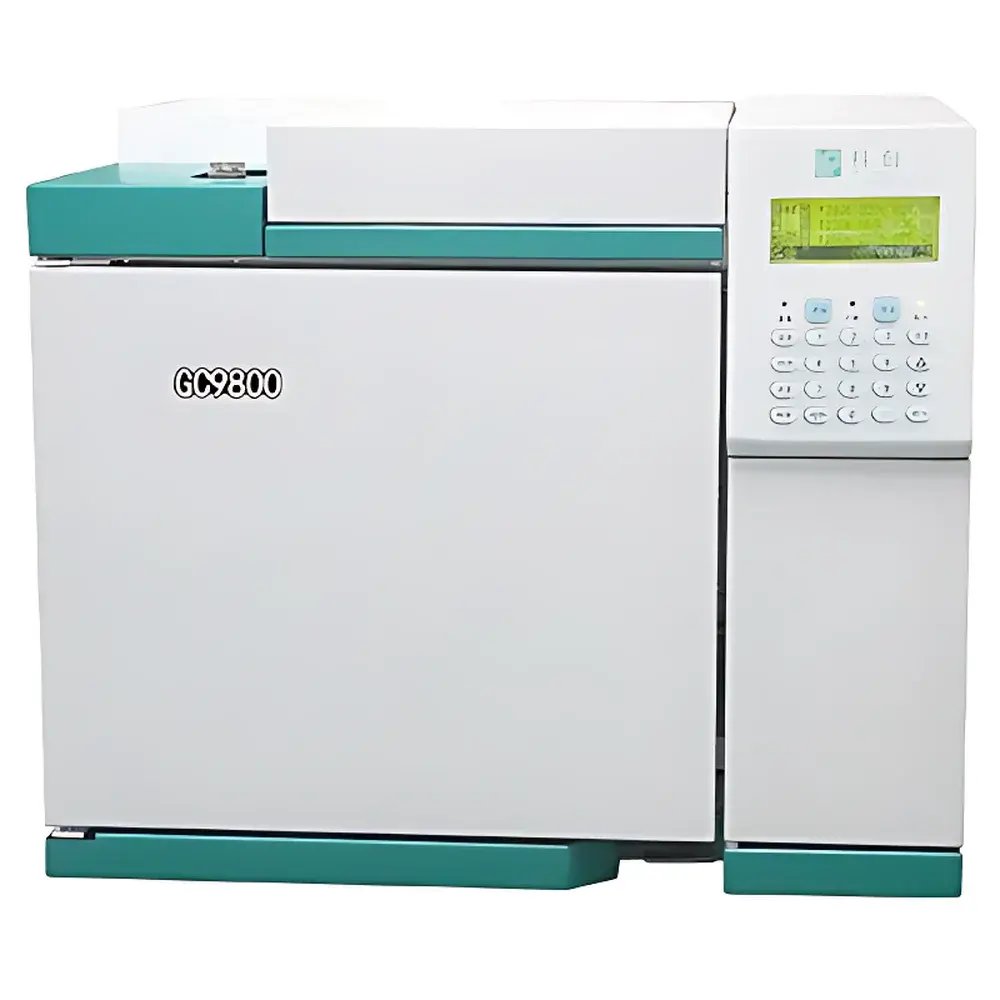
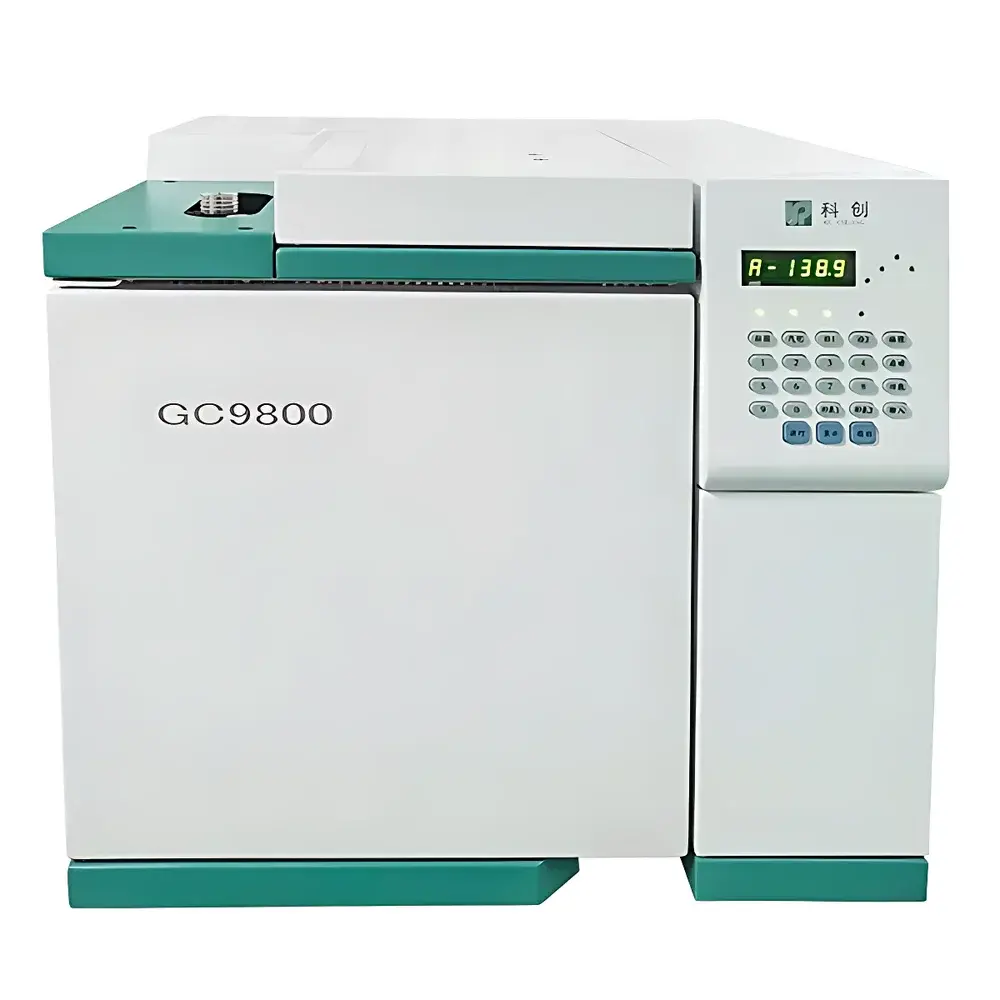
English Product Name
| Brand | Kechuang |
|---|---|
| Origin | Shanghai, China |
| Manufacturer Type | Direct Manufacturer |
| Instrument Type | Laboratory Gas Chromatograph |
| Application Field | Petroleum & Petrochemical Industry |
| Oven Temperature Range | 8 °C to 400 °C (above ambient) |
| Oven Ramp Rate | 0.1–40 °C/min |
| Oven Cooling Time | ≤4 min (from 400 °C to 50 °C) |
| Carrier Gas Flow Range | 0–100 mL/min |
| Carrier Gas Pressure Range | 0–250 kPa |
| Injector Max Temp | 300 °C |
| Injector Pressure Setpoint Range | 0–250 kPa |
| Injector Total Flow Setpoint Range | 0–1200 mL/min |
| FID Detection Limit | ≤5×10⁻¹² g/s (n-C₁₆ in iso-octane) |
| FID Baseline Noise (packed column) | <10×10⁻¹⁴ A |
| FID Baseline Drift (packed column, 30 min) | <6×10⁻¹³ A |
| Column Oven Stability at 70 °C | <0.5% RSD |
| Temperature Display Resolution | 0.1 °C |
| Programmable Temperature Ramping | 8-step, min increment 0.1 °C/min |
| Repeatability (50–250 °C at 10 °C/min) | ≤1% RSD |
Overview
The Kechuang GC-9800 Dedicated Gas Chromatograph is a purpose-built analytical system engineered for precise, reproducible light hydrocarbon (C₁–C₉) profiling in petroleum geological samples—including crude oils, formation fluids, mud gas logs, and core headspace gases. It operates on the fundamental principle of gas-phase separation via differential partitioning between a mobile carrier gas phase and a stationary phase coated inside fused-silica capillary or stainless-steel packed columns. Retention time, peak area, and elution order are quantitatively correlated with compound identity and concentration using calibrated response factors traceable to NIST-traceable hydrocarbon standards. Designed specifically for field laboratories and upstream geochemical service units, the GC-9800 integrates robust thermal management, high-stability flame ionization detection (FID), and application-optimized hardware configurations to meet ASTM D1319 (hydrocarbon type analysis), ISO 6974 (natural gas composition), and internal API RP 44 protocols for reservoir fluid characterization.
Key Features
- Thermally isolated oven with precision Peltier-assisted cooling and dual-zone heating—enabling rapid, repeatable temperature transitions from 8 °C to 400 °C with ≤4-minute cooldown (400 °C → 50 °C) under controlled ambient conditions (<27 °C).
- Eight-stage programmable temperature ramping with 0.1 °C/min resolution, supporting complex multi-step methods required for co-elution resolution of isomeric light hydrocarbons (e.g., isobutane/n-butane, isopentane/n-pentane).
- Dual independent inlet systems: split/splitless injector with pressure-programmable control (0–250 kPa) and total flow regulation (0–1200 mL/min), compatible with both packed and capillary columns.
- High-sensitivity FID with low-noise electrometer (10¹⁰ Ω feedback resistor), achieving ≤5×10⁻¹² g/s detection limit for n-hexadecane—validated per IUPAC-recommended calibration procedures using certified 144.4 ng/µL n-C₁₆ standard solutions.
- Real-time thermal stability monitoring: column oven drift <0.5% RSD at 70 °C; FID baseline noise <50 µV (capillary mode, 35–105 °C ramp); baseline drift <1000 µV/30 min under dynamic conditions.
- Integrated electronic pressure control (EPC) for carrier gas, make-up gas, and hydrogen/air flows—ensuring method transferability across instruments and compliance with GLP audit requirements.
Sample Compatibility & Compliance
The GC-9800 accepts liquid injections (via syringe or autosampler), gas-phase samples (via loop injection or direct connection to gas extraction manifolds), and headspace vials. It supports standard ¼″ packed columns (e.g., Porapak Q, Al₂O₃/KCl) and 0.25–0.53 mm ID fused-silica capillaries (e.g., DB-PONA, HP-PLOT Al₂O₃). All thermal zones—oven, injector, detector, and valve box—are independently configurable to match ASTM D2425 (light ends in distillates), ASTM D5186 (aromatics in reformulated gasoline), and CNPC SY/T 5777–2017 (light hydrocarbon geochemical logging). The instrument architecture conforms to IEC 61000-4 electromagnetic compatibility standards and includes hardware-level safeguards for overpressure, overtemperature, and flame-out detection—critical for unattended operation in remote field labs.
Software & Data Management
Controlled via Kechuang ChromaSoft™ v3.2 (Windows-based), the system supports full method development, sequence scheduling, real-time chromatogram overlay, and automated peak integration with retention time locking (RTL). Data files comply with ASTM E1947-compliant .CDF format and are exportable to LIMS-compatible CSV, XML, or PDF reports. Audit trail functionality records all parameter changes, user logins, calibration events, and run history—meeting FDA 21 CFR Part 11 requirements when deployed with Windows domain authentication and digital signature modules. Raw data integrity is preserved through write-once storage options and optional encrypted database backup.
Applications
- Quantitative C₁–C₉ light hydrocarbon fingerprinting for source rock maturity assessment (e.g., pristane/phytane ratios, n-alkane distribution indices).
- Mud logging gas analysis: real-time discrimination of drilling fluid contaminants vs. formation-derived hydrocarbons using carbon number distribution trends.
- Reservoir compartmentalization studies via compositional gradients (e.g., iC₄/nC₄, iC₅/nC₅) across wellbores.
- Crude oil assay pre-screening for refinery feedstock classification and blending optimization.
- Geochemical quality control in core gas desorption experiments and canister sampling programs.
FAQ
What sample introduction methods are supported?
Liquid micro-syringe injection (1–10 µL), gas loop injection (0.25–2 mL), and static headspace analysis using 10–20 mL vials.
Is the system compatible with third-party autosamplers?
Yes—RS-232 and USB interfaces support integration with CTC Analytics PAL, Gerstel MPS, or Thermo AS-3000 systems via standardized command protocols.
Does the GC-9800 meet regulatory requirements for reporting to national oil agencies?
It complies with technical specifications referenced in China’s SY/T 5777–2017 and aligns with data validation workflows accepted by CNPC, Sinopec, and CNOOC internal QA/QC manuals.
Can the instrument operate continuously for 72-hour unattended runs?
Yes—when equipped with optional uninterruptible power supply (UPS), remote diagnostics module, and validated maintenance intervals (e.g., FID jet cleaning every 200 injections).
What column types are recommended for C₁–C₅ analysis?
Al₂O₃/KCl PLOT columns (30 m × 0.53 mm) for maximum resolution of ethane/propane/isobutane/n-butane; or DB-PONA (50 m × 0.25 mm) for extended C₁–C₉ profiling with internal standard quantification.



