
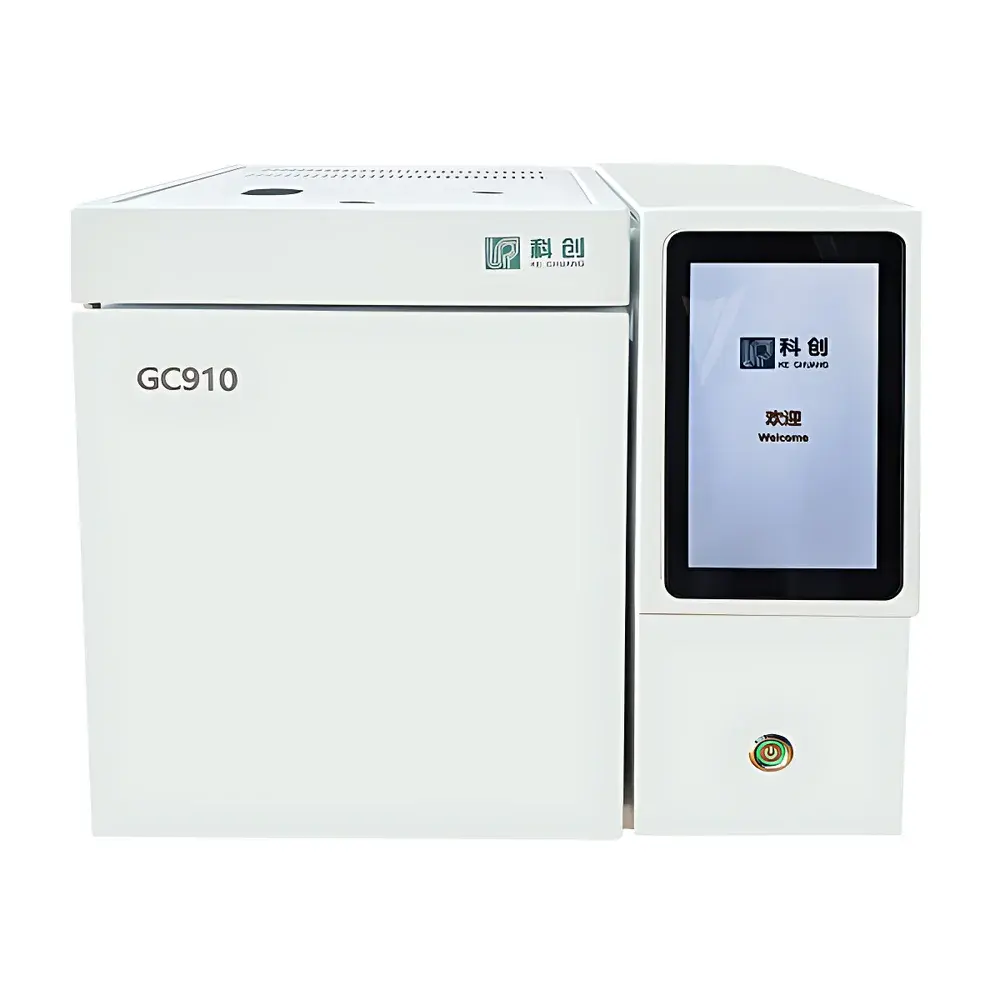
English Product Name
| Brand | Kechuang |
|---|---|
| Origin | Shanghai, China |
| Manufacturer Type | OEM Manufacturer |
| Country of Origin | China |
| Model | GC910 |
| Price | USD 2,800 (FOB Shanghai) |
Overview
The Kechuang GC910 is a compact, single-detector portable gas chromatograph engineered for field-deployable and benchtop analytical applications where space, power efficiency, and operational autonomy are critical. Built on a modular micro-processor-controlled architecture, the GC910 employs capillary or packed column separation coupled with temperature-programmed elution and precision electronic pressure/flow control (EPC/EFC) to deliver high-resolution volatile and semi-volatile organic compound analysis. Its design targets routine quality control, environmental screening (e.g., VOCs in air/water), petrochemical field testing, and educational laboratory use—where robustness, rapid thermal equilibration, and deterministic signal acquisition outweigh ultra-high-end detection sensitivity. The instrument operates on standard 220 V AC power and complies with IEC 61010-1 safety requirements for laboratory electrical equipment.
Key Features
- 10-channel independent temperature control system, including dual independently programmable column ovens—each supporting up to 16 heating ramps (expandable to unlimited steps via firmware update); temperature stability ±0.1% with 0.01 °C display resolution.
- Integrated RJ45 Ethernet interface enabling digital signal transmission; supports TCP/IP-based remote operation and data streaming to centralized workstations—up to 253 units controllable from a single PC under networked lab management protocols.
- Standard EPC/EFC module with pressure control accuracy of ±0.001 psi and flow control accuracy of ±0.001 mL/min; configurable in constant-pressure, constant-flow, or multi-step programmed-pressure modes (up to 8 steps).
- 7-inch resistive touch panel with real-time baseline monitoring, chromatogram visualization, and full instrument reverse control—no external software required for basic acquisition and method execution.
- Front-panel mass spectrometer coupling port (standard) for future GC-MS integration; column oven cooling time ≤3.5 min (350 °C → 50 °C) via motorized auto-backdoor mechanism.
- Onboard fault diagnostics with real-time error logging—including over-temperature cutoff for all heated zones—and eight user-defined external event timing channels for automated valve switching or sample introduction sequencing.
- Wide-dynamic-range detector amplifier board prevents solvent peak saturation (flat-top distortion), ensuring linear response across concentration ranges without manual gain adjustment.
Sample Compatibility & Compliance
The GC910 accommodates standard 1/8″ or 1/16″ stainless steel or fused-silica capillary columns (up to 30 m length, 0.53 mm ID). It supports common carrier gases—N₂, H₂, He, and Ar—with EPC/EFC calibration traceable to NIST-certified pressure standards. Detector configurations include TCD, FID, ECD, and FPD (field-selectable at order), each meeting baseline noise and linearity specifications aligned with ASTM D3606 (FID for gasoline aromatics), ISO 8573-5 (compressed air hydrocarbon analysis), and EPA Method 8021B (halogenated organics via ECD). The system’s thermal and pneumatic reproducibility (RSD ≤0.1% for flow, ≤0.5% for retention time) satisfies GLP-aligned validation requirements for routine QC labs. No internal battery or hazardous material certifications (e.g., ATEX) are included; operation is restricted to indoor or sheltered outdoor environments (5–35 °C, ≤85% RH).
Software & Data Management
The embedded chromatography workstation resides on the main control board and communicates via HTTP/HTTPS or raw TCP socket protocols. Data files adhere to ASTM E1947-compliant ASCII text format (.csv/.txt) with metadata headers, enabling direct import into LIMS, MATLAB, or Python-based chemometric pipelines. Reverse-control commands follow a documented REST-like API schema—supporting method upload, run initiation, parameter modification, and status polling without proprietary drivers. Audit trails log all user-initiated changes (timestamp, operator ID, parameter name, pre/post values) in compliance with FDA 21 CFR Part 11 Annex 11 principles when deployed with validated identity management. No cloud synchronization or telemetry is enabled by default; all data remains local unless explicitly routed through enterprise firewalls.
Applications
- Environmental field labs: On-site screening of BTEX, chlorinated solvents, and fuel markers in soil headspace or ambient air using FID or PID-compatible inlet modules.
- Petrochemical QA/QC: Rapid assay of refinery stream composition (C₁–C₁₂ hydrocarbons) with TCD or FID detection under ISO 6974-1 conditions.
- Academic teaching: Hands-on GC fundamentals instruction—retention indexing, resolution optimization, and detector response characterization—without dependency on centralized instrument clusters.
- Pharmaceutical excipient testing: Residual solvent quantification (ICH Q3C Class 2/3) via headspace-GC/FID with calibrated standard addition.
- Food safety: Pesticide residue screening (organochlorines, organophosphates) using ECD with matrix-matched calibration.
FAQ
Does the GC910 support regulatory-compliant electronic signatures and audit trails?
Yes—when operated within a validated network environment with authenticated user accounts, its built-in event logging meets core ALCOA+ data integrity criteria for non-clinical laboratories.
Can the instrument be powered by a DC source or uninterruptible power supply (UPS)?
It requires 220 V AC ±10%, 50 Hz ±5%; DC conversion is not supported natively, but compatible industrial UPS systems (e.g., APC Smart-UPS XL) have been verified in third-party field deployments.
Is method transfer possible between GC910 and larger benchtop GC systems?
Retention time and peak shape are transferable within ±2% RSD when using identical column dimensions, carrier gas, and temperature ramp profiles—validated per USP guidelines.
What maintenance intervals are recommended for the EPC/EFC module?
Calibration verification is advised every 6 months using certified pressure transducers; filter replacement (inlet gas lines) every 3 months in high-particulate environments.
Are firmware updates provided free of charge after purchase?
Yes—Kechuang releases firmware patches and minor feature upgrades at no cost for registered instruments via secure FTP access, with version-controlled release notes and rollback capability.



