
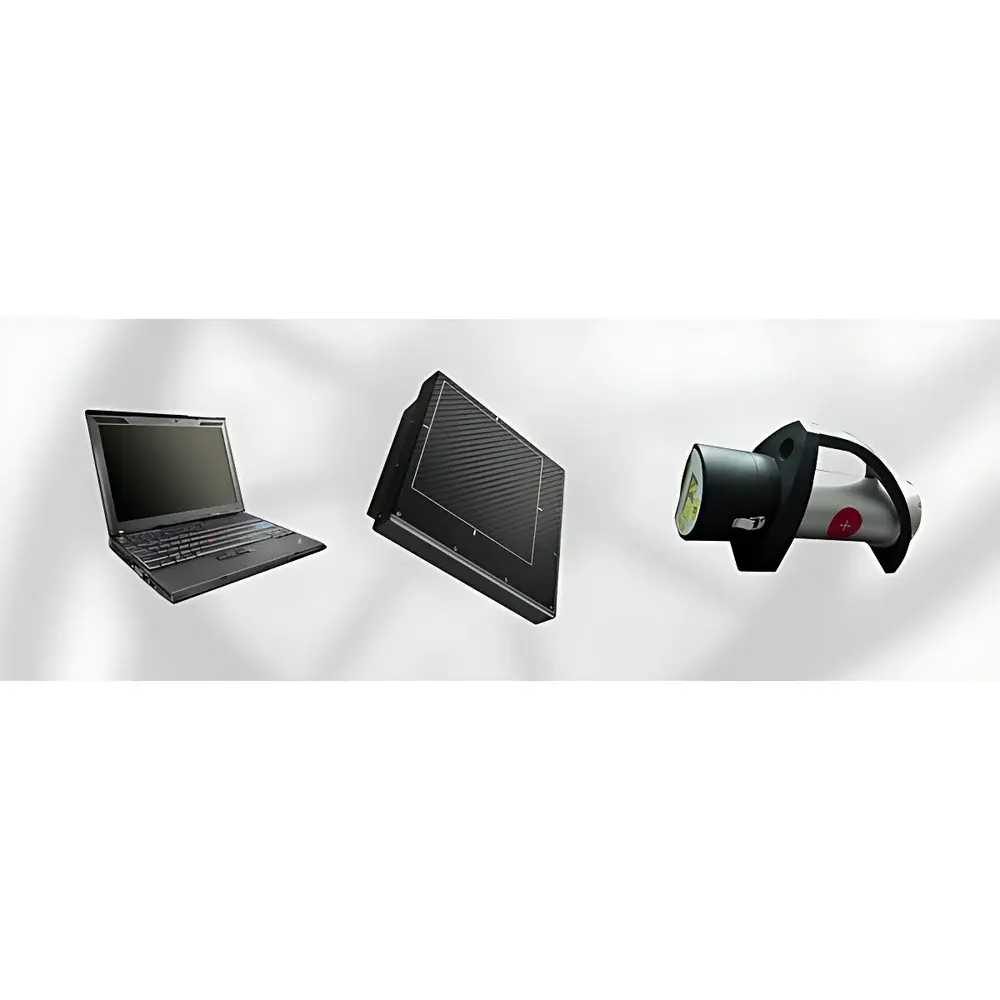
Aolong Portable X-ray Digital Radiography (DR) Imaging System
| Brand | Aolong |
|---|---|
| Origin | Liaoning, China |
| Manufacturer Type | OEM Manufacturer |
| Country of Origin | China |
| Model | Portable X-ray DR Imaging System |
| Price Range | USD 140,000 – 280,000 |
| X-ray Tube Voltage | 160 kV (120 kV optional) |
| X-ray Tube Current | up to 5 mA |
| System Weight | 10 kg |
| Operating Temperature | −20 °C to +60 °C |
| Image Area | 130 mm × 130 mm |
| Pixel Pitch | 85 µm |
| Spatial Resolution | 4.0 line pairs/mm |
| Core Components | X-ray generator, flat-panel detector (indirect conversion), ruggedized laptop workstation |
Overview
The Aolong Portable X-ray Digital Radiography (DR) Imaging System is an integrated, field-deployable non-destructive testing (NDT) platform engineered for high-fidelity radiographic inspection in constrained or remote environments. Based on direct digital acquisition architecture, the system employs a pulsed microfocus X-ray source coupled with a cesium iodide (CsI)-scintillator-based amorphous silicon (a-Si) flat-panel detector to deliver real-time, high-contrast images without film processing or phosphor plate scanning. Its compact form factor and low thermal mass enable rapid setup and operation across infrastructure maintenance, energy transmission networks, and industrial field service applications—where conventional fixed-room or cabinet-based radiography systems are impractical. The system operates under principles compliant with ISO 17636-2:2020 (Non-destructive testing of welds — Radiographic testing — Part 2: X- and gamma-ray methods for metallic materials) and supports quantitative defect assessment per ASTM E2737-21 (Standard Guide for Digital Detector Array (DDA) Performance Evaluation).
Key Features
- Lightweight modular design: total system mass ≤10 kg, enabling single-operator transport and deployment in elevated, confined, or hazardous locations (e.g., scaffolding, trench edges, substation enclosures)
- Adjustable X-ray output: selectable tube voltage (120–160 kV) and current (0.1–5.0 mA) with programmable pulse width and duty cycle for optimized contrast-to-noise ratio across material thicknesses (steel: 2–45 mm; aluminum: 5–120 mm)
- High-fidelity imaging chain: 130 mm × 130 mm active detection area, 85 µm pixel pitch, and ≥4.0 LP/mm spatial resolution ensure reliable detection of planar discontinuities such as lack-of-fusion, porosity, and cracking in welds and base metal
- Ruggedized hardware architecture: IP54-rated detector housing, shock-absorbing chassis, and extended-temperature electronics certified for continuous operation between −20 °C and +60 °C
- Integrated workflow control: embedded acquisition software synchronizes exposure parameters, image capture, geometric calibration, and basic contrast enhancement—all executed via the bundled industrial-grade laptop
Sample Compatibility & Compliance
The system is validated for use on ferrous and non-ferrous metallic components including carbon steel pipelines, stainless steel flanges, aluminum busbars, and copper conductor assemblies. It meets essential requirements for field NDT under ASME BPVC Section V, Article 2 (Radiographic Examination), and supports traceable inspection records aligned with ISO 9712:2021 personnel certification frameworks. All image metadata—including exposure time, kV/mA settings, source-to-detector distance (SDD), and detector gain calibration—are embedded in DICOM 3.0-compliant files. System validation documentation includes IQ/OQ protocols per EN ISO/IEC 17025:2017, and optional factory-issued calibration certificates conforming to ISO/IEC 17025-accredited laboratories.
Software & Data Management
Acquisition and post-processing are managed through Aolong’s proprietary DRView™ v4.x software suite, installed on the included Windows 10 IoT Enterprise laptop. The interface provides real-time histogram analysis, linear and logarithmic window-level adjustment, edge enhancement, noise suppression filters, and measurement tools for defect sizing (length, width, area). Export formats include DICOM, TIFF (16-bit), PNG, and PDF reports with embedded inspector ID, timestamp, GPS coordinates (optional external module), and audit trail logs. Software supports 21 CFR Part 11-compliant user authentication, electronic signatures, and immutable audit trails when configured for regulated environments (e.g., nuclear component verification or power grid asset integrity programs).
Applications
- Weld inspection of pipeline girth welds, branch connections, and field splices in oil & gas and municipal water infrastructure
- In-service corrosion mapping of buried or insulated piping using comparative thickness profiling from radiographic density gradients
- Integrity verification of overhead transmission line hardware—including compression-type tension clamps, suspension clamps, and connector sleeves—without disassembly
- Pre-commissioning safety screening of pressure vessels, heat exchanger tubesheets, and turbine casings in power generation facilities
- Emergency response radiography for structural welds in bridges, wind tower bases, and seismic retrofit joints where access is limited
FAQ
What radiation safety certifications does this system hold?
The system complies with IEC 61331-1:2014 (Protective devices against diagnostic medical X-radiation) and carries CE marking under EU Directive 2013/59/Euratom. Local regulatory registration (e.g., NRC or state-specific licensing in the US) is the responsibility of the end-user operator.
Can the system be used for real-time fluoroscopy?
No—it is optimized for static or step-and-shoot radiography only. Frame rates exceed 1 fps only during preview mode; full-resolution image acquisition requires stable exposure conditions and is not intended for dynamic motion analysis.
Is detector calibration traceable to national standards?
Yes. Each flat-panel detector ships with a factory calibration report traceable to NIST SRM 2084 (X-ray beam quality reference standards) and includes annual recalibration intervals specified in the maintenance manual.
Does the system support wireless image transfer?
Local Wi-Fi 5 (802.11ac) is enabled for secure intra-site file sharing; however, all primary acquisition and processing occur offline to ensure data integrity and eliminate latency-related artifacts.
What training and technical support options are available?
Aolong provides on-site operator certification (2-day course), ISO 9712 Level II radiographic interpretation training alignment, and remote diagnostics via encrypted VPN. Extended warranty and annual preventive maintenance contracts are available globally through authorized service partners.



