
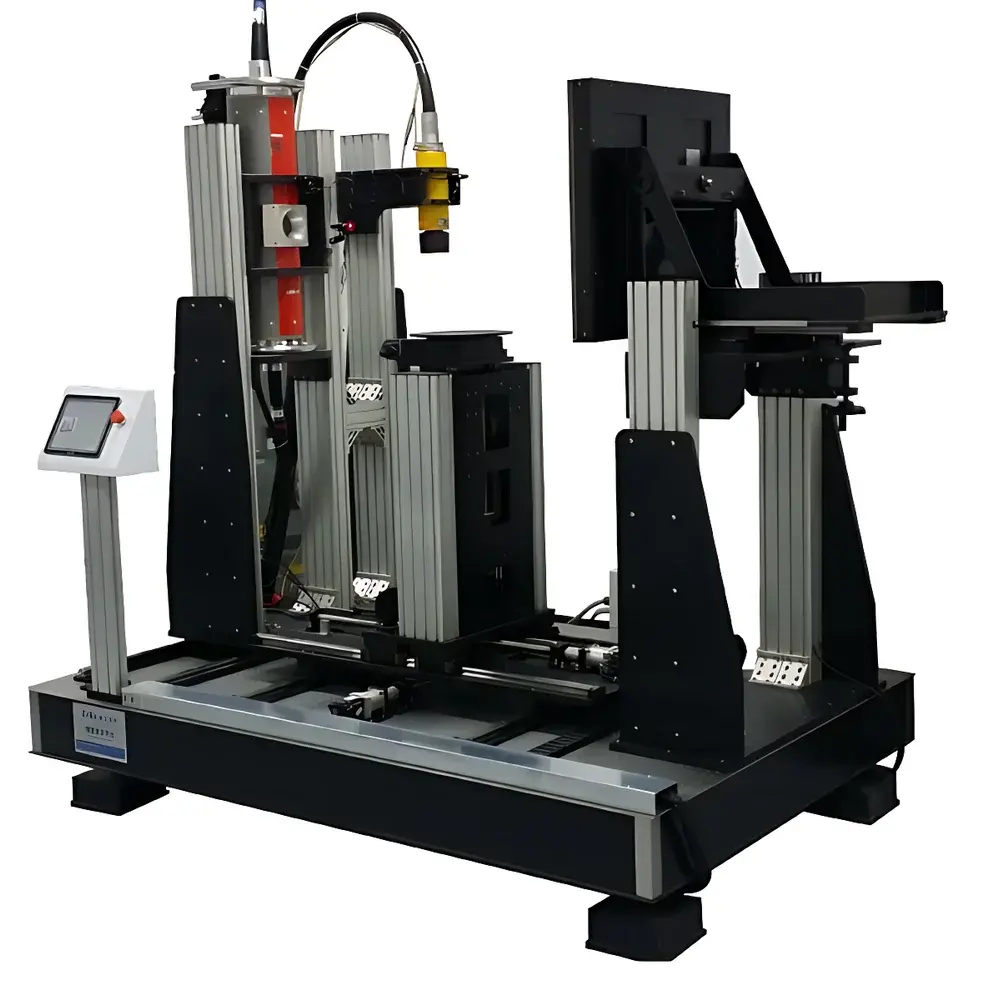
Aolong High-Energy Industrial Micro CT System
| Brand | Aolong |
|---|---|
| Origin | Liaoning, China |
| Manufacturer Type | Manufacturer |
| Regional Category | Domestic |
| Model | 20 kV–450 kV High-Energy Industrial CT |
| Detector Type | Flat-Panel Detector |
| Scan Mode | Translation-Rotation (TR) |
| Density Resolution | 0.5% |
Overview
The Aolong High-Energy Industrial Micro CT System is a precision-engineered non-destructive testing (NDT) platform designed for high-fidelity volumetric inspection of dense, large-scale industrial components. Leveraging high-voltage X-ray generation (20–450 kV, optionally up to 600 kV), cone-beam computed tomography (CBCT), and digital flat-panel detector technology, the system delivers quantitative 3D internal structure visualization with sub-millimeter spatial resolution and 0.5% density contrast sensitivity. Unlike conventional radiography or low-energy micro-CT systems, this high-energy configuration enables penetration of thick metallic sections—including aluminum castings, titanium aerospace housings, steel weldments, and composite-reinforced structures—while maintaining geometric fidelity and measurement traceability. The system integrates a rigid mechanical gantry with sub-micron motion control, supporting both TR (translation-rotation) scanning for enhanced uniformity and standard cone-beam acquisition for rapid throughput. Its dual-mode operation—simultaneous DR (digital radiography) real-time imaging and full-volume CT reconstruction—facilitates dynamic process monitoring, defect localization, and metrological validation in a single platform.
Key Features
- High-voltage X-ray source (20–450 kV, optional 600 kV upgrade) with stable high-frequency constant-potential output for consistent beam quality and reduced dose variability
- Digital flat-panel detector with high DQE (detective quantum efficiency) and low electronic noise, optimized for high-energy photon detection
- Translation-rotation (TR) scanning geometry to minimize cone-beam artifacts and improve quantitative accuracy across large field-of-view acquisitions
- Integrated metrology-grade software suite supporting ISO 15530-3 compliant dimensional analysis, including GD&T evaluation and uncertainty estimation
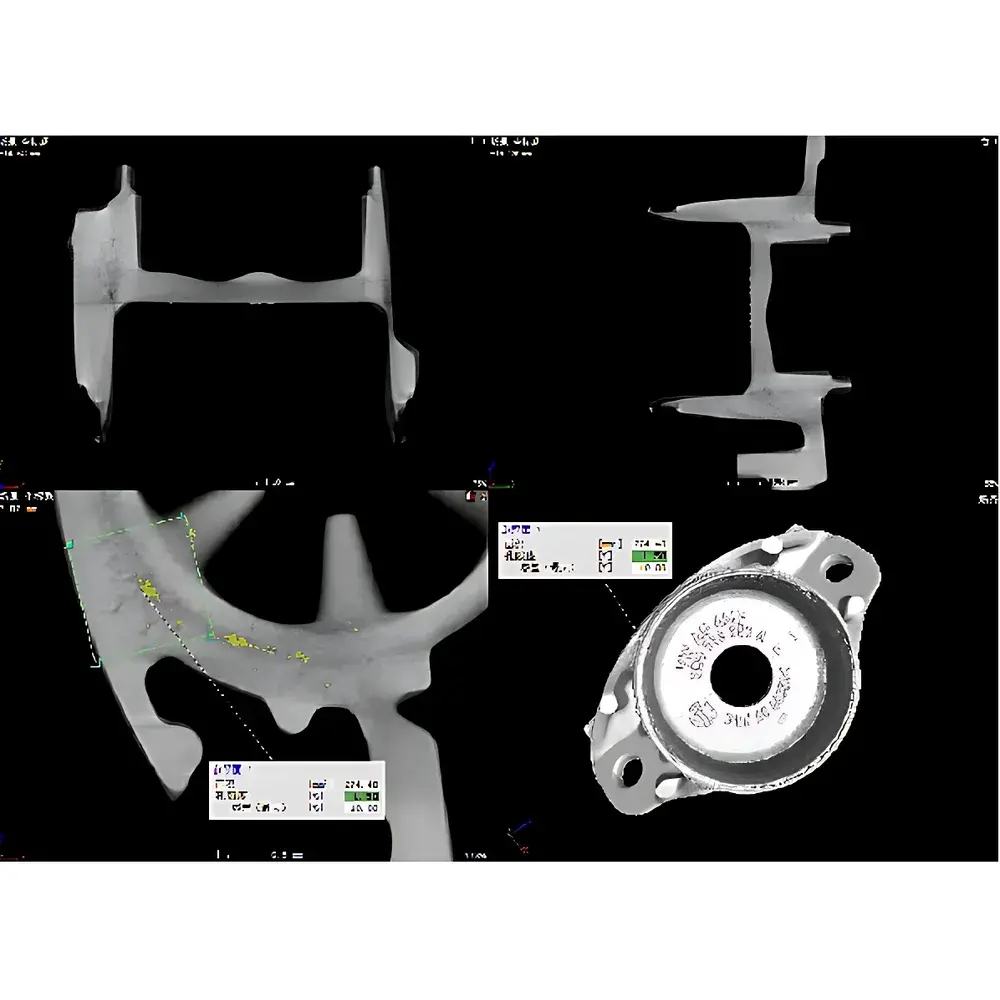
- Automated void and porosity quantification per ASTM E1558 and ISO 10893-10, with customizable segmentation thresholds and volume-based defect classification
- Color-mapped wall thickness analysis with deviation reporting against nominal CAD models (GD&T-compliant)
- Multi-modal measurement toolkit: point-to-point distance, radius, angle, parallelism, perpendicularity, and coordinate transformation relative to user-defined datums
- Reverse engineering workflow with STL-to-CAD comparison, deviation heatmaps, and ASME Y14.5-aligned tolerance reporting
Sample Compatibility & Compliance
The system accommodates samples up to 600 mm in diameter and 1,200 mm in height (configurable based on voltage/detector selection), making it suitable for turbine blades, engine blocks, pressure vessels, and additively manufactured structural components. It complies with core NDT regulatory frameworks including ASTM E2737 (standard practice for CT data acquisition), ISO/IEC 17025 requirements for accredited testing laboratories, and supports audit-ready documentation for GLP and GMP environments. All image reconstruction algorithms adhere to filtered back-projection (FBP) and iterative reconstruction (IR) methods validated per AAPM Report No. 229. System calibration is traceable to NIST-traceable phantoms for density and spatial linearity verification.
Software & Data Management
Built on a modular, 64-bit Windows-based architecture, the proprietary acquisition and reconstruction software provides DICOM 3.0 export, HDF5 binary storage for large-volume datasets (>100 GB per scan), and native support for third-party post-processing tools (e.g., VGStudio MAX, Avizo, Simpleware). Audit trails record all user actions—including parameter changes, reconstruction settings, and measurement annotations—in compliance with FDA 21 CFR Part 11 requirements. Data encryption at rest, role-based access control, and automated backup to network-attached storage (NAS) ensure secure long-term archiving. Raw projection data, reconstructed volumes (16-bit TIFF stacks), and annotated measurement reports are stored with embedded metadata (voltage, current, exposure time, detector gain, rotation step, etc.) for full experimental reproducibility.
Applications
- Aerospace: Inspection of turbine disk porosity, blade root integrity, and TLP (transient liquid phase) bond quality in nickel superalloys
- Automotive: Validation of sand core retention in aluminum cylinder heads, airbag inflator housing weld integrity, and battery module cell alignment
- Defense: Non-destructive verification of explosive charge uniformity, penetrator density gradients, and composite armor layer adhesion
- Additive Manufacturing: In-process defect mapping (lack-of-fusion, keyholing), powder bed residual stress inference via lattice distortion analysis, and as-built vs. as-designed conformity assessment
- Energy: Wall thickness consistency in nuclear fuel cladding tubes, crack propagation tracking in steam generator tubing, and ceramic insulator void fraction quantification
- Research & Development: Time-resolved in situ CT during thermal cycling, mechanical loading, or fluid infiltration experiments using custom environmental chambers
FAQ
What is the minimum detectable feature size under standard operating conditions?
The practical spatial resolution depends on focal spot size (0.4–1.0 mm), geometric magnification, and detector pixel pitch; typical effective isotropic voxel sizes range from 20 µm to 200 µm, verified using line-pair phantoms per ISO 16508.
Does the system support automated batch scanning and report generation?
Yes—scripted acquisition protocols enable unattended multi-part scanning with auto-alignment, standardized reconstruction parameters, and PDF/Excel report generation including pass/fail flags against user-defined acceptance criteria.
Can the system be integrated into an existing factory MES or QMS infrastructure?
It supports OPC UA connectivity and RESTful API endpoints for bidirectional data exchange with Siemens Opcenter, PTC ThingWorx, and ETQ Reliance, enabling direct linkage to nonconformance workflows and SPC dashboards.
Is on-site installation and IQ/OQ/PQ validation assistance available?
Aolong provides full commissioning services including site readiness assessment, mechanical and radiation safety certification, and documented Installation Qualification (IQ), Operational Qualification (OQ), and Performance Qualification (PQ) aligned with ISO 9001 and ASNT SNT-TC-1A Level III supervision.



