
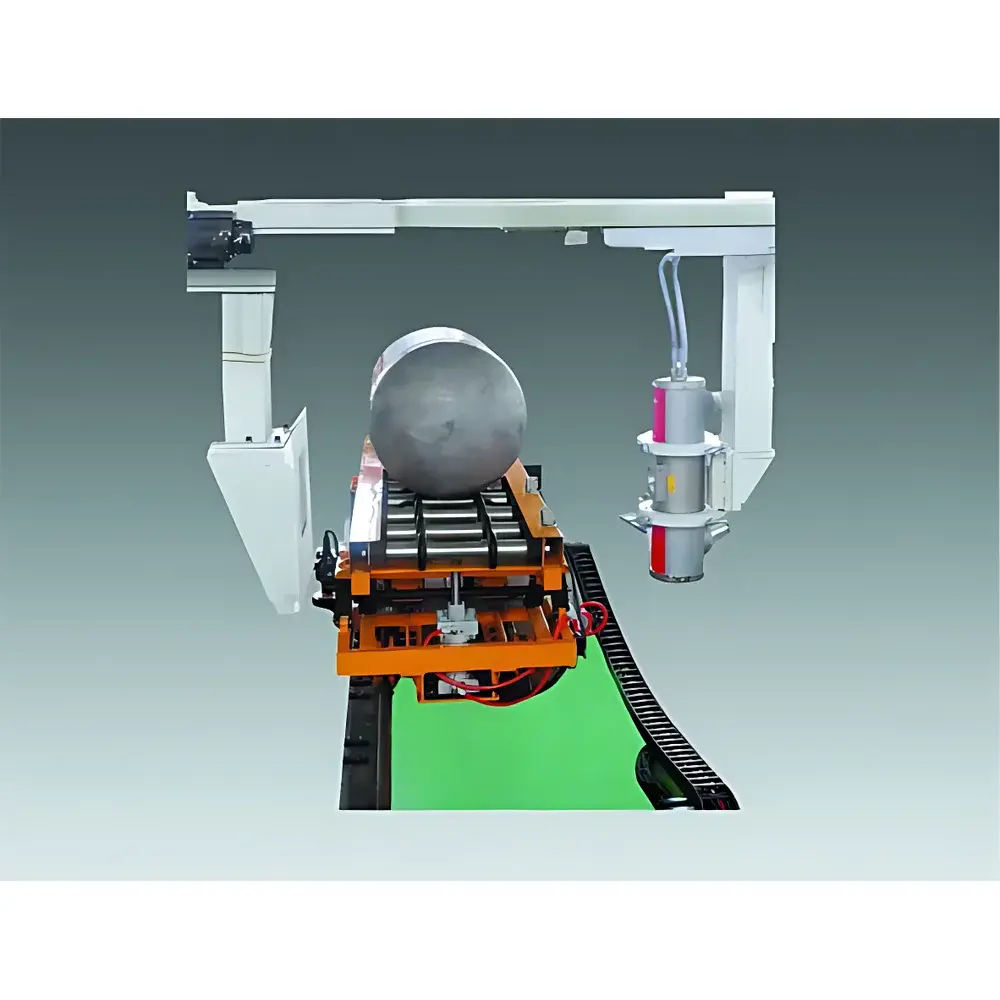
Aolong XYG-22508/3 Industrial Micro CT System for Non-Destructive Inspection of LNG Vehicle-Mounted Cryogenic Tanks
| Brand | Aolong |
|---|---|
| Origin | Liaoning, China |
| Manufacturer Type | OEM Manufacturer |
| Country of Origin | China |
| Model | XYG-22508/3 |
| Price | Upon Request |
| X-ray Tube Voltage Range | 20–450 kV |
| X-ray Tube Current Range | 0.1–20 mA |
| Repeatability | ±0.01% |
| High-Voltage Rise Time | 0.1–0.3 ms |
| System Spatial Resolution | 16–39 lp/cm |
| Contrast Sensitivity | 1.2–1.5% |
| Detector Type | Digital Flat-Panel Detector |
| Application-Specific Software | Proprietary NDT Software for Stainless Steel Cryotanks |
| Conveyor Material | Polyurethane Rollers (Carbon-Free for Austenitic Stainless Steel) |
| Compliance | Designed to Support ISO 17636-2, ASTM E2737, and EN 1435 Conformance Requirements |
Overview
The Aolong XYG-22508/3 Industrial Micro CT System is a high-performance, production-integrated X-ray digital radiography platform engineered specifically for non-destructive inspection of thin- to medium-wall stainless steel components—particularly LNG vehicle-mounted cryogenic tanks. Unlike conventional radiographic systems relying on film or image intensifiers, this system employs a pulsed, high-stability 40 kHz X-ray generator with ultra-low ripple (<0.3%) and rapid high-voltage rise time (0.1–0.3 ms), enabling precise dose control and minimizing motion blur during high-throughput line scanning. The core imaging modality is digital radiography (DR) enhanced by micro-focus geometry and geometric magnification, supporting both 2D real-time radiography and reconstructed 3D volumetric tomography (micro-CT) when configured with rotational gantry modules. Its architecture integrates radiation safety, material compatibility, and metrological traceability into a single turnkey solution validated across more than 50 LNG tank manufacturing facilities globally.
Key Features
- High-stability X-ray source: 20–450 kV adjustable tube voltage and 0.1–20 mA tube current, optimized for austenitic stainless steel (e.g., 304/316L) with minimal beam hardening artifacts
- Digital flat-panel detector (FPD) with active area ≥ 40 cm × 30 cm, 14-bit dynamic range, and pixel pitch ≤ 150 µm — delivering spatial resolution of 16–39 line pairs per centimeter under standard test conditions (ASTM E2737 Annex A1)
- Patented polyurethane roller conveyor system: Eliminates carbon contamination risk during handling of passivated stainless surfaces — critical for post-weld integrity verification and pressure vessel certification
- Modular multi-axis positioning stage: Supports programmable tilt, rotation, and lateral translation for full circumferential inspection without manual repositioning
- Integrated lead-shielded enclosure (≥ 2.0 mm Pb equivalent) compliant with IEC 61331-1 and local regulatory requirements for Class II radiation facilities
- OEM-designed DR acquisition software with real-time defect annotation, automatic weld seam tracking, and ISO 17636-2-compliant IQI-based sensitivity reporting
Sample Compatibility & Compliance
The XYG-22508/3 is qualified for inspection of cylindrical, seamless, and welded stainless steel pressure vessels with diameters from 300 mm to 2,200 mm and wall thicknesses up to 45 mm. It accommodates both longitudinal and circumferential welds in accordance with ASME BPVC Section V, Article 2 and EN 1435. All mechanical handling interfaces—including centering fixtures and end-cap supports—are designed to preserve surface finish and avoid mechanical marking. The system meets electromagnetic compatibility (EMC) standards per IEC 61000-6-3 and has undergone third-party validation for repeatability (±0.01% intensity stability over 8-hour operation) and geometric distortion <0.1% across the full field of view. Documentation packages include IQI sensitivity logs, beam quality reports (HVL measurements), and audit-ready calibration records aligned with GLP principles.
Software & Data Management
The proprietary Aolong NDT Suite v4.2 provides DICOM-compliant image acquisition, processing, and archiving with full FDA 21 CFR Part 11 readiness — including electronic signatures, role-based access control, and immutable audit trails for all image annotations, parameter changes, and report exports. Image enhancement algorithms include adaptive histogram equalization, noise suppression via non-local means filtering, and edge-preserving deconvolution tailored for stainless steel grain structure visualization. Quantitative analysis tools support porosity measurement (ISO 10893-19), inclusion sizing (ASTM E112), and linear defect length/depth estimation using calibrated depth-discrimination curves. Raw projection data and reconstructed volumes are exportable in standard formats (TIFF, HDF5, STL) for integration with external CAE platforms such as ANSYS or Simcenter 3D.
Applications
- Automated detection and classification of internal discontinuities in LNG tank bodies: porosity, slag inclusions, lack-of-fusion, and micro-cracks within heat-affected zones
- Verification of liner integrity and interlayer bonding in multi-layer cryotank designs
- In-process QA during robotic welding cycles — synchronized with PLC-triggered exposure sequences
- Root pass inspection of circumferential girth welds without removal of backing strips
- Post-hydrotest evaluation of stress-induced anomalies in service-aged components
- Reference standard development for ultrasonic testing (UT) and phased array (PAUT) method qualification
FAQ
Does the system support automated defect recognition (ADR) for weld inspection?
Yes — optional AI-powered ADR module trained on >12,000 labeled weld radiographs enables classification of six defect types (porosity, tungsten inclusion, crack, lack of penetration, lack of fusion, slag) with ≥92% precision at 1.5% contrast sensitivity.
Can the system be integrated into an existing factory MES or SAP environment?
Fully supported via OPC UA and RESTful API interfaces; includes prebuilt connectors for Siemens Opcenter, Rockwell FactoryTalk, and SAP QM modules.
What radiation safety certifications does the shielded enclosure carry?
Certified to IEC 61331-1:2014 and GBZ 138-2019; full shielding validation report includes scatter dose mapping at 30 cm and 1 m distances per NCRP Report No. 147.
Is micro-CT reconstruction capability included in the base configuration?
Micro-CT functionality requires optional rotational gantry and dedicated reconstruction workstation (Aolong CT-Engine v3.1); standard configuration delivers high-speed DR with real-time image processing only.
How is system calibration maintained between scheduled service intervals?
Onboard reference phantom (tungsten-copper step wedge + stainless steel IQI set) enables daily user-performed sensitivity verification; calibration certificates are traceable to CNAS-accredited laboratories.
Related Products



