
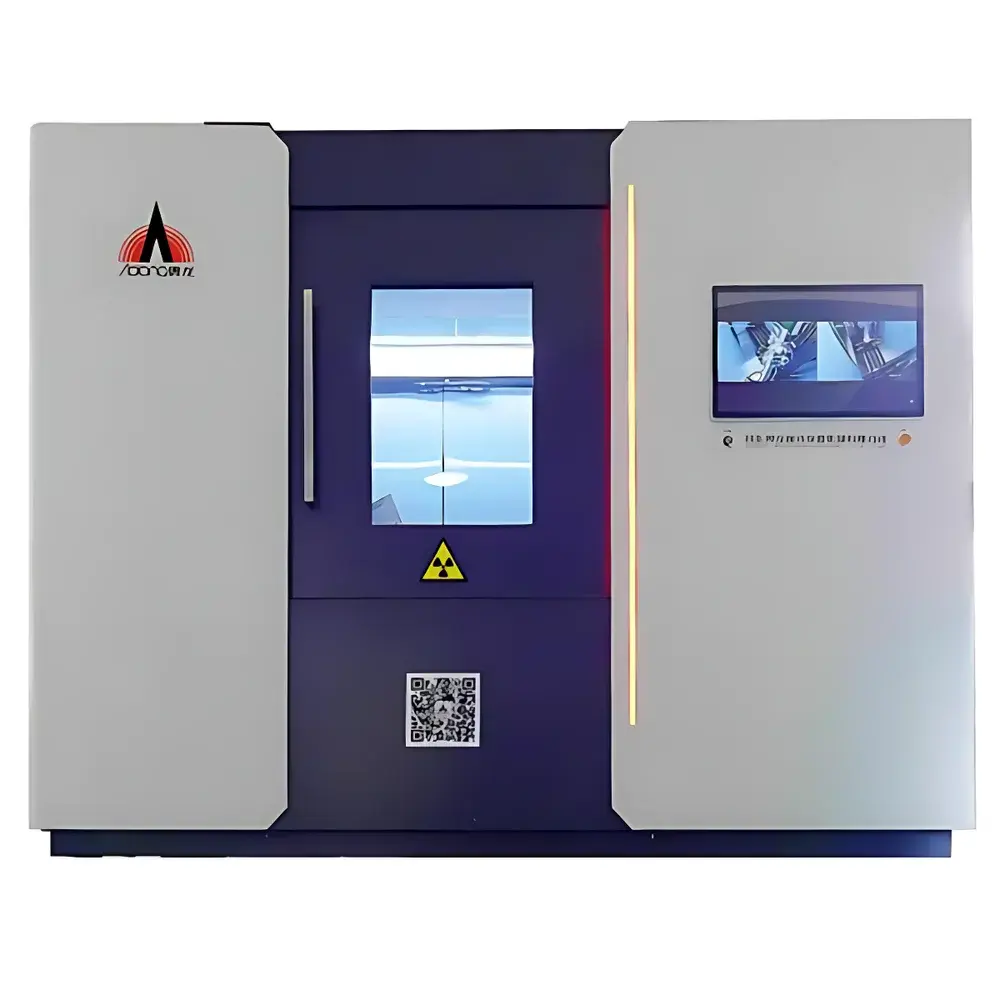
Industrial Micro CT System for Lithium-ion Battery Inspection – AOLONG BatteryCT Series
| Brand | AOLONG |
|---|---|
| Model | BatteryCT |
| Type | Industrial Micro-Computed Tomography System |
| Origin | Liaoning, China |
| Manufacturer | OEM Producer |
| X-ray Max Power | 320 W |
| X-ray Max Voltage | 225 kV |
| X-ray Max Current | 3 mA |
| Focal Spot Size | 4 µm |
| Beam Divergence Angle | 30° |
| Flat-Panel Detector Pixel Pitch | 139 µm |
Overview
The AOLONG BatteryCT Series is a high-resolution industrial micro-computed tomography (micro-CT) system specifically engineered for non-destructive, three-dimensional internal inspection of lithium-ion traction batteries used in electric vehicles (EVs) and energy storage systems. Leveraging cone-beam geometry and high-brightness microfocus X-ray generation, the system reconstructs volumetric datasets with sub-micron spatial resolution capability—enabling quantitative analysis of internal structural integrity without disassembly or sample preparation. Its design prioritizes metrological traceability, mechanical stability under long-duration scanning, and thermal management for consistent tube output—critical for repeatable defect detection across production-line battery cells including prismatic, pouch, and blade-type configurations.
Key Features
- Microfocus X-ray source with 4 µm nominal focal spot size, optimized for high geometric magnification and edge sharpness in battery component imaging.
- High-power X-ray generator rated up to 225 kV / 3 mA / 320 W, enabling sufficient photon flux penetration through dense cathode/anode stacks and aluminum/copper current collectors.
- 30° beam divergence angle ensures optimal trade-off between field-of-view coverage and detector-limited resolution for full-cell scans (up to 300 mm diameter).
- Large-area flat-panel detector with 139 µm pixel pitch, supporting high dynamic range (16-bit grayscale) acquisition and low-noise signal capture essential for distinguishing subtle density variations—e.g., electrolyte distribution, separator delamination, or metallic particle contamination.
- Rigid granite-based gantry architecture with precision air-bearing rotation stage (angular repeatability < 0.005°), minimizing motion-induced artifacts during helical or step-and-shoot acquisition protocols.
- Integrated thermal regulation system for both X-ray tube and detector, maintaining stable operating conditions over extended scan durations required for high-fidelity reconstruction of multi-layer electrode assemblies.
Sample Compatibility & Compliance
The BatteryCT platform accommodates cylindrical (18650–4680), prismatic (including LFP blade cells), and pouch-type battery formats up to 350 mm in height and 25 kg mass. Sample mounting fixtures are modular and configurable for vertical or horizontal orientation, supporting both bare cells and assembled modules (with appropriate shielding assessment). The system conforms to IEC 62471 (photobiological safety), meets electromagnetic compatibility requirements per EN 61326-1, and supports integration into ISO/IEC 17025-accredited laboratories. Optional audit-trail logging and user-access control modules align with GLP and GMP documentation expectations for quality assurance workflows in automotive Tier-1 supplier environments.
Software & Data Management
AOLONG’s proprietary CT Suite v4.x provides end-to-end workflow support—from acquisition parameter optimization (voltage/current/filtration/scanning trajectory) to GPU-accelerated FDK reconstruction, volume rendering, and defect-specific segmentation. Quantitative analysis tools include wall-thickness mapping, porosity measurement (per ASTM E1558), void fraction calculation, and dimensional metrology traceable to NIST-traceable phantoms. All raw projections and reconstructed volumes are stored in DICOM 3.0 format; metadata embedding complies with FDA 21 CFR Part 11 requirements when configured with electronic signature and audit-log modules. Data export supports STL, VTK, and CSV for downstream CAE simulation (e.g., thermal runaway modeling) or statistical process control (SPC) dashboards.
Applications
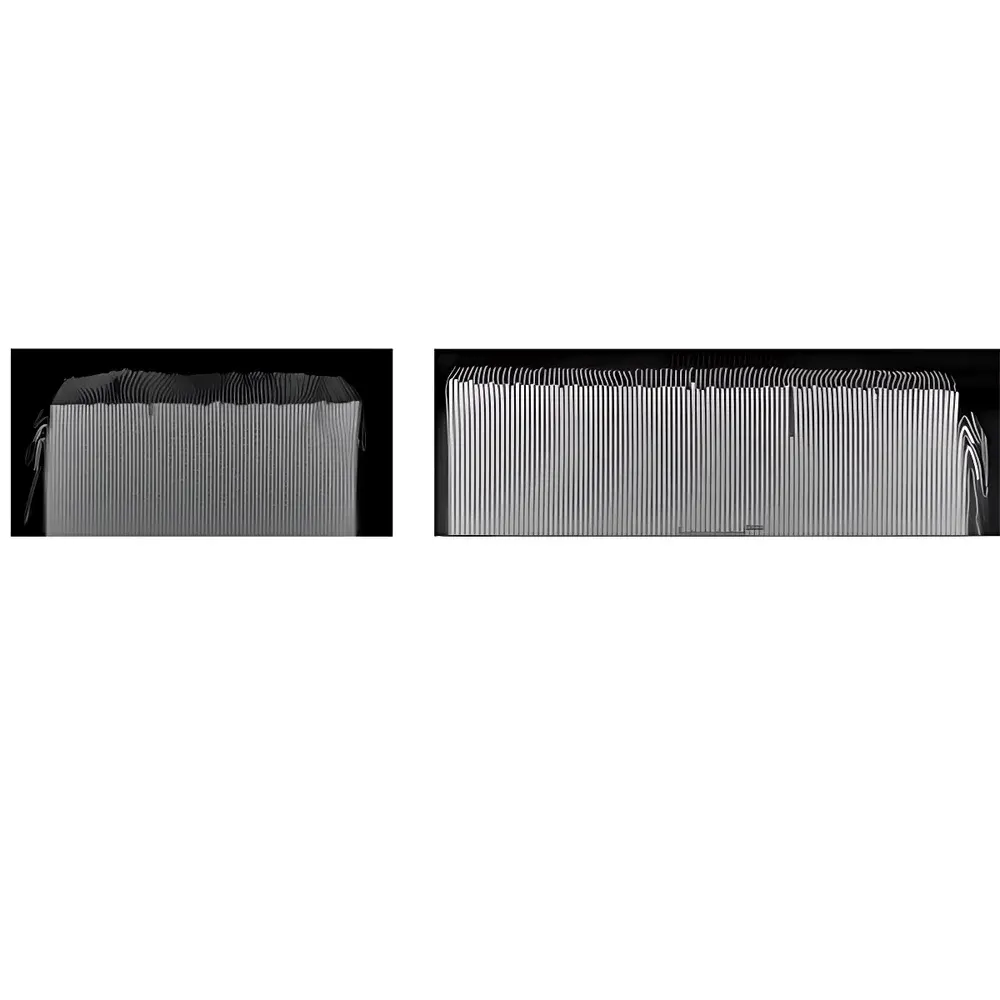
- Detection and localization of internal defects: electrode folding, tab misalignment, separator cracks, weld pore formation in top-cap laser joints, and foreign particulate inclusion in jelly-roll assemblies.
- Quantitative evaluation of winding tension uniformity, anode/cathode coating thickness variation, and calendering-induced density gradients.
- Post-cycle degradation analysis: lithium plating visualization, dendrite growth tracking, and interfacial delamination progression at current-collector interfaces.
- Validation of cell assembly processes—including ultrasonic welding integrity, adhesive dispensing coverage, and housing seal conformity—prior to thermal cycling or safety testing.
- Root-cause failure analysis for field returns, supporting FA reports compliant with AIAG CQI-17 and VDA 19.2 standards.
FAQ
What battery formats can the BatteryCT system scan without modification?
Standard configurations support cylindrical (18650, 21700, 4680), prismatic (up to 300 × 200 × 100 mm), and blade cells (up to 600 × 100 × 15 mm); custom fixturing is available for module-level scanning.
Is the system capable of measuring electrode coating thickness quantitatively?
Yes—using calibrated density-to-thickness conversion models and reference phantoms, coating thickness can be resolved within ±1.5 µm uncertainty for standard NMC/LFP layers under controlled acquisition conditions.
Does the software support automated defect classification?
The optional AI-Assisted Defect Recognition (ADR) module provides configurable CNN-based classifiers trained on annotated battery CT datasets; deployment requires validation per ISO/IEC 17025 clause 7.7.2 for measurement software.
Can scan data be exported for finite element analysis (FEA)?
Yes—segmented binary masks and labeled volumes are exportable as STL or voxel-based NRRD files, compatible with ANSYS Mechanical, COMSOL Multiphysics, and open-source platforms such as SimpleITK and ITK-SNAP.
What regulatory documentation is provided for qualification in automotive manufacturing?
Factory acceptance test (FAT) reports, IQ/OQ protocols, radiation safety certification, and traceable calibration certificates for geometric accuracy (per ISO 15530-3) are included with each system shipment.
Related Products



