
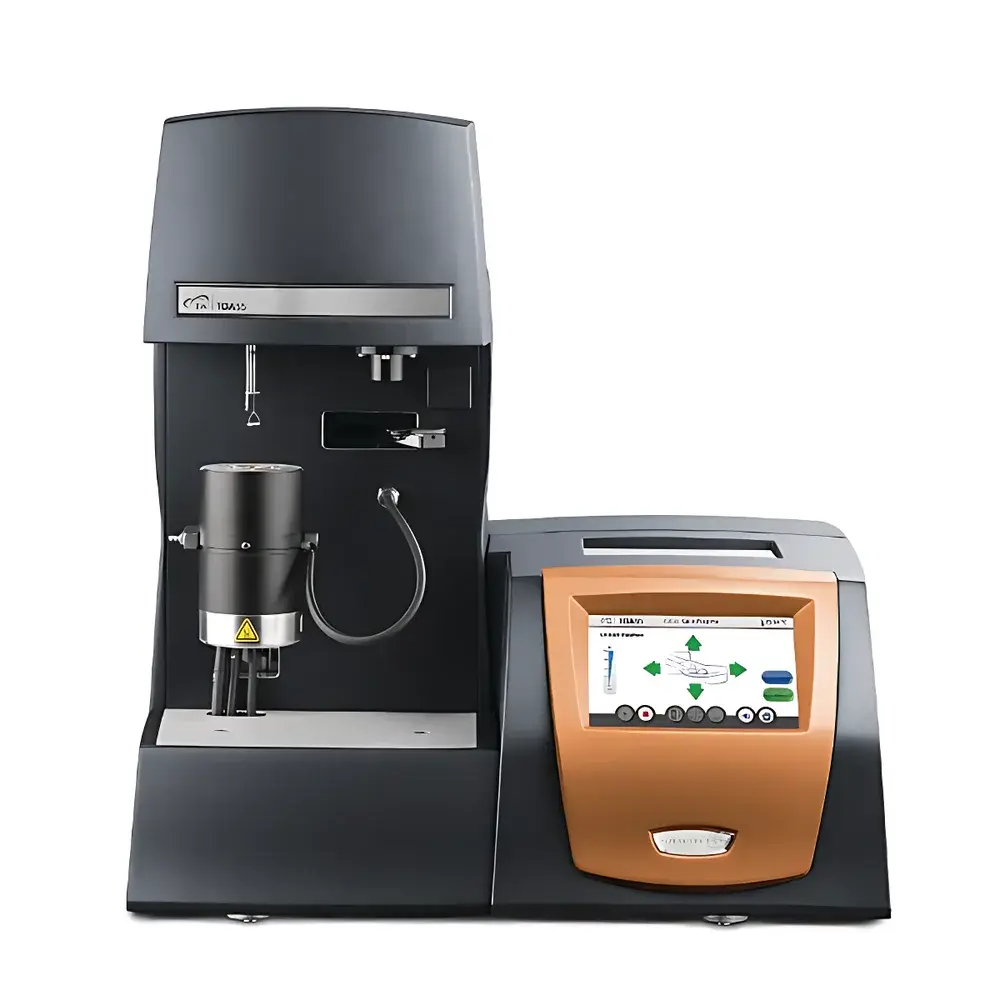
Discovery TGA 55 Thermogravimetric Analyzer by TA Instruments
| Brand | TA Instruments |
|---|---|
| Origin | USA |
| Model | Discovery TGA 55 |
| Temperature Range | Ambient to 1000 °C |
| Balance Sensitivity | 0.1 μg |
| Heating/Cooling Rate | 0.1–100 °C/min |
| Baseline Drift | <25 μg |
Overview
The Discovery TGA 55 is a high-performance thermogravimetric analyzer engineered for precision mass-change measurement as a function of temperature or time under controlled atmospheric conditions. Utilizing a high-resolution, low-drift microbalance coupled with a robust horizontal furnace architecture, the instrument operates on the fundamental principle of monitoring sample mass loss or gain during thermal treatment—enabling quantitative analysis of decomposition kinetics, moisture content, filler loading, oxidative stability, and volatilization behavior. Designed for laboratories requiring rigorous reproducibility in materials characterization, the Discovery TGA 55 delivers traceable thermal data compliant with international standards including ASTM E1131, ISO 11358, and USP <467> for residual solvents. Its modular design supports optional gas switching, humidity control, and evolved gas analysis (EGA) coupling via FTIR or MS interfaces.
Key Features
- Ultra-sensitive ceramic-fused quartz microbalance with 0.1 μg resolution and real-time digital filtering to minimize mechanical noise and thermal convection artifacts.
- Horizontal furnace configuration ensuring uniform temperature distribution across the sample zone and minimizing buoyancy effects—critical for accurate kinetic modeling.
- Programmable heating/cooling rates from 0.1 to 100 °C/min, enabling both slow-scan stability profiling and rapid screening protocols without hardware reconfiguration.
- Active temperature calibration using certified reference materials (e.g., Ni, In, Zn, Al₂O₃), supporting NIST-traceable temperature accuracy within ±0.3 °C.
- Integrated purge gas management system with dual mass flow controllers (MFCs) for precise inert (N₂, Ar) or reactive (air, O₂) atmosphere switching during dynamic runs.
- Low baseline drift (<25 μg over 1000 °C) achieved through symmetrical thermal shielding, active furnace cooling, and advanced drift compensation algorithms embedded in Trios software.
Sample Compatibility & Compliance
The Discovery TGA 55 accommodates standard platinum, alumina, and gold crucibles (50–100 μL capacity), with optional high-temperature alloys (e.g., Ir, Mo) for aggressive environments up to 1000 °C. Sample mass range spans 0.1 mg to 1000 mg, supporting both micro-scale polymer additives and macro-scale composites. All thermal protocols adhere to GLP/GMP documentation requirements: audit trails, electronic signatures, and 21 CFR Part 11–compliant data security are enforced through Trios software. Instrument validation packages support IQ/OQ/PQ execution per ASTM E2550 and ISO/IEC 17025 laboratory accreditation frameworks.
Software & Data Management
Trios™ Software provides a unified platform for method development, real-time data visualization, derivative thermogravimetry (DTG), and multi-step kinetic analysis (e.g., Friedman, Ozawa-Flynn-Wall). Raw data files (.tga) are stored in vendor-neutral HDF5 format with embedded metadata (operator ID, calibration history, gas composition, ramp parameters). Batch processing tools enable automated peak detection, residue quantification, and comparative overlay of up to 32 curves. Export options include CSV, ASCII, and PDF reports conforming to internal SOPs or regulatory submissions. Remote monitoring and scheduled shutdown functions enhance unattended operation reliability.
Applications
- Quantitative determination of polymer degradation onset, char yield, and filler content in composites per ASTM D3850 and ISO 11358-1.
- Residual solvent profiling in pharmaceutical intermediates and final drug substances (USP <467>).
- Oxidative induction time (OIT) measurement for polyolefins and stabilizer efficacy evaluation (ASTM D3895).
- Hydration/dehydration behavior of metal-organic frameworks (MOFs), clays, and battery cathode materials.
- Thermal stability assessment of catalysts, carbon blacks, and nanomaterials under controlled oxygen partial pressures.
- Multi-stage decomposition modeling for energetic materials and flame-retardant formulations.
FAQ
What is the maximum operating temperature of the Discovery TGA 55?
The instrument is rated for continuous operation from ambient temperature up to 1000 °C in inert or oxidizing atmospheres.
Can the Discovery TGA 55 be coupled to a mass spectrometer or FTIR?
Yes—it features a standardized heated transfer line port (150 °C max) compatible with most commercial EGA systems for real-time evolved gas identification.
Is baseline correction performed automatically during data acquisition?
Trios software applies real-time baseline subtraction using pre-run empty-crucible reference scans, with optional post-acquisition polynomial fitting for extended temperature ranges.
How is temperature calibration verified?
Certified reference materials with sharp, well-defined melting or Curie transitions (e.g., Ni, In, Al₂O₃) are used to validate furnace temperature accuracy prior to critical measurements.
Does the system meet FDA 21 CFR Part 11 requirements?
When deployed with Trios Enterprise Edition and configured with role-based access controls, electronic signatures, and immutable audit logs, the system satisfies Part 11 compliance for regulated environments.



