
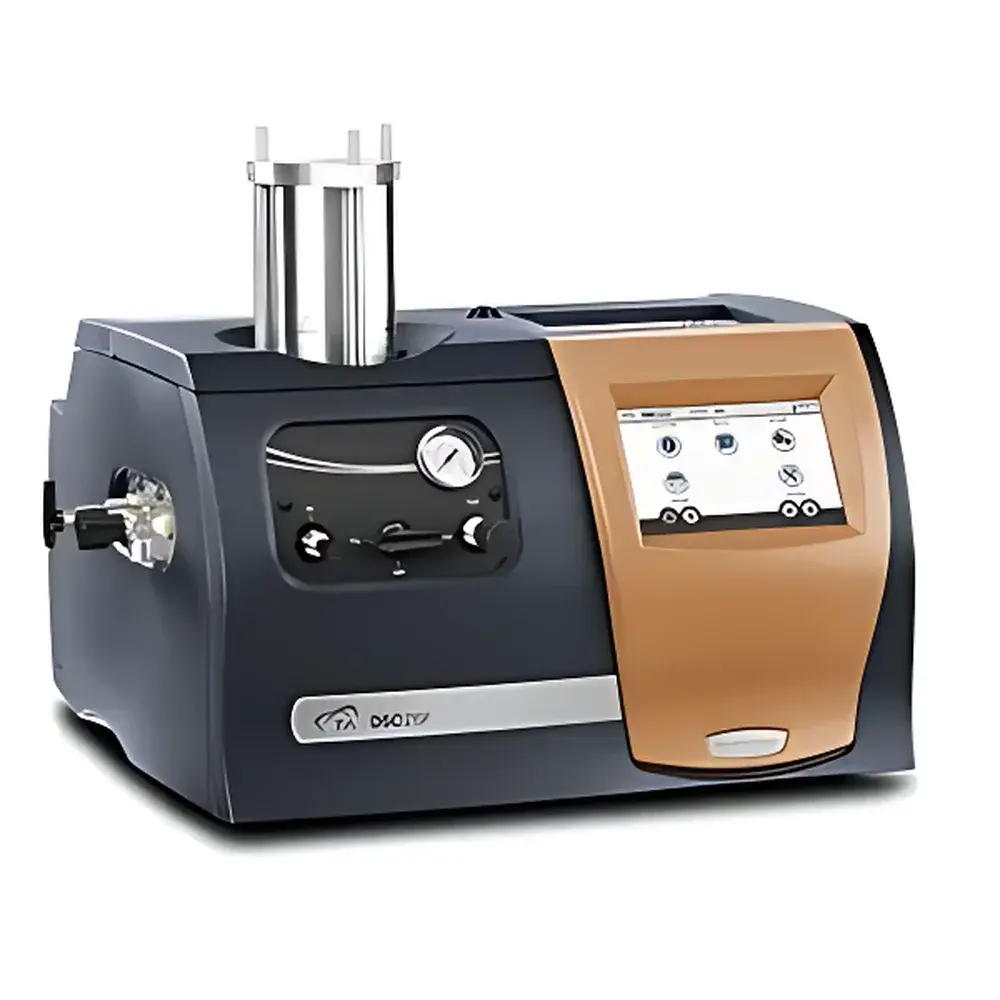
TA Instruments Discovery DSC 25P High-Pressure Differential Scanning Calorimeter
| Brand | TA Instruments |
|---|---|
| Origin | USA |
| Model | Discovery DSC 25P |
| Sample Capacity | Single |
| Instrument Type | Differential Scanning Calorimeter (DSC) |
| Temperature Range | –130 °C to 550 °C |
| Temperature Accuracy | ±0.1 °C |
| Heating/Cooling Rate | Up to 200 K/min |
| DSC Heat Flow Range | ±500 mW |
| Pressure Range | 1 Pa to 7 MPa (0.0001–1,000 psi) |
Overview
The TA Instruments Discovery DSC 25P is a high-performance, pressure-capable differential scanning calorimeter engineered for precise thermal characterization of materials under controlled gaseous and pressurized environments. Unlike conventional ambient-pressure DSC systems, the DSC 25P integrates a fully sealed, actively monitored Fusion Cell™ measurement chamber that enables quantitative heat flow analysis across a broad pressure spectrum—from ultra-high vacuum (1 Pa) to 7 MPa (1,000 psi). Its core measurement principle relies on heat flux detection via dual Tzero™ thermocouples embedded in a high-stability silver furnace, delivering high reproducibility and baseline integrity during dynamic temperature ramps and isothermal holds. The instrument operates across an extended thermal range of –130 °C to 550 °C—achievable with optional Fast Access Cryosystem (FACS) cooling—and supports both static and dynamic gas purge modes (constant volume or constant pressure), making it suitable for rigorous investigation of phase transitions, reaction kinetics, oxidative degradation, and thermodynamic stability under industrially relevant process conditions.
Key Features
- Fusion Cell™ architecture with integrated pressure transducer, fixed-position temperature sensor, and precision-machined silver heating block for exceptional thermal homogeneity and long-term baseline stability
- One Touch Away™ intuitive touchscreen interface enabling real-time monitoring and manual override of pressure, temperature, time, and gas flow parameters
- Modulated DSC® (MDSC®) capability for simultaneous separation of reversing and non-reversing thermal events—including heat capacity quantification—even under elevated pressure conditions
- TRIOS™ software platform providing full instrument control, automated method development, multi-step pressure/temperature profiling, and ASTM-compliant reporting templates
- Comprehensive 5-year warranty covering both the Fusion Cell™ reaction chamber and furnace assembly—among the longest standard coverage offerings in the thermal analysis industry
Sample Compatibility & Compliance
The DSC 25P accommodates standard hermetic aluminum, stainless steel, and gold-plated pans compatible with reactive or volatile samples. It supports inert (N₂, Ar), oxidizing (O₂, air), and reducing (H₂, forming gas) atmospheres, as well as solvent vapor equilibration studies. The system meets or exceeds requirements for multiple ASTM standards including E537 (thermal stability), E1782 (vapor pressure determination), D1858/D2009 (oxidation induction time and onset temperature for hydrocarbons), D5885/D6186/D8117 (pressure-assisted oxidation testing of polyolefins and lubricants). Its hardware and software architecture support audit-ready data handling in accordance with FDA 21 CFR Part 11, GLP, and GMP environments when configured with electronic signatures and secure user access controls.
Software & Data Management
TRIOS™ serves as the unified control and analysis environment for the DSC 25P. It enables synchronized acquisition of heat flow, temperature, pressure, and gas flow signals at up to 10 Hz sampling resolution. Method templates include preconfigured pressure ramp sequences, step-isothermal oxidation protocols, and MDSC® harmonic analysis workflows. All raw and processed data are stored in a vendor-neutral, timestamped binary format (.dsc) with embedded metadata (instrument ID, operator, calibration history, environmental logs). Export options include ASTM-compliant CSV, PDF reports with traceable calibration certificates, and direct integration with LIMS via OPC UA or RESTful API interfaces. Audit trails record every parameter change, file export, and user login event—fully compliant with regulatory data integrity expectations.
Applications
- Oxidative induction time (OIT) and onset temperature assessment of polymers, elastomers, and composites under service-relevant pressure and atmosphere conditions
- Thermal decomposition kinetics of energetic materials, pharmaceuticals, and battery electrolytes under controlled oxygen partial pressure
- Phase transition mapping (melting, crystallization, glass transition) of low-volatility organics and ionic liquids where vapor pressure significantly influences transition enthalpy
- High-pressure curing behavior and crosslink density evolution in thermosetting resins and adhesives
- Vapor pressure–temperature relationships for volatile organic compounds using effusion-based isothermal methods per ASTM E1782
FAQ
What pressure ranges can the DSC 25P accommodate, and how is pressure controlled?
The system operates from 1 Pa (high vacuum) to 7 MPa (1,000 psi) using a digitally regulated, closed-loop pressure controller with integrated mass flow meters and back-pressure regulators.
Can the DSC 25P perform Modulated DSC® under pressure?
Yes—MDSC® is fully supported across the entire pressure and temperature operating envelope, enabling separation of total heat flow into reversing (e.g., Cp) and non-reversing (e.g., crystallization, decomposition) components.
Is FACS cooling required to reach –130 °C?
Yes—the standard DSC 25P base configuration begins at room temperature; the optional Fast Access Cryosystem (FACS) is necessary to achieve the full –130 °C lower limit while maintaining pressure integrity.
How does the Fusion Cell™ design improve baseline stability compared to traditional high-pressure DSC cells?
By integrating the pressure sensor directly into the cell body and anchoring the thermocouple to a thermally massive silver block, mechanical drift and thermal lag are minimized—yielding sub-microW baseline noise over extended isotherms.
Does TRIOS software support automated compliance reporting for ASTM standards?
Yes—TRIOS includes validated report generators for ASTM E537, D6186, and other referenced methods, embedding calibration verification data, uncertainty estimates, and instrument performance logs directly into exportable PDF outputs.



