
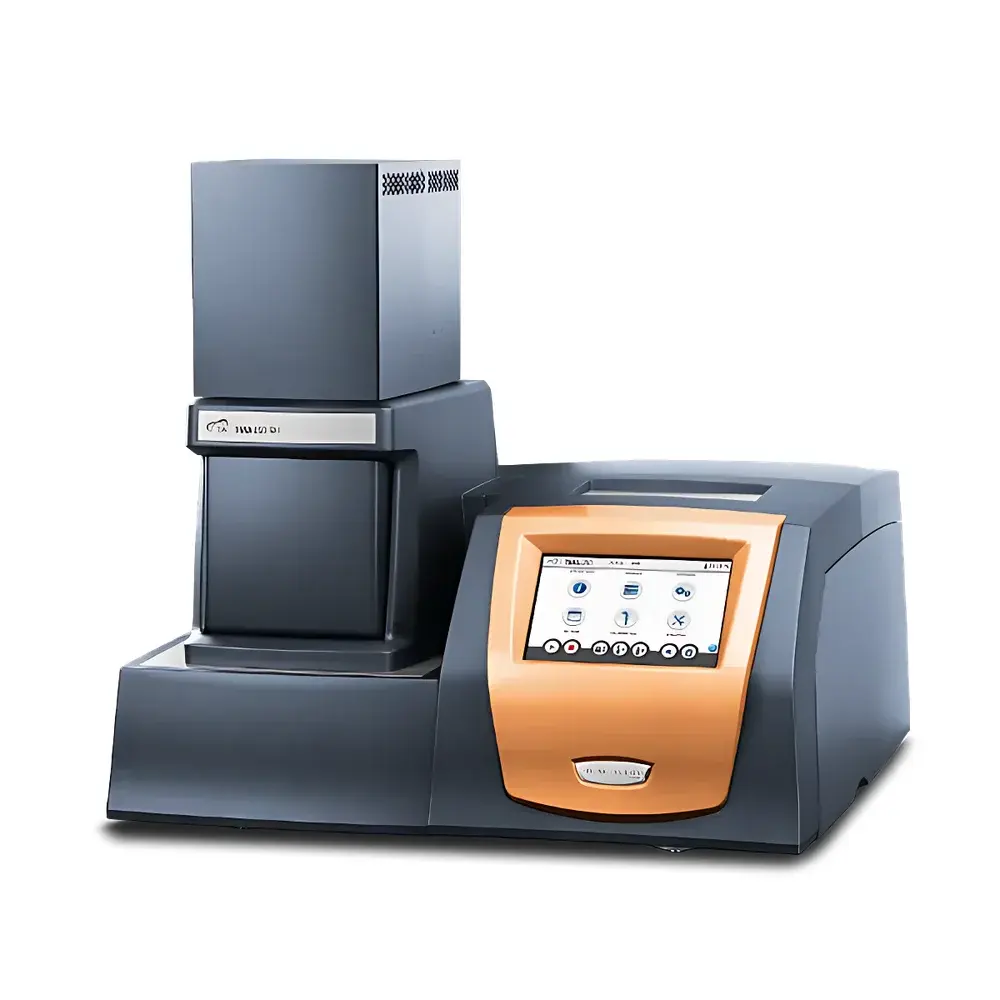
TA Instruments Discovery TMA 450 RH Thermomechanical Analyzer
| Brand | TA Instruments |
|---|---|
| Origin | USA |
| Model | Discovery TMA 450 RH |
| Instrument Type | Thermomechanical Analyzer (TMA) |
| Temperature Range | −150 to 1000 °C |
| Temperature Accuracy | ±1 °C |
| Force Range | 0.001–2 N |
| Frequency Range | 0.01–2 Hz |
Overview
The TA Instruments Discovery TMA 450 RH is a high-precision, humidity-controlled thermomechanical analyzer engineered for quantitative measurement of dimensional changes in solid and semi-solid materials under controlled thermal, mechanical, and environmental conditions. Operating on the fundamental principle of contact-based probe displacement detection—where a low-mass, non-contact linear motor applies precisely regulated axial force while a high-resolution capacitive sensor tracks sample expansion, contraction, or penetration—the instrument delivers nanometer-scale resolution across extreme temperature excursions. Its integrated Relative Humidity (RH) control module enables dynamic vapor environment regulation from 0% to 95% RH at temperatures up to 200 °C, making it uniquely suited for studying hygroscopic swelling, moisture-induced phase transitions, plasticization effects, and time-dependent viscoelastic responses under realistic service conditions. Designed for rigorous R&D, quality control, and regulatory-compliant laboratories, the Discovery TMA 450 RH meets structural requirements for ISO 11359-2, ASTM E831, and USP for thermal expansion and softening behavior characterization.
Key Features
- Non-contact linear motor actuation delivering ultra-low force resolution (0.001 N) and high-force capability (up to 2 N), enabling consistent testing of compliant polymers, elastomers, gels, rigid composites, and ceramics without mechanical hysteresis or stiction artifacts.
- Capacitive displacement sensor with ±2.5 mm full-scale range and 15 nm resolution, supporting samples up to 26 mm in length—ideal for multi-segment thermal expansion profiling and localized transition detection.
- Modulated TMA (MTMA™) mode: superimposes small-amplitude oscillatory force on static load to separate reversible thermal expansion from irreversible creep or stress relaxation components, enhancing discrimination of α-, β-, and γ-transitions in amorphous and semi-crystalline systems.
- Integrated Mechanical Cooling Accessory (MCA 70): achieves stable cooling to −70 °C without liquid nitrogen, eliminating cryogen handling risks, storage constraints, and operational downtime associated with dewar refills.
- Five-year furnace warranty—the industry’s longest standard coverage—reflecting robust thermal design, precision-wound heating elements, and long-term calibration stability under repeated thermal cycling.
Sample Compatibility & Compliance
The Discovery TMA 450 RH accommodates diverse geometries—including rods, films, fibers, powders (in quartz crucibles), coatings on substrates, and encapsulated devices—via interchangeable probe fixtures (penetration, expansion, tension, bending). Its RH chamber supports standardized humidity ramping, isothermal holds, and step-change protocols compliant with ICH Q5C stability guidelines and ISO 4892-3 for accelerated aging simulations. Data acquisition and metadata logging conform to FDA 21 CFR Part 11 requirements when deployed with TRIOS software in audit-trail-enabled mode, supporting GLP/GMP environments where traceability, electronic signatures, and version-controlled method files are mandatory.
Software & Data Management
TRIOS software serves as the unified platform for instrument control, real-time visualization, advanced data reduction, and regulatory-grade reporting. It provides preconfigured application methods—including CTE (coefficient of thermal expansion), glass transition (Tg), softening point, modulus profiling, and MTMA spectral analysis—with automated baseline correction, derivative peak identification, and ASTM/ISO-compliant calculation engines. All raw data are stored in vendor-neutral HDF5 format with embedded calibration coefficients, environmental metadata (temperature, RH, force, time), and user-defined annotations. Export options include CSV, XML, and PDF reports with customizable templates aligned to internal SOPs or external submission standards (e.g., regulatory dossiers, peer-reviewed publications).
Applications
- Quantifying coefficient of thermal expansion (CTE) mismatch in microelectronic packaging and PCB laminates to predict solder joint reliability.
- Evaluating moisture diffusion kinetics and equilibrium swelling ratios in hydrogels, food packaging films, and biodegradable polymers.
- Characterizing cure shrinkage and post-cure relaxation in thermosetting resins used in aerospace composites.
- Determining heat deflection temperature (HDT) and Vicat softening point under controlled humidity per ASTM D648 and ISO 306.
- Mapping viscoelastic transition spectra via MTMA for polymer blend compatibility assessment and filler dispersion analysis.
FAQ
What humidity ranges and temperature limits does the RH module support?
The RH module operates from 0% to 95% relative humidity at temperatures between 25 °C and 200 °C; below 25 °C, condensation risk limits lower RH setpoints unless active dew-point control is enabled.
Can the Discovery TMA 450 RH perform dynamic mechanical tests like DMA?
No—it is not a dynamic mechanical analyzer; however, its MTMA™ and creep/stress-relaxation modes provide complementary time–temperature–force insights into viscoelastic behavior distinct from oscillatory strain-controlled DMA.
Is liquid nitrogen required for sub-ambient operation?
Not for operation down to −70 °C; the MCA 70 eliminates LN2 dependency. For extended cooling to −150 °C, optional liquid nitrogen cooling is available with appropriate safety interlocks and vapor management.
How is calibration traceability maintained?
Each system ships with NIST-traceable reference materials (indium, aluminum, and fused silica) and an automated calibration routine that verifies temperature, force, and displacement accuracy prior to every test sequence.
Does TRIOS support automated method transfer between instruments?
Yes—TRIOS uses portable method files (.triosm) that retain all instrument-specific parameters, calibration references, and report formatting, enabling seamless deployment across labs and instrument generations.



