
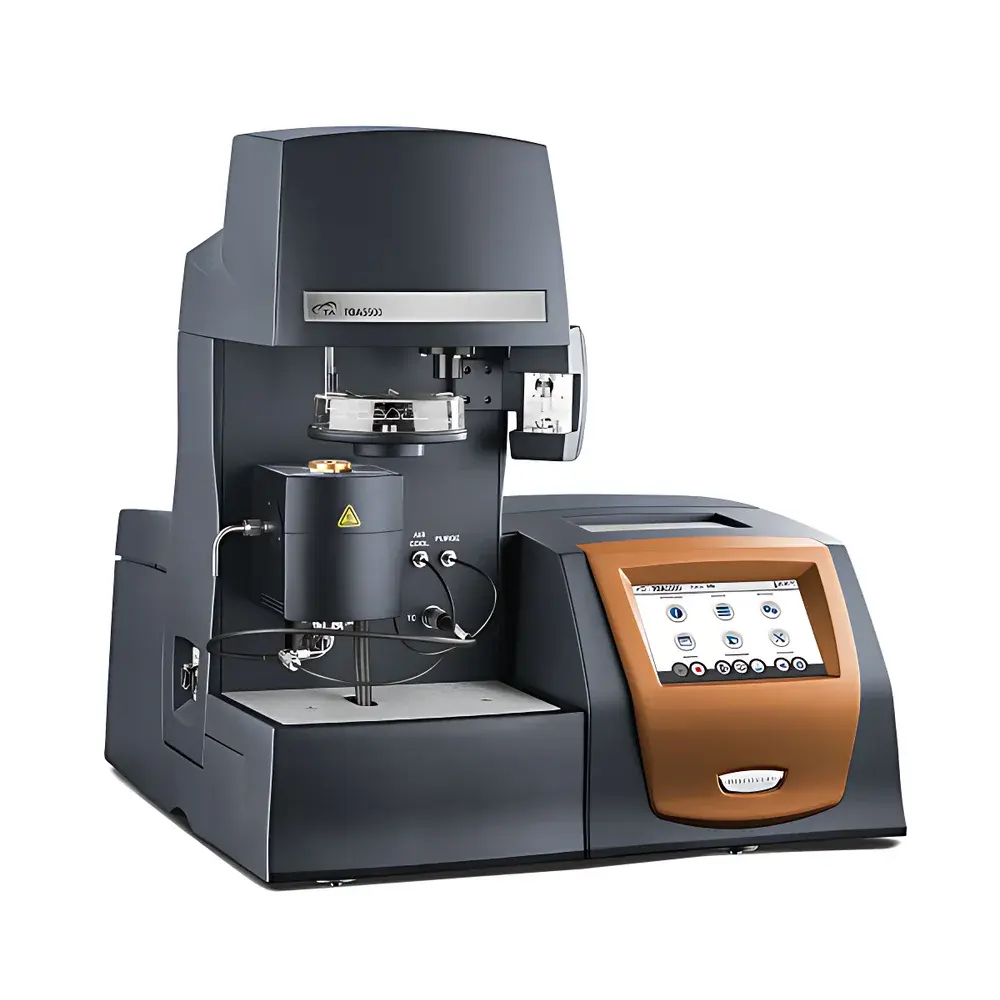
TA Instruments Discovery TGA 5500 Thermogravimetric Analyzer
| Brand | TA Instruments |
|---|---|
| Origin | USA |
| Model | Discovery TGA 5500 |
| Temperature Range | Ambient to 1200 °C |
| Balance Sensitivity | < 0.1 µg |
| Heating/Cooling Rate | 0.1 to 500 °C/min |
| Maximum Sample Mass | 1 g |
| Baseline Drift | < 10 µg |
Overview
The TA Instruments Discovery TGA 5500 is a high-performance thermogravimetric analyzer engineered for precision mass-change measurement as a function of temperature or time under controlled atmospheric conditions. It operates on the fundamental principle of monitoring real-time mass variation during thermal treatment—enabling quantitative analysis of decomposition, oxidation, volatilization, hydration/dehydration, and compositional changes in solid and liquid samples. Designed for research laboratories, quality control environments, and regulatory-compliant production facilities, the TGA 5500 integrates a high-stability microbalance with advanced furnace architecture and gas flow management to deliver exceptional resolution, reproducibility, and thermal fidelity across its full operating range (ambient to 1200 °C). Its modular design supports seamless integration with evolved gas analysis (EGA) systems—including FTIR and MS—facilitating comprehensive mechanistic interpretation of thermal events.
Key Features
- Ultra-high-sensitivity balance with < 0.1 µg resolution and < 10 µg baseline drift over extended runs—ensuring detection of minute mass changes in low-mass or high-thermal-stability samples.
- Programmable heating and cooling rates from 0.1 to 500 °C/min, enabling both conventional stepwise analysis and rapid screening protocols without hardware modification.
- Patented Q5000 IR furnace technology delivering uniform axial temperature gradients (< ±0.5 °C over 25 mm), critical for accurate kinetic modeling and ASTM E1641-compliant activation energy calculations.
- Automated sample loading via the AutoQ™ sample changer (optional), supporting unattended operation for up to 25 samples with integrated calibration verification before each run.
- Dual-gas manifold with independent mass flow controllers (MFCs) for precise, programmable switching between inert (N₂, Ar), oxidative (air, O₂), and reactive (H₂, CO) atmospheres—including dynamic gas composition ramping.
- Hermetically sealed balance enclosure with active vibration isolation and electromagnetic shielding to minimize environmental interference in shared lab spaces.
Sample Compatibility & Compliance
The Discovery TGA 5500 accommodates standard platinum, alumina, and silica crucibles (including hermetic and vented configurations), as well as proprietary Tzero™ pans for enhanced thermal contact and baseline stability. It supports powders, films, fibers, granules, and viscous liquids—provided mass remains within the 1 g maximum limit and thermal expansion does not compromise crucible integrity. The system complies with key international standards including ASTM E1131 (composition determination), ASTM E1641 (kinetic parameter derivation), ISO 11358 (polymer thermal degradation), and USP (residual solvents in pharmaceuticals). Full audit trail, electronic signatures, and 21 CFR Part 11–compliant data security are enabled through TRIOS software when deployed in GLP/GMP-regulated environments.
Software & Data Management
TRIOS Software provides an integrated platform for instrument control, real-time visualization, and advanced post-processing—including derivative thermogravimetry (DTG), multi-step kinetic modeling (e.g., Friedman, Ozawa-Flynn-Wall), and comparative overlay of up to 32 curves. Raw data are stored in secure, timestamped .tga binary format with embedded metadata (operator ID, method file hash, calibration history). Export options include CSV, Excel, and PDF reports with customizable templates aligned to internal SOPs or regulatory submission requirements. Data integrity is reinforced via role-based access control, automated backup to network drives, and optional cloud synchronization with encrypted TLS 1.2 transmission.
Applications
- Quantification of filler content (e.g., carbon black, CaCO₃) and polymer matrix degradation in composites per ISO 3451.
- Residual solvent analysis and moisture loss profiling in active pharmaceutical ingredients (APIs) and excipients.
- Oxidative induction time (OIT) determination for polyolefins per ASTM D3895.
- Thermal stability assessment of battery cathode materials (e.g., NMC, LFP) under air and argon atmospheres.
- Decomposition kinetics of catalysts, metal-organic frameworks (MOFs), and energetic materials.
- Char yield evaluation in flame-retardant formulations and carbonization behavior of precursors for C/C composites.
FAQ
What is the recommended calibration frequency for the TGA 5500 balance?
Balance calibration is performed automatically at startup and before each scheduled run when AutoCal™ is enabled; manual recalibration is advised after major maintenance or if baseline drift exceeds specification thresholds.
Can the TGA 5500 operate under vacuum?
Yes—the system supports vacuum operation down to 10⁻² mbar using optional vacuum pump integration and compatible crucibles with hermetic lids.
Is the furnace temperature accuracy traceable to NIST standards?
Temperature calibration utilizes NIST-traceable reference materials (e.g., Ni, Cu, Al, KCl), and certificate documentation is generated per run when calibration mode is activated.
How does the TGA 5500 handle moisture-sensitive samples?
An integrated dry gas purge (with optional desiccant trap) and glove-box-compatible sample loading station minimize ambient moisture exposure prior to analysis.
Does TRIOS software support IQ/OQ/PQ documentation?
Yes—validated installation qualification (IQ), operational qualification (OQ), and performance qualification (PQ) protocols are available as part of the TA Instruments GxP Validation Package.



