
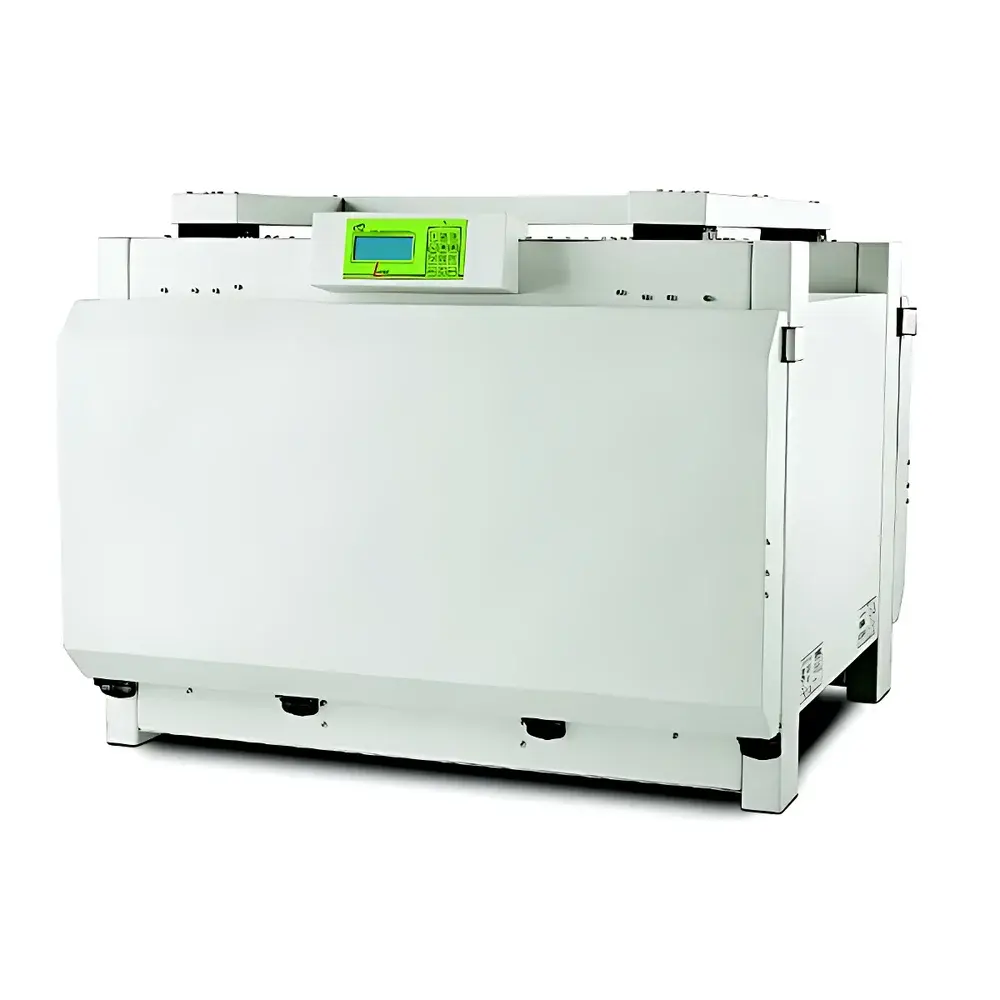
TA Instruments FOX 801 Heat Flow Meter Thermal Conductivity Analyzer
| Brand | TA Instruments |
|---|---|
| Origin | Shanghai, China |
| Manufacturer Type | Authorized Distributor |
| Origin Category | Imported Instrument |
| Model | FOX 801 |
| Price | Upon Request |
| Thermal Conductivity Range | 0.001–0.35 W/m·K |
| Accuracy | ±1% |
| Temperature Range | −10 to +65 °C |
| Thickness Measurement Resolution | 0.025 mm |
| Sensor Type | Dual Thin-Film Heat Flux Sensors |
| Compliance | ASTM C518, ISO 8301 |
| Cooling/Heating Method | Solid-State Peltier |
| Control Mode | Standalone or PC-Driven (WinTherm Software) |
| Optional Accessories | Automated Sample Changer, Rotational Sample Holder |
Overview
The TA Instruments FOX 801 Heat Flow Meter (HFM) is a precision thermal conductivity analyzer engineered for reliable, repeatable measurement of low-to-moderate conductivity materials under steady-state conditions. Based on the guarded hot plate principle—adapted into a compact, dual-sensor heat flow meter configuration—the FOX 801 quantifies thermal conductivity (λ) by measuring the heat flux across a stationary, uniformly compressed sample sandwiched between two temperature-controlled plates. This method satisfies the fundamental requirements of ASTM C518 and ISO 8301 for flat, homogeneous, isotropic insulating materials. The instrument employs proprietary thin-film heat flux sensors with integrated thermopile arrays, enabling high signal-to-noise ratio detection even at low thermal gradients. Its solid-state Peltier-based heating and cooling system ensures stable, programmable temperature control from −10 °C to +65 °C, supporting both ambient and sub-ambient testing without external chillers. Designed for laboratory and quality assurance environments, the FOX 801 delivers traceable, GLP-compliant data suitable for material qualification, R&D benchmarking, and regulatory submissions.
Key Features
- Dual thin-film heat flux sensors with factory-calibrated sensitivity and long-term drift stability
- Automated digital thickness measurement with 0.025 mm resolution, synchronized with load application to minimize compressive error
- Independent operation via built-in touchscreen interface or full PC integration using WinTherm software
- Modular front- and rear-access doors enabling longitudinal sample evaluation up to 1.2 m in length—ideal for uncutable vacuum insulation panels (VIPs), continuous fiberglass batts, or large-area aerogel composites
- Peltier-driven temperature control with active gradient compensation, eliminating reliance on water baths or external refrigeration units
- Optional automated sample changer (ASC) supporting unattended sequential testing of up to 24 specimens per run
- Rotational sample holder accessory for angular anisotropy mapping of directionally aligned insulators (e.g., mineral wool, bio-based fiber mats)
Sample Compatibility & Compliance
The FOX 801 accommodates rigid, semi-rigid, and flexible low-conductivity solids—including mineral wool, expanded polystyrene (EPS), polyisocyanurate (PIR), phenolic foams, silica aerogels, and vacuum-insulated panels—with nominal dimensions up to 305 mm × 305 mm × 50 mm (standard platen size). Its low-force compression mechanism preserves microstructure integrity in delicate VIPs and nano-porous matrices. All measurements adhere strictly to the procedural rigor defined in ASTM C518 (“Standard Test Method for Steady-State Thermal Transmission Properties by Means of the Heat Flow Meter Apparatus”) and ISO 8301 (“Thermal Insulation — Determination of Steady-State Thermal Resistance and Related Properties — Heat Flow Meter Apparatus”). System validation includes NIST-traceable reference material calibration (e.g., SRM 1450c Fibrous Glass Board), and raw data files retain full audit trails required for FDA 21 CFR Part 11 and ISO/IEC 17025 compliance.
Software & Data Management
WinTherm software provides comprehensive instrument control, real-time thermal gradient visualization, and automated report generation in PDF or CSV formats. It supports multi-parameter trending (conductivity vs. mean temperature, thickness, or density), statistical process control (SPC) charting, and batch-level uncertainty propagation per GUM (Guide to the Expression of Uncertainty in Measurement). All test sequences are timestamped and user-logged; electronic signatures, role-based access controls, and immutable data archiving meet GLP/GMP documentation standards. Raw sensor voltage, temperature setpoints, and thickness displacement values are stored in open ASCII format for third-party analysis or LIMS integration.
Applications
- Quality control of commercial insulation products against ASTM C1289 and EN 14323 specifications
- R&D screening of next-generation aerogel composites and phase-change material (PCM)-integrated boards
- Thermal performance certification of building envelope components per ASHRAE 90.1 and ISO 6946
- Anisotropy characterization of oriented fiber insulation under variable orientation angles
- Low-temperature thermal resistance validation for cryogenic packaging and cold-chain logistics materials
- Long-term aging studies tracking λ-drift in hygroscopic or UV-exposed specimens
FAQ
Does the FOX 801 require external cooling water or refrigerant?
No—it uses solid-state Peltier modules for both heating and cooling, eliminating dependency on chilled water loops or Freon-based systems.
Can it measure materials with thermal conductivity above 0.35 W/m·K?
The FOX 801 is optimized for low-conductivity insulators; higher-conductivity metals or ceramics fall outside its validated range and require a guarded hot plate (e.g., FOX 50) or laser flash analyzer.
Is WinTherm software compliant with 21 CFR Part 11?
Yes—when deployed with configured electronic signatures, audit trail logging, and secure user authentication, WinTherm satisfies predicate rule requirements for regulated environments.
What sample thickness accuracy is achievable during automated compression?
Digital micrometer feedback enables reproducible thickness determination to ±0.025 mm, critical for minimizing compressive error in soft or compressible specimens.
How does the dual-sensor architecture improve measurement robustness?
Symmetric placement eliminates parasitic lateral heat loss effects and enables real-time cross-validation of heat flux signals, enhancing repeatability across environmental fluctuations.



