
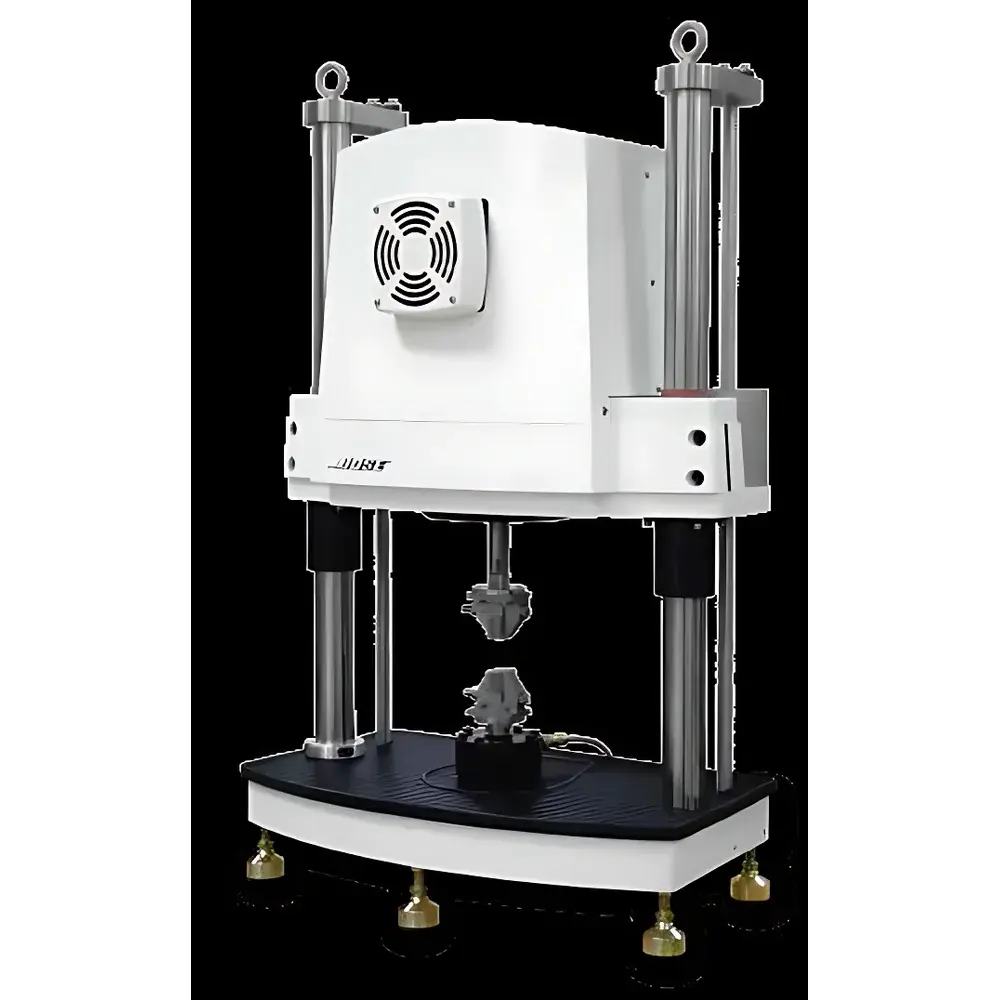
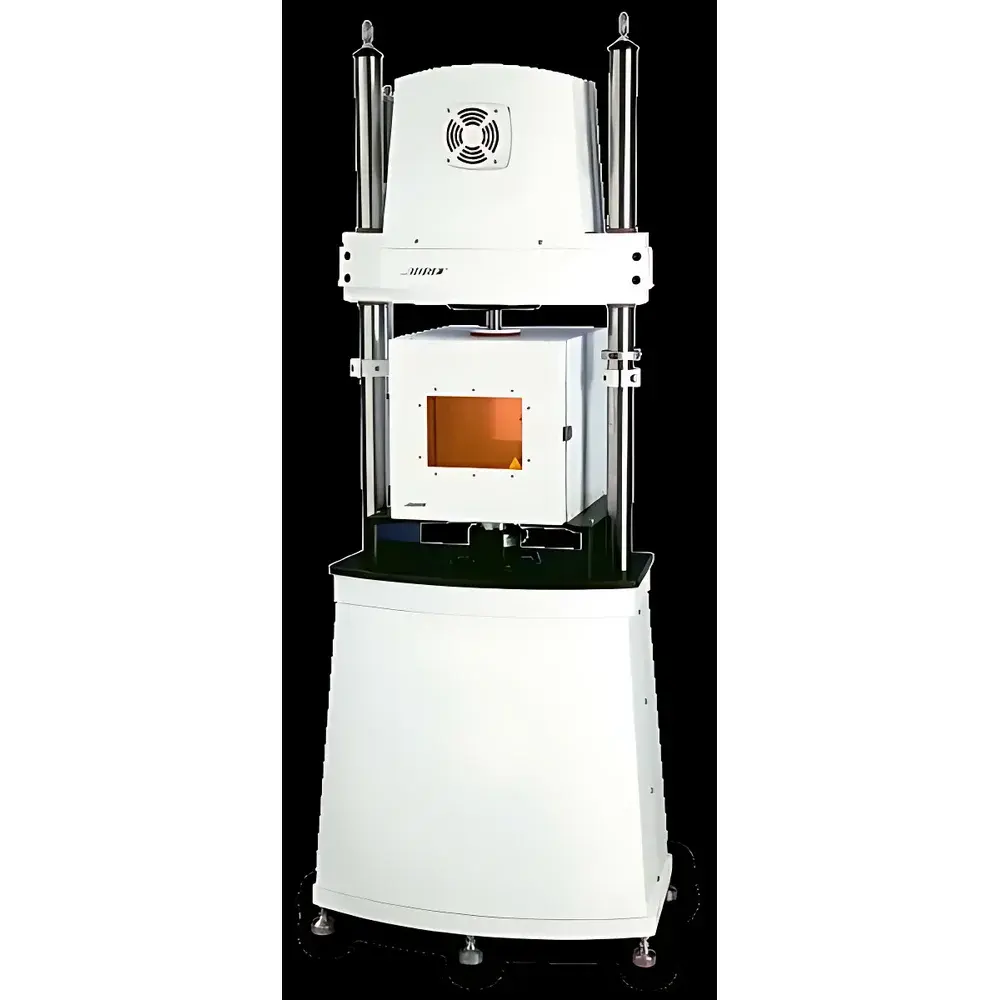
TA Instruments ElectroForce 3330 Dynamic Mechanical Testing System
| Brand | TA Instruments |
|---|---|
| Origin | USA |
| Model | 3330 |
| Instrument Type | Dynamic Mechanical Tester (DMA/DMTA-Compatible Platform) |
| Frequency Range | 0.00001–100 Hz |
| Maximum Dynamic Load | ±3000 N |
| Maximum Dynamic Torque (with optional torsion module) | 28 N·m |
| Configuration Options | Benchtop or Floor-standing |
| Power Requirement | Standard 220 V AC outlet |
| Pneumatic Interface | Compressed air supply required |
| Structural Design | Rigid dual-column beam architecture |
| Vertical Stroke Adjustment | Integrated pneumatic/electric/manual lift mechanism |
| Multi-Axis Capability | Optional torsion motor for axial-torsional coupling |
Overview
The TA Instruments ElectroForce® 3330 Dynamic Mechanical Testing System is a high-performance, servo-hydraulic-free electrodynamic platform engineered for precision-controlled mechanical characterization under static, quasi-static, and dynamic loading conditions. Unlike conventional thermal analysis-based DMA instruments, the 3330 operates on electromagnetic actuation principles—delivering force and displacement with exceptional linearity, low thermal drift, and zero fluid contamination risk. Its core architecture supports both uniaxial and multi-axial test configurations, making it uniquely suited for long-duration fatigue studies, viscoelastic property mapping, and time-dependent mechanical behavior assessment across biomedical, aerospace, and advanced materials domains. Designed to meet the stringent repeatability and traceability requirements of regulated laboratories, the system complies with ASTM E4, E8, E21, F2117, F2129, ISO 7500-1, ISO 13314, and ISO 14879-1 standards for force calibration, fatigue testing, and biomaterials evaluation.
Key Features
- Electrodynamic actuation system delivering high-fidelity force control from static to 100 Hz without hydraulic fluid or oil maintenance
- ±3000 N peak dynamic load capacity with sub-micron displacement resolution and <0.5% full-scale force linearity
- Modular frame design supporting benchtop or floor-standing installation; vertical test space adjustable via integrated pneumatic/electric lift
- Optional axial-torsional configuration enabled by add-on 28 N·m torsion motor—enabling coupled loading protocols per ASTM F2624 and ISO 14879-2
- Rigid dual-column beam structure minimizing frame compliance and ensuring measurement integrity during high-cycle fatigue (>10⁷ cycles)
- Native compatibility with environmental chambers (−70 °C to +300 °C), humidity control enclosures, and immersion baths for in-situ conditioning
- No external chiller, high-voltage supply, or dedicated utility infrastructure required—operates from standard 220 V AC and compressed air (6 bar)
Sample Compatibility & Compliance
The ElectroForce 3330 accommodates specimens ranging from millimeter-scale bone coupons and dental implants to full-size orthopedic fixation systems (e.g., spinal rods, locking plates) and automotive suspension components. Its universal grip interface supports custom fixture integration—including cryo-grips, saline-submerged fixtures, and articulating joint simulators. All hardware and firmware comply with ISO/IEC 17025 accreditation prerequisites for mechanical testing laboratories. Data acquisition meets FDA 21 CFR Part 11 requirements when paired with TA Instruments’ TRIOS software, including electronic signatures, audit trails, and role-based access control. System validation documentation (IQ/OQ/PQ) is available for GMP/GLP-regulated environments conducting ASTM F1800 (fatigue of orthopedic devices) or ISO 14242-1 (wear testing of hip/knee prostheses).
Software & Data Management
Control and analysis are performed using TA Instruments’ TRIOS software—a validated, Windows-based platform supporting method scripting, real-time FFT spectral analysis, hysteresis loop quantification, and master curve construction via time-temperature superposition (TTS). The software enables automated test sequencing across variable frequency, amplitude, and temperature ramps while maintaining full metadata capture (load cell calibration ID, environmental chamber logs, operator credentials). Raw data export is provided in ASTM E1436-compliant ASCII format, with native support for MATLAB, Python (via .csv/.xlsx), and LIMS integration through OPC UA and SQL database connectors. Audit trail records include timestamped parameter changes, user logins, and instrument state transitions—fully traceable for regulatory submissions.
Applications
- Fatigue life assessment of orthopedic implants per ASTM F2117 and ISO 14801
- Dynamic modulus and damping ratio (tan δ) determination of polymers, composites, and hydrogels under physiological loading frequencies
- Mechanical characterization of hard biological tissues—including cortical bone, dentin, and calcified cartilage—under cyclic compression, tension, and bending
- Multi-axial durability testing of spinal fusion constructs, total joint replacements, and craniofacial fixation plates
- High- and low-cycle fatigue analysis of aerospace alloys, elastomeric dampers, and automotive NVH components
- Fracture mechanics studies (e.g., crack propagation under sinusoidal loading) compliant with ASTM E647 and ISO 12135
- Dynamic stiffness and energy dissipation profiling of shock absorbers, bushings, and seismic isolators
FAQ
Is the ElectroForce 3330 classified as a DMA instrument?
No—it is a high-precision electrodynamic mechanical tester capable of performing DMA-like measurements (e.g., storage/loss modulus vs. frequency) but fundamentally distinct from thermal-analysis-based DMA systems. It measures mechanical response directly under controlled force/displacement, independent of thermal scanning.
What environmental chambers can be integrated with this system?
Standard options include −70 °C to +300 °C convection ovens, humidity-controlled enclosures (10–95% RH), and saline immersion baths with temperature regulation. Custom vacuum or gas-purged chambers are available upon request.
Does the system support ASTM-standard test methods out of the box?
Yes—TRIOS software includes preconfigured test templates for ASTM F2117 (orthopedic implant fatigue), ASTM E8/E21 (tensile/compression), and ISO 14879-1 (biomaterials torsion), all with embedded pass/fail criteria and report generation.
Can the 3330 perform creep and stress-relaxation tests?
Yes—its closed-loop displacement and load control architecture supports ISO 899-1 and ASTM D2990-compliant creep and stress-relaxation protocols with automatic hold duration, ramp rate, and recovery phase definition.
Is third-party calibration certification included?
TA Instruments provides NIST-traceable force calibration certificates with each system shipment. Optional annual recalibration services adhere to ISO/IEC 17025 and include uncertainty budgets per ISO 17025:2017 Annex A.3.



