
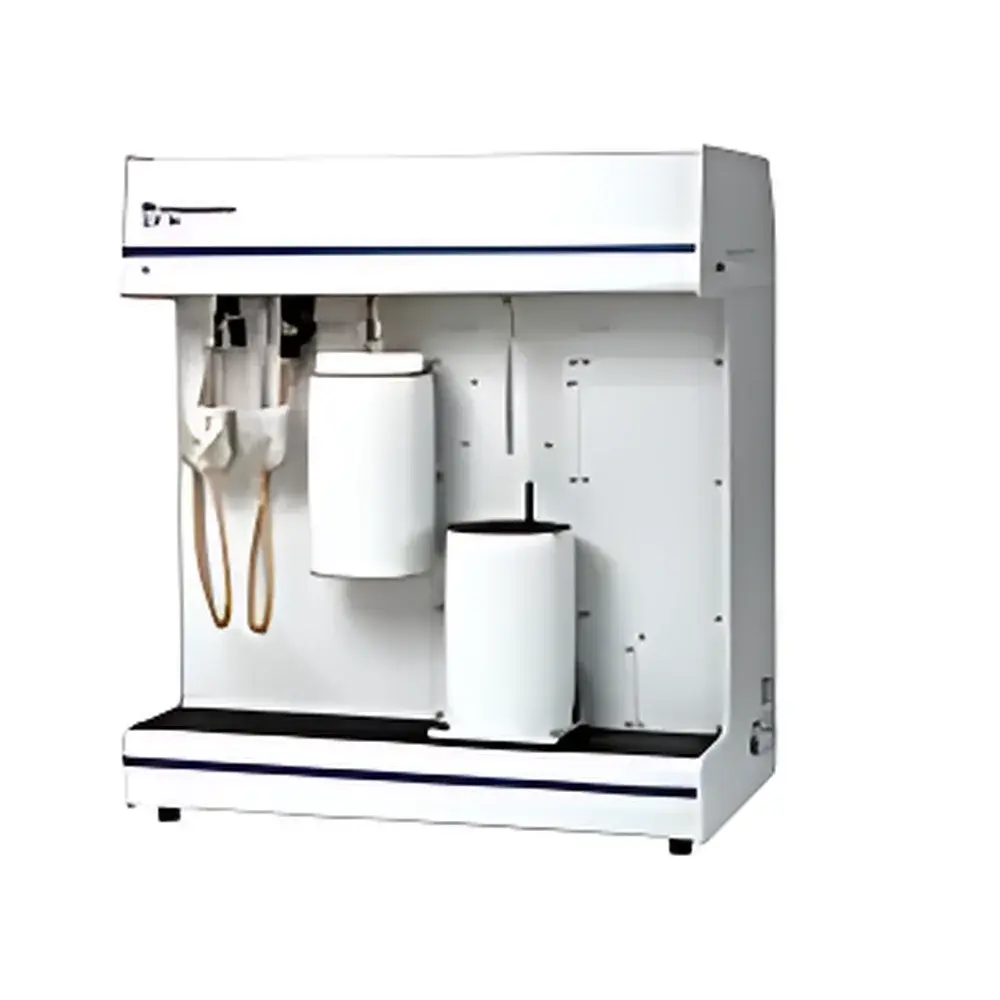
Micromeritics ASAP 2050 High Pressure Gas Adsorption Analyzer
| Brand | Micromeritics |
|---|---|
| Origin | USA |
| Manufacturer | Micromeritics Instrument Corporation |
| Model | ASAP 2050 |
| Measurement Principle | Volumetric (Manometric) High-Pressure Adsorption |
| Temperature Range | 20–120 °C (operational analysis range) |
| Pressure Range | 10⁻⁶ Torr to 10 atm (1.013 MPa) |
| Ultimate Vacuum | <1×10⁻⁶ Torr |
| Sample Tube Material | Stainless Steel (straight-walled, rated to 150 psi) |
| Degassing Control | Independent dual-station programmable heating (temperature ramp rate & hold time user-defined) |
| Optional Cooling | Liquid nitrogen or argon cryogenic Dewar |
Overview
The Micromeritics ASAP 2050 High Pressure Gas Adsorption Analyzer is an engineered platform for quantitative characterization of gas adsorption behavior under controlled thermodynamic conditions—specifically designed for research and quality control laboratories requiring rigorous measurement of physisorption and chemisorption isotherms at elevated pressures. Utilizing the volumetric (manometric) method, the instrument precisely measures gas uptake by monitoring pressure differentials in a calibrated reference volume against a sample-containing chamber, enabling high reproducibility across wide pressure ranges—from ultra-high vacuum (≤1×10⁻⁶ Torr) up to 10 atmospheres (1.013 MPa). Its dual independent vacuum systems allow concurrent sample preparation and analysis: two degas stations operate autonomously while the analysis manifold performs measurements—significantly reducing total experimental turnaround time without compromising thermal or pressure stability. The system’s stainless-steel straight-wall sample tubes are rated to 150 psi, supporting safe handling of reactive or volatile materials during both degassing and adsorption protocols.
Key Features
- Dual independent vacuum trains: Enables simultaneous degassing of two samples and real-time analysis on a third station—eliminating sequential bottlenecks.
- Programmable dual degas stations: Each station supports user-defined temperature ramps (0.1–10 °C/min), isothermal holds, and pressure-limited degassing to prevent sample decomposition or volatilization.
- High-fidelity pressure control: Equipped with high-resolution capacitance manometers and precision solenoid valves, delivering stable pressure regulation across seven decades (10⁻⁶ Torr to 7600 Torr).
- Thermal management flexibility: Compatible with liquid nitrogen or argon Dewars for cryogenic adsorption studies; also supports recirculating chillers for isothermal operation between 20–120 °C.
- Modular manifold architecture: The analysis manifold is fully isolated from degas lines, minimizing cross-contamination risk and ensuring baseline integrity during long-duration isotherm acquisition.
- Integrated safety interlocks: Overpressure protection, temperature cutoffs, and vacuum-loss detection conform to IEC 61000-6-2/6-4 electromagnetic compatibility and UL 61010-1 laboratory equipment safety standards.
Sample Compatibility & Compliance
The ASAP 2050 accommodates powders, granules, monoliths, and catalyst pellets in standardized 6–9 mm OD stainless-steel sample tubes. Its design complies with ASTM D3663 (Standard Test Method for Surface Area of Catalysts), ISO 9277 (Determination of specific surface area by gas adsorption using the BET method), and supports method development aligned with USP (Surface Area) and ICH Q5C (Stability Testing of Biotechnological Products). Data acquisition and reporting meet GLP/GMP traceability requirements through optional 21 CFR Part 11-compliant software modules, including electronic signatures, audit trails, and user-access controls.
Software & Data Management
Instrument control and data reduction are managed via Micromeritics’ proprietary NovaWin software—a Windows-based application supporting automated isotherm acquisition, multi-point Langmuir/BET/Dubinin–Astakhov modeling, and pore size distribution derivation using NLDFT and QSDFT kernel libraries. Reports are exportable in CSV, PDF, and XML formats; customizable templates enable lab-specific formatting for internal SOPs or regulatory submissions. Raw pressure–time datasets are stored with full metadata (gas type, temperature, equilibration criteria, valve states), ensuring full experimental reproducibility and compliance with FAIR (Findable, Accessible, Interoperable, Reusable) data principles.
Applications
- Characterization of porous carbons, MOFs, and zeolites for hydrogen or methane storage capacity assessment per DOE targets.
- CO₂ capture material screening under flue-gas-relevant partial pressures (0.1–1 atm CO₂).
- Catalyst support interaction studies via H₂ or CO chemisorption at elevated temperatures (up to 450 °C degas + 120 °C analysis).
- Pharmaceutical excipient moisture uptake profiling under controlled RH-equivalent gas environments.
- Geochemical modeling of shale gas adsorption isotherms using CH₄, C₂H₆, and CO₂ at reservoir-relevant P/T conditions.
FAQ
What gases can be used with the ASAP 2050?
Commonly employed gases include N₂, Ar, CO₂, CH₄, H₂, and Kr; compatibility with other non-corrosive, non-reactive gases is verified case-by-case per material safety and manifold seal integrity.
Does the system support dynamic breakthrough experiments?
No—the ASAP 2050 is optimized for equilibrium adsorption isotherm measurement; transient flow-through or TPD experiments require complementary instrumentation such as a TPD reactor or fixed-bed microreactor.
Can I perform low-pressure micropore analysis down to 10⁻⁷ Torr?
Yes—the base vacuum performance (<1×10⁻⁶ Torr) and optional turbomolecular pump upgrade enable sub-monolayer N₂ or Ar isotherms suitable for ultramicroporous material characterization.
Is calibration traceable to NIST standards?
All pressure transducers are factory-calibrated against NIST-traceable references; users may perform in-house verification using certified reference gases and volumetric standards per ISO/IEC 17025 guidelines.
How is data security handled in regulated environments?
With the optional Compliance Edition software, all analytical sessions generate immutable audit trails, role-based access logs, and encrypted database backups—fully aligned with FDA 21 CFR Part 11 and EU Annex 11 requirements.



