
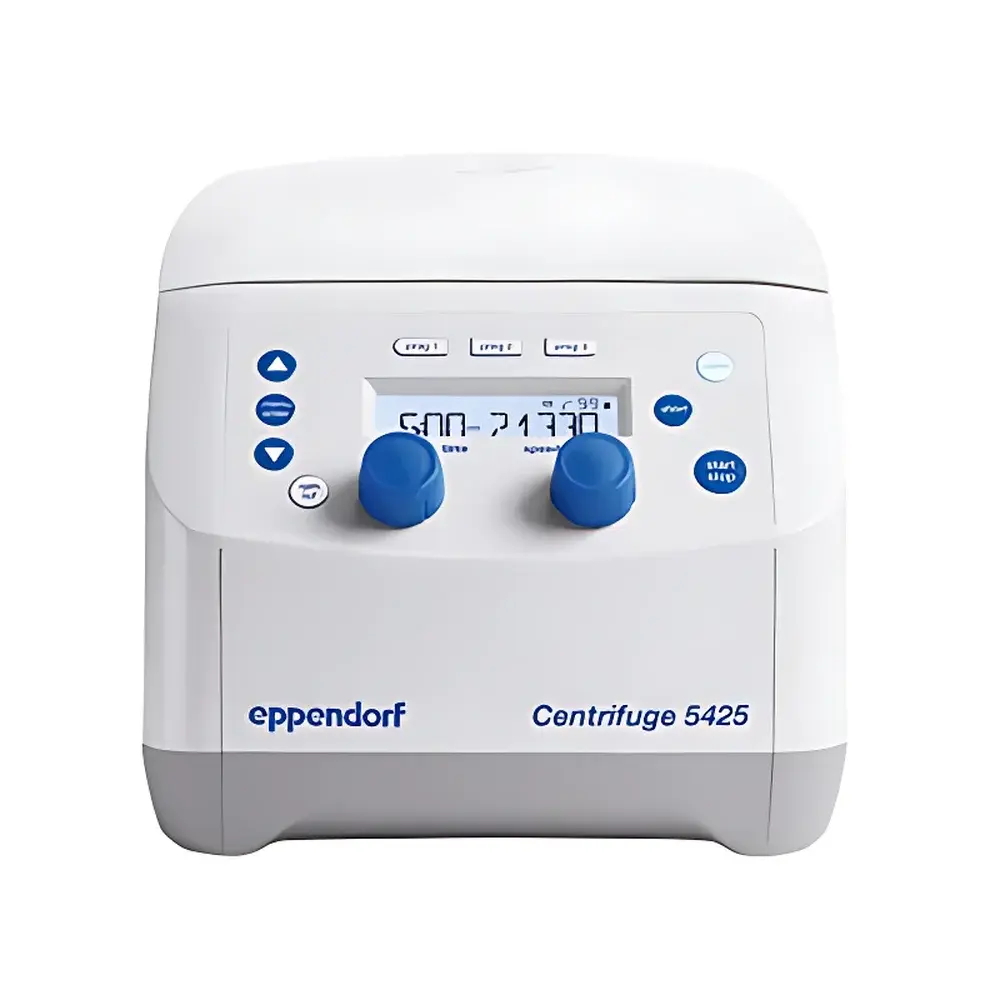
Eppendorf 5425 Compact High-Speed Centrifuge
| Brand | Eppendorf |
|---|---|
| Origin | Germany |
| Manufacturer Type | Original Equipment Manufacturer (OEM) |
| Import Status | Imported |
| Model | 5425 |
| Instrument Type | Benchtop Centrifuge |
| Category | High-Speed Centrifuge (10,000–30,000 rpm) |
| Function | General-Purpose Centrifuge |
| Configuration | Fixed-Angle Rotor Centrifuge |
| Separation Class | Biomacromolecules |
| Maximum Capacity | 10 × 5.0 mL |
| Maximum Speed | 15,060 rpm |
| Maximum RCF | 21,330 × g |
| Dimensions | 24 × 39 × 24 cm |
| Acoustic Noise Level | < 51 dB(A) |
| Rotor Recognition | Yes (5.0 mL fixed-angle rotor, PCR swing-bucket rotor) |
| Acceleration/Deceleration Programs | 10-step selectable |
| Quick-Start Function | Short-spin mode with single-button activation |
| Lid Mechanism | Eppendorf QuickLock® fast-locking system |
| Lid Opening | Automatic post-run opening |
| Safety Certification | Third-party validated hermetic rotor sealing |
Overview
The Eppendorf 5425 Compact High-Speed Centrifuge is an engineered solution for laboratories requiring high-performance, space-efficient separation of biomacromolecules—including nucleic acids, proteins, and subcellular organelles—under reproducible, controlled conditions. Based on fixed-angle rotor centrifugation physics, it delivers precise sedimentation forces governed by rotational speed (rpm), rotor radius, and sample density gradients. Its design prioritizes operational integrity in molecular biology workflows where consistent RCF (relative centrifugal force) application, thermal management, and biosafety are non-negotiable. With a maximum RCF of 21,330 × g at 15,060 rpm and compatibility with standard microtubes (1.5/2.0 mL) and conical tubes (5.0 mL), the 5425 bridges the performance gap between compact benchtop units and larger floor-standing systems—without compromising on regulatory readiness or ergonomic fidelity.
Key Features
- Eppendorf QuickLock® lid mechanism enables one-handed, tool-free rotor access with tactile feedback and secure mechanical engagement—reducing user fatigue during high-throughput runs.
- OptiBowl® acoustic enclosure design minimizes airborne vibration transmission, achieving < 51 dB(A) noise emission even during full-speed operation—critical for open-lab environments and shared core facilities.
- Automatic lid opening post-run prevents heat accumulation in rotor chambers and accelerates sample retrieval, supporting workflow continuity and minimizing thermal denaturation risk for temperature-sensitive analytes.
- Integrated rotor recognition system validates installed rotor type (e.g., FA-45-24-11 fixed-angle rotor for 24 × 1.5/2.0 mL; FA-50-10-5 for 10 × 5.0 mL) before run initiation—preventing mismatched speed/RCF errors and ensuring compliance with ISO 22870:2021 requirements for pre-analytical equipment validation.
- Programmable acceleration/deceleration profiles (10 discrete steps) allow fine-tuned control over pelleting kinetics—essential for fragile precipitates or viscous lysates where abrupt braking may cause resuspension.
- Hermetically sealed rotors certified by independent third-party testing (e.g., DIN EN 61000-6-3, IEC 61010-2-020) meet biosafety level 2 (BSL-2) containment standards for centrifuging infectious or hazardous biological materials.
Sample Compatibility & Compliance
The 5425 supports standardized consumables across major global suppliers: Eppendorf Safe-Lock™ tubes (1.5/2.0 mL), polypropylene conical tubes (5.0 mL), and PCR strip-compatible swing-bucket rotors. All rotors comply with ISO 13485:2016 for medical device manufacturing quality systems and undergo routine validation per CLSI EP17-A2 for centrifugal recovery efficiency. The instrument’s firmware architecture supports audit-trail generation for GLP/GMP-aligned labs, including timestamped run logs, rotor usage counters, and error event history—all exportable via USB interface for 21 CFR Part 11-compliant documentation when paired with validated LIMS integration.
Software & Data Management
No external PC is required: onboard controls provide intuitive parameter entry via rotary encoder and LED status display. Ten programmable methods store speed, time, RCF, acceleration/deceleration ramps, and short-spin presets. Run data—including actual vs. setpoint RCF, cumulative rotor hours, and thermal drift compensation values—is retained in non-volatile memory. Export-ready CSV logs support traceability in ISO/IEC 17025-accredited testing laboratories. Optional Eppendorf VisioNize Lab Suite connectivity enables remote monitoring and fleet-wide calibration status tracking—aligned with laboratory digitalization frameworks such as ISO/IEC 20000-1.
Applications
- Plasmid DNA purification via alkaline lysis followed by silica-membrane binding and elution.
- Clarification of bacterial lysates prior to affinity chromatography or SDS-PAGE analysis.
- Microvesicle and exosome isolation from cell culture supernatants using differential ultracentrifugation protocols (adapted for 5.0 mL tube formats).
- Routine PCR product cleanup and enzymatic reaction termination via ethanol precipitation.
- Preparative separation of ribosomal subunits and protein complexes under native buffer conditions.
- Quality control of biopharmaceutical intermediates, including host-cell protein removal verification per ICH Q5A(R2).
FAQ
Is the Eppendorf 5425 compliant with FDA 21 CFR Part 11 for electronic records?
Yes—when used with validated software modules (e.g., VisioNize Lab Suite v3.2+) and configured with user authentication, audit trail logging, and electronic signature capability.
Can the 5425 accommodate 15 mL conical tubes?
No—its rotor portfolio is optimized for 1.5/2.0 mL microcentrifuge tubes and 5.0 mL conical tubes only. For larger volumes, consider the Eppendorf 5810 R or 5430 platforms.
Does the automatic lid opening function activate after every run?
Yes—by default, unless manually disabled via service mode; this behavior is hard-coded to ensure thermal safety and is not subject to user override in standard operation.
What third-party certifications validate the hermetic seal of the rotors?
Rotors carry TÜV SÜD certification per EN 61010-2-020 Annex BB for containment integrity under maximum rated speed and load conditions.
How frequently does the 5425 require preventive maintenance?
Eppendorf recommends biannual inspection by authorized service personnel, including bearing wear assessment, rotor corrosion screening, and calibration verification against NIST-traceable tachometers.



