
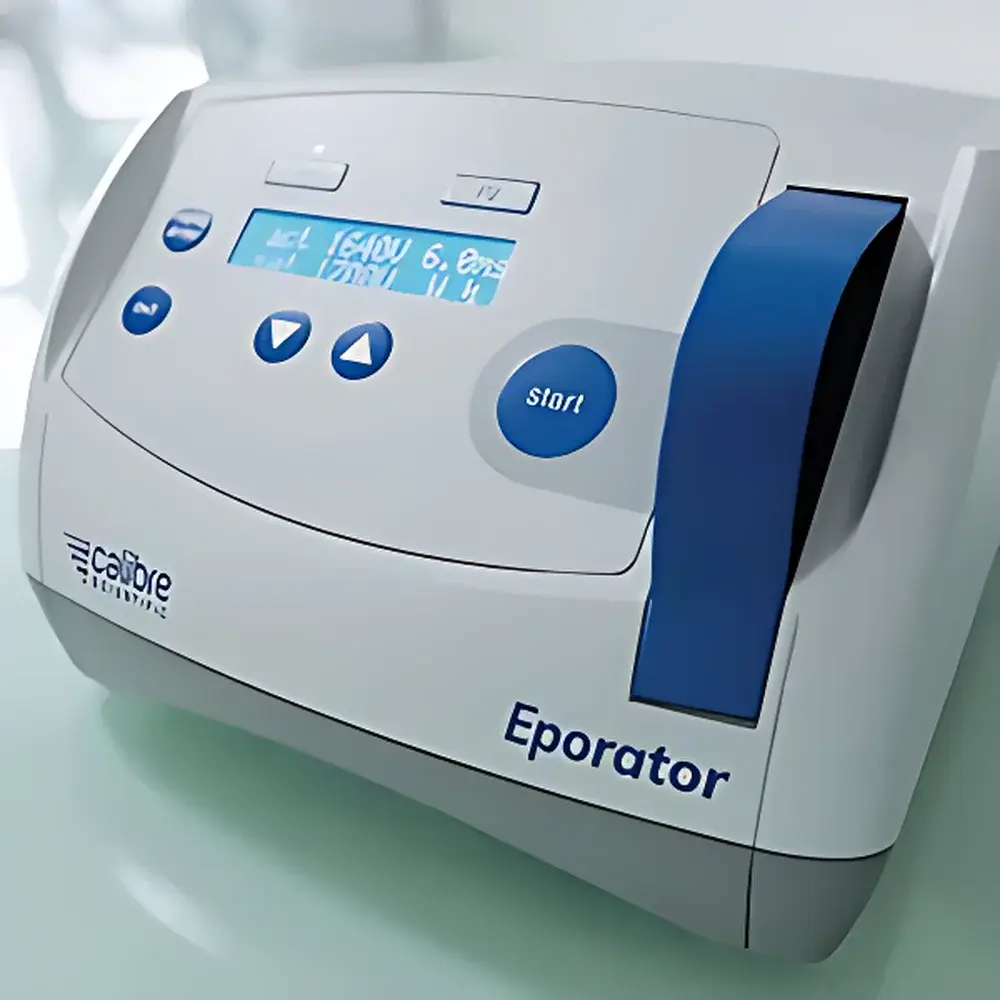
Calibre Eporator Electroporator
| Brand | Calibre |
|---|---|
| Origin | Germany |
| Model | Eporator |
| Voltage Presets | P1 = 1700 V, P2 = 2500 V |
| Display | Color LCD Interface |
| Safety | Integrated Electrode Slot with Leakage Protection |
| Compliance | GLP-Compliant Data Logging via USB |
| Dimensions | Compact Benchtop Form Factor |
| Regulatory Status | Import-Class Life Science Instrument for Transfection and Cell Fusion Applications |
Overview
The Calibre Eporator Electroporator is a precision-engineered benchtop instrument designed for high-efficiency nucleic acid delivery into prokaryotic and eukaryotic cells via electroporation. Operating on the principle of transient membrane permeabilization through controlled high-voltage electrical pulses, the Eporator enables reproducible DNA, RNA, or plasmid introduction into competent Escherichia coli, Bacillus subtilis, Saccharomyces cerevisiae, and other microbial systems. Unlike chemical transfection methods—such as calcium phosphate or lithium acetate protocols—the Eporator delivers superior transformation efficiency (often exceeding 10⁹–10¹⁰ CFU/µg plasmid DNA in optimized E. coli strains) and significantly improved inter-experimental reproducibility. Its pulse delivery architecture adheres to fundamental electroporation theory: membrane capacitance discharge kinetics are governed by field strength (V/cm), pulse duration (typically 5–25 ms), and conductivity of the electroporation buffer. The Eporator’s fixed-pulse design eliminates variable capacitance charging artifacts common in capacitor-based analog systems, ensuring consistent energy delivery across repeated runs.
Key Features
- Single-button operation with intuitive parameter selection—users choose between preconfigured voltage presets (P1 = 1700 V, P2 = 2500 V) or manually enter custom voltage settings
- High-contrast color LCD display providing real-time status feedback—including pulse confirmation, error codes, and elapsed time—to minimize operator missteps
- Dual programmable memory keys (P1/P2) for rapid recall of frequently used protocols; default configurations align with established electroporation standards for E. coli DH5α and S. cerevisiae BY4741
- Integrated electrode slot with mechanical interlock and current-limiting circuitry, preventing accidental activation without proper cuvette insertion and eliminating risk of stray discharge or user exposure
- Compact footprint (≤200 × 150 × 120 mm) engineered for space-constrained biosafety cabinets and shared core facility environments
- USB 2.0 interface supporting GLP-compliant data export: timestamped pulse logs (voltage, capacitance, resistance, arcing detection flags) are saved as CSV files for audit-ready documentation
Sample Compatibility & Compliance
The Eporator is validated for use with standard 0.1 cm and 0.2 cm gap electroporation cuvettes (e.g., Bio-Rad, Harvard Apparatus, or Eppendorf certified formats). It supports bacterial species including E. coli, Pseudomonas aeruginosa, and Lactococcus lactis, as well as yeast models such as S. cerevisiae, Schizosaccharomyces pombe, and Candida albicans. While not intended for mammalian cell electroporation (which typically requires lower field strengths and exponential decay waveforms), its fixed square-wave output is optimized for microbial electropermeabilization per ISO/IEC 17025-aligned laboratory practices. The device meets IEC 61010-1:2012 safety requirements for electrical equipment used in laboratory environments and incorporates firmware-level safeguards compliant with EU Directive 2014/30/EU (EMC) and 2014/35/EU (LVD). All exported data files retain immutable timestamps and session identifiers, satisfying traceability requirements under FDA 21 CFR Part 11 for electronic records in regulated bioprocessing labs.
Software & Data Management
No proprietary software installation is required. The Eporator functions as a USB mass-storage class device: upon connection to a Windows, macOS, or Linux host, it appears as a removable drive containing dated subfolders (e.g., “2024-06-15_Eporator_Logs”). Each session generates a structured CSV file listing pulse number, applied voltage, measured resistance (Ω), detected arcing events, and system temperature at initiation. These logs integrate seamlessly with LIMS platforms via automated ingestion scripts or manual import into Excel, GraphPad Prism, or Python-based analysis pipelines. Audit trails include firmware version (v2.3+), serial-number-stamped entries, and write-protected file attributes—ensuring compliance with GLP documentation standards for method validation and QC record retention.
Applications
- Routine plasmid transformation in cloning workflows, especially for large constructs (>10 kb) where chemical methods exhibit diminishing returns
- High-throughput strain engineering in synthetic biology pipelines requiring consistent transformation across hundreds of variants
- Yeast two-hybrid library construction and CRISPR-Cas9 editing in S. cerevisiae with minimal background colony formation
- Preparation of electrocompetent cell stocks for centralized core facilities—enabling standardized, operator-independent preparation protocols
- Teaching laboratories: robust design and visual feedback support pedagogical demonstration of membrane biophysics principles
FAQ
What cuvette gap sizes are supported by the Eporator?
The instrument accepts standard 0.1 cm and 0.2 cm gap electroporation cuvettes with gold-plated electrodes; compatibility has been verified with cuvettes meeting DIN EN 61000-4-2 specifications.
Does the Eporator support adjustable pulse duration or exponential decay waveforms?
No—it delivers fixed-duration square-wave pulses optimized for microbial applications; variable waveform control is outside its design scope and intended use case.
Can the USB log files be imported directly into ELN systems?
Yes—CSV-formatted logs contain ISO 8601 timestamps and machine-readable metadata, enabling automated parsing by most modern electronic lab notebook platforms.
Is calibration required prior to use?
The Eporator undergoes factory calibration per ISO/IEC 17025-accredited procedures; no user-performed calibration is necessary, though annual verification using a certified high-voltage probe is recommended for GLP environments.
What safety certifications does the device hold?
It complies with IEC 61010-1:2012 (Safety Requirements for Electrical Equipment for Measurement, Control, and Laboratory Use) and carries CE marking under the Low Voltage and EMC Directives.





