
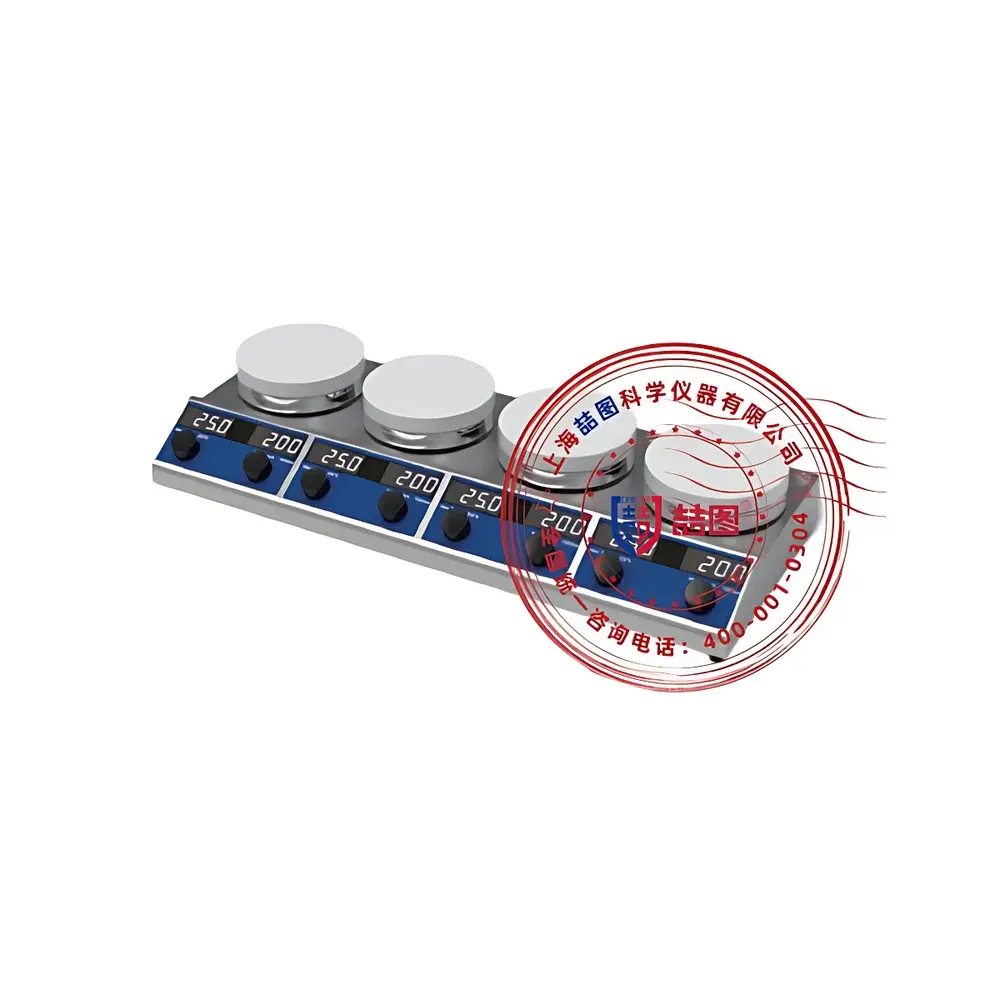
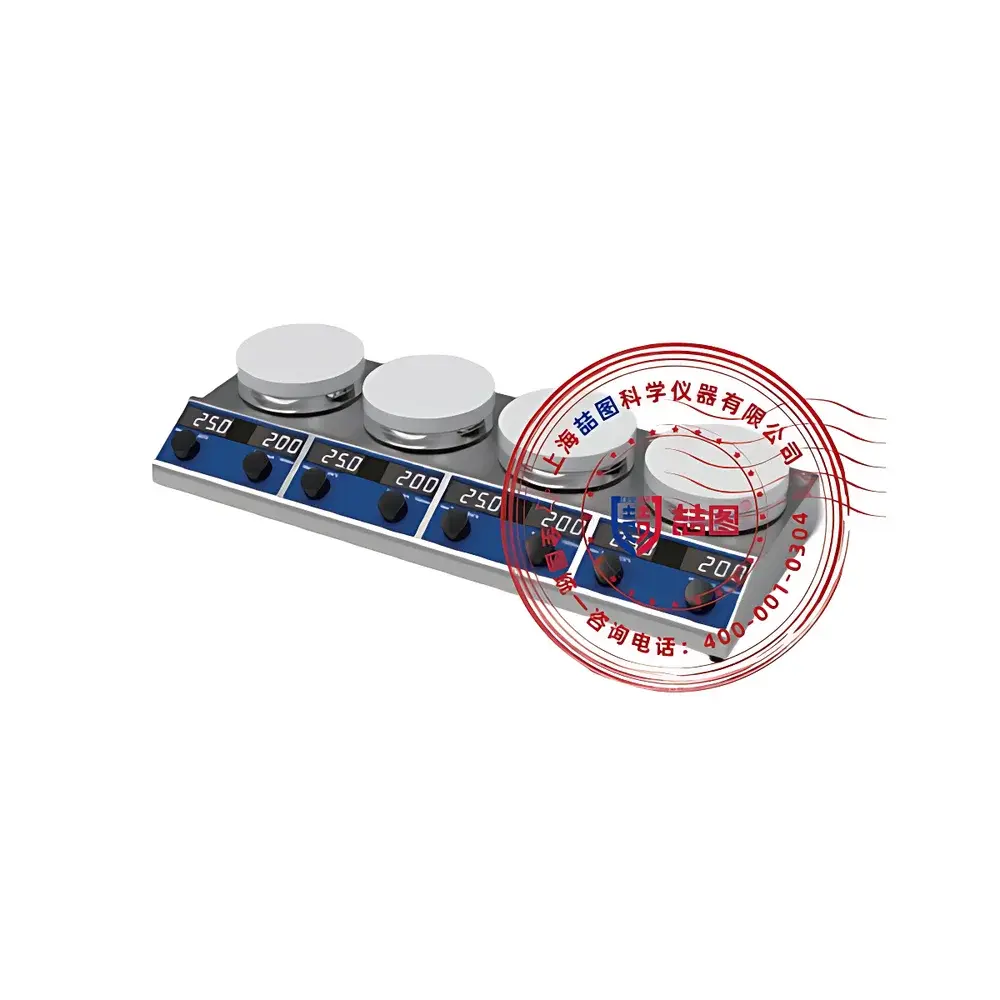
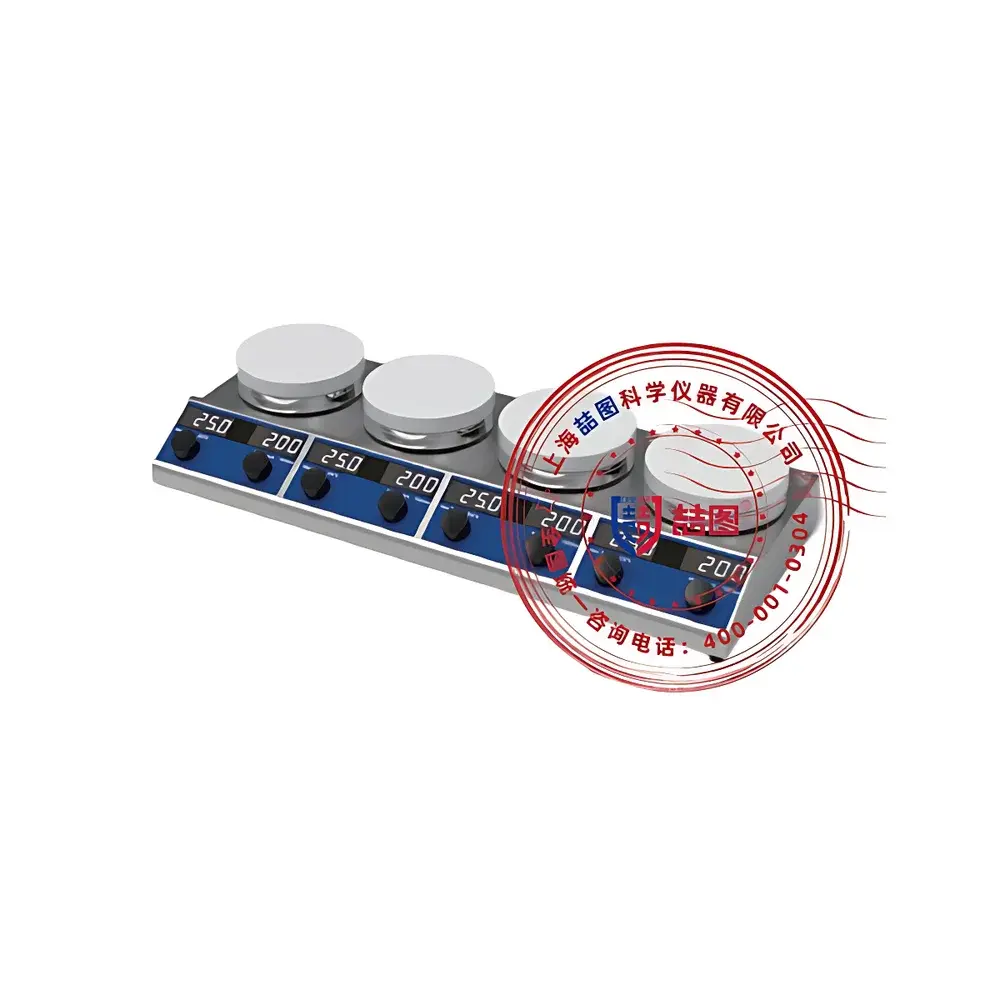
DRETOP MCH-4D Four-Position Programmable Temperature-Controlled Magnetic Stirrer
| Brand | DRETOP |
|---|---|
| Origin | Shanghai, China |
| Model | MCH-4D |
| Instrument Type | Magnetic Stirrer |
| Heating Plate Material | Ceramic-Coated PTFE Surface |
| Temperature Range | RT to 300 °C |
| Number of Stirring Positions | 4 |
| Heating Power | 300 W × 4 |
| Motor Input Power | 9 W × 4 |
| Max Stirring Volume (per position) | 3 L (water) |
| Plate Diameter | 140 mm |
| Timer Range | 1 s – 99 min 59 s |
| Enclosure Material | 304 Stainless Steel |
| Motor Type | Brushless DC Motor |
| Magnet Type | High-Temperature Resistant Rare-Earth Magnet |
Overview
The DRETOP MCH-4D is a four-position programmable magnetic stirrer with independent temperature control per station, engineered for precision thermal management and consistent mechanical agitation in analytical, synthetic, and quality control laboratories. It operates on the principle of contactless magnetic coupling—where a rotating permanent magnet beneath the ceramic-PTFE heating plate induces synchronous rotation of a magnetic stir bar immersed in the sample vessel. Simultaneous, independent regulation of temperature (RT–300 °C), rotational speed (adjustable via microprocessor-controlled PWM drive), and timing enables rigorous experimental replication across multiple samples under identical or differentiated conditions. This architecture supports method development requiring parallel parameter screening—such as optimization of reaction kinetics, solubility profiling, or dissolution testing—without cross-contamination or thermal crosstalk between positions.
Key Features
- Four independently controlled stirring stations, each with dedicated digital PID temperature regulation and speed adjustment
- Ceramic-coated PTFE heating surface: chemically inert, scratch-resistant, and thermally stable up to 300 °C; facilitates rapid heat transfer and easy decontamination
- Brushless DC motors: deliver low-noise operation (20,000 h MTBF)
- High-temperature rare-earth magnets: maintain >95% magnetic flux retention at 250 °C, ensuring reliable coupling with standard PTFE- or glass-coated stir bars
- 304 stainless steel chassis: corrosion-resistant, non-magnetic, and compliant with ISO 8573-1 Class 4 cleanroom-compatible surface finish standards
- Programmable timer with 1-second resolution and auto-shutdown: supports GLP-compliant experiment logging when paired with external data acquisition systems
Sample Compatibility & Compliance
The MCH-4D accommodates standard laboratory vessels—including borosilicate glass beakers (50–1000 mL), round-bottom flasks (with optional support stands), and polypropylene containers—provided stir bar geometry and size match viscosity and volume requirements (max. 3 L aqueous solution per station). Its RT–300 °C operating envelope meets ASTM E2931-22 guidelines for thermal stability verification of stirred systems. The device conforms to IEC 61010-1:2010 for electrical safety in laboratory equipment and carries CE marking under the Low Voltage Directive (2014/35/EU) and EMC Directive (2014/30/EU). While not intrinsically rated for hazardous locations, it may be deployed in Class 10,000 cleanrooms when installed with grounded anti-static work surfaces.
Software & Data Management
The MCH-4D operates via an embedded 4-digit LED interface with tactile membrane keys—designed for glove-compatible operation and minimal firmware complexity. No proprietary software or USB connectivity is included; however, analog output ports (0–5 V DC) are available upon request for integration into SCADA or LIMS environments via third-party signal conditioners. All parameter settings are retained after power cycling. For audit-trail compliance under FDA 21 CFR Part 11, users may pair the unit with external calibrated data loggers (e.g., Omega OM-DAQPRO-5300) to record time-stamped temperature and timer status signals. Firmware versioning and calibration history must be maintained manually per GLP Annex 11 requirements.
Applications
- Parallel synthesis of metal-organic frameworks (MOFs) under controlled thermal ramping and agitation
- Dissolution testing of pharmaceutical tablets per USP , where multi-vessel consistency is critical for QbD workflows
- Preparation of homogeneous polymer solutions prior to rheological characterization
- pH adjustment and buffer equilibration in cell culture media formulation
- Accelerated stability studies requiring simultaneous exposure of replicates to identical thermal-agitation profiles
- Calibration of temperature probes and stir bar performance benchmarks across viscosity gradients (1–10,000 mPa·s)
FAQ
What is the maximum recommended viscosity for reliable stirring at full 300 °C?
For optimal coupling efficiency and motor longevity, use stir bars ≥30 mm length with cylindrical geometry; maximum tested viscosity is 5,000 mPa·s (glycerol/water 80/20 v/v) at 200 °C. Above 250 °C, reduce load to ≤2,000 mPa·s.
Can the MCH-4D be used under inert atmosphere or vacuum?
Yes—when mounted on a vacuum-rated benchtop with sealed vessel lids (e.g., Schlenk flasks with septa); ensure stir bar coating (PTFE/glass) remains intact to prevent outgassing.
Is NIST-traceable calibration documentation available?
Factory calibration certificates (temperature ±1.5 °C at 100/200/300 °C; timer ±0.5 s per minute) are provided. Full NIST-traceable recalibration requires third-party metrology labs using accredited dry-block calibrators.
How is thermal uniformity across the 140 mm plate verified?
Per ISO/IEC 17025:2017, uniformity is characterized using 9-point grid mapping (center + 8 radial points) with Class A Pt100 probes; typical deviation is ≤±3.5 °C at 300 °C steady state.
Does the unit support remote monitoring via Ethernet or Wi-Fi?
No native network interface is integrated. RS-485 Modbus RTU expansion modules are available as OEM add-ons for industrial automation integration.



