
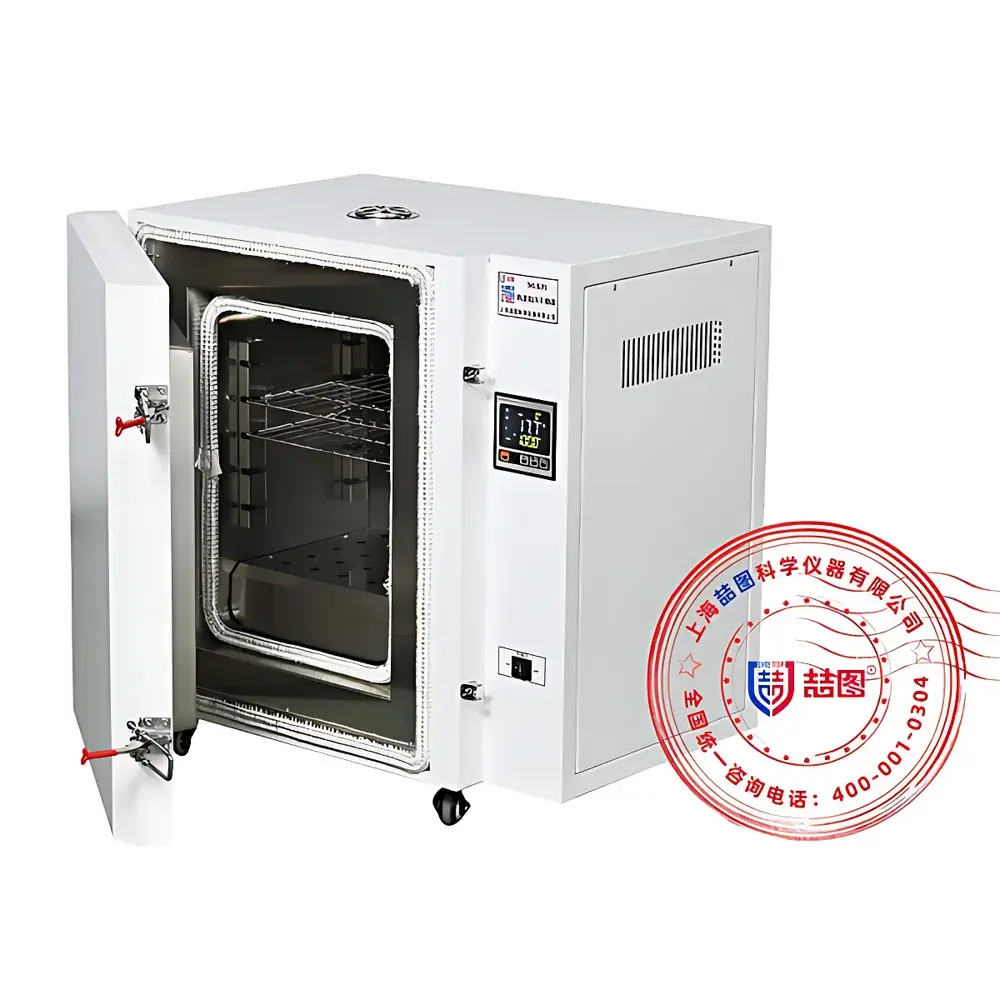
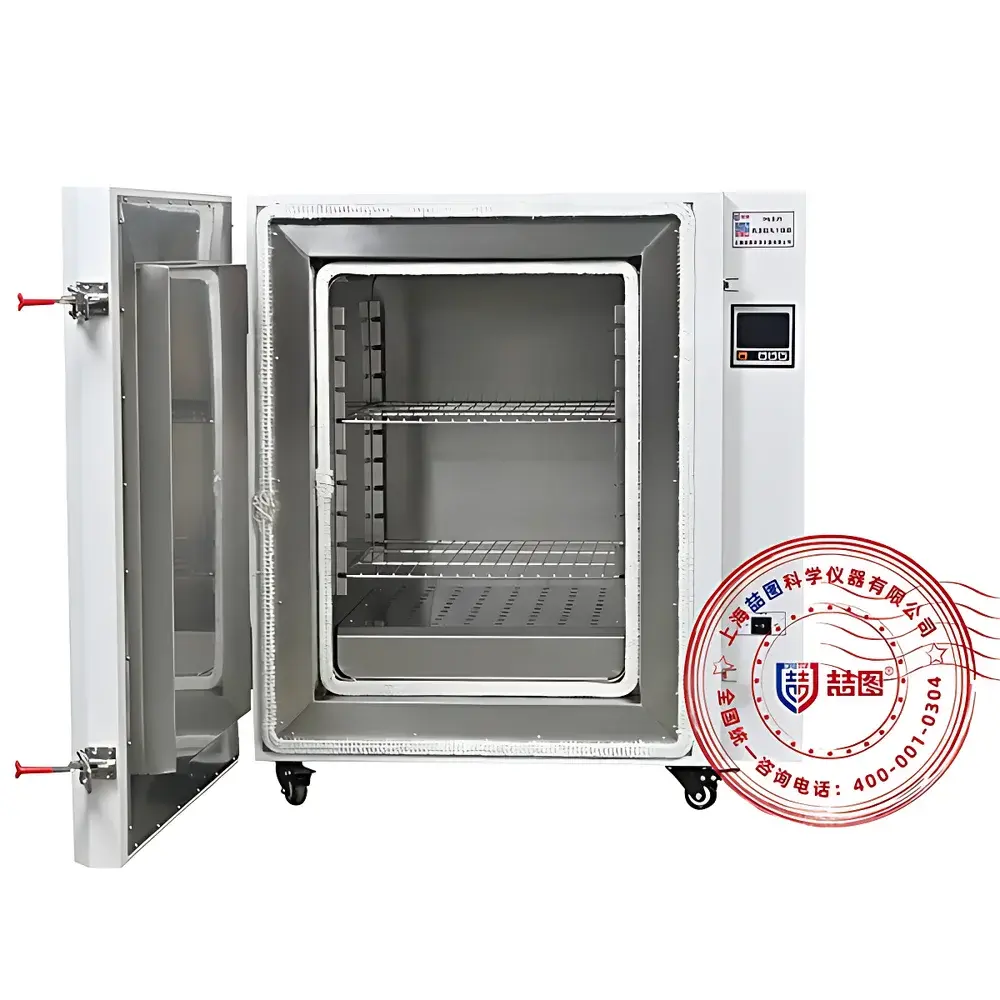
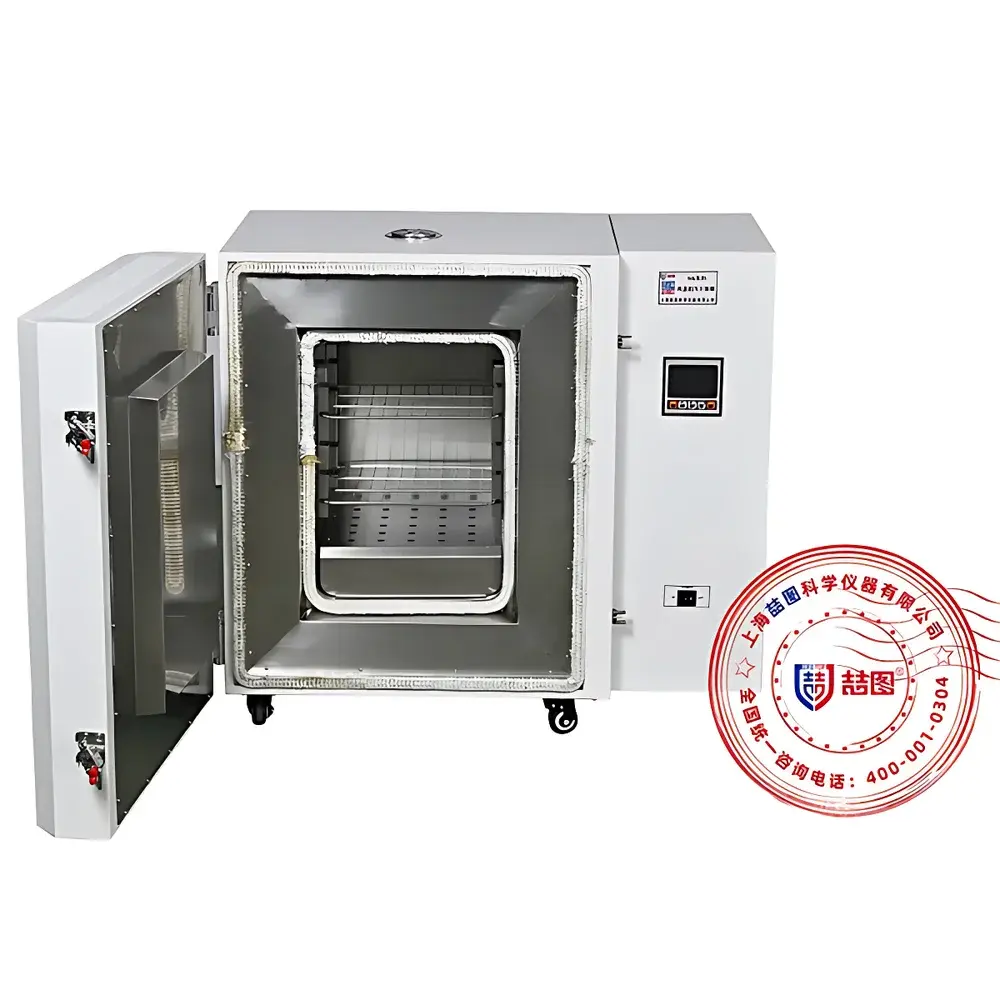
DRETOP TGF-9070A Forced-Air Laboratory Drying Oven
| Brand | DRETOP |
|---|---|
| Origin | Shanghai, China |
| Model | TGF-9070A |
| Instrument Type | General-Purpose Forced-Air Drying Oven |
| Temperature Range | RT+10°C to 250°C (operational up to 300°C) |
| Temperature Uniformity | ±2.5°C (at 100°C, empty chamber) |
| Temperature Fluctuation | ±0.5°C |
| Temperature Resolution | 0.1°C |
| Working Environment | RT+5°C to 45°C |
| Inner Chamber Dimensions (W×D×H) | 450×400×450 mm |
| External Dimensions (W×D×H) | 735×520×635 mm |
| Inner Chamber Material | Stainless Steel (mirror-finished) |
| Heating Method | Forced Convection with High-Temperature Fan and Optimized Airflow Ducts |
| Vacuum Capability | None |
Overview
The DRETOP TGF-9070A is a compact, benchtop forced-air laboratory drying oven engineered for precision thermal processing of non-volatile, non-flammable materials in research, quality control, and production environments. It operates on the principle of convective heat transfer, utilizing a high-reliability centrifugal fan and a thermally optimized airflow path to ensure uniform temperature distribution across the working chamber. Designed for applications requiring controlled thermal exposure—including moisture removal, thermal sterilization, polymer curing, solvent evaporation, and dry-heat depyrogenation—the TGF-9070A complies with foundational thermal stability requirements outlined in ISO 17025-accredited laboratories and aligns with general Good Laboratory Practice (GLP) documentation expectations for equipment qualification. Its RT+10°C to 250°C operating range (with short-term capability up to 300°C) supports standard protocols such as ASTM D1654 (coating drying), ISO 293 (plastic compression molding conditioning), and USP (dry-heat sterilization validation prerequisites).
Key Features
- Microprocessor-based P.I.D. temperature controller with 0.1°C resolution, ±0.5°C fluctuation tolerance, and programmable deviation alarms
- Dual-layer tempered glass observation window with wide-angle visibility and enhanced thermal insulation
- Three adjustable, removable stainless steel shelves with tool-free height positioning for flexible sample loading
- Self-diagnostic system displaying fault codes directly on the large backlit LCD interface
- Robust dual-stage rotary latch mechanism with high-temperature silicone gasket (rated to 350°C), ensuring long-term sealing integrity and minimal heat leakage
- Automatic condensate exhaust function integrated into the forced-air circulation loop to mitigate internal humidity buildup during extended low-temperature drying cycles
- Power-loss recovery mode retaining setpoint, timer, and alarm parameters after interruption
- Electrostatically coated carbon steel exterior and mirror-finish 304 stainless steel interior—resistant to corrosion, cleaning agents, and repeated thermal cycling
- Independent over-temperature cut-off circuit with audible/visual alarm, meeting IEC 61010-1 Class II safety requirements
Sample Compatibility & Compliance
The TGF-9070A accommodates standard laboratory vessels including borosilicate glassware (e.g., Petri dishes, weighing boats, crucibles), metal sample pans, ceramic trays, and polymer substrates—provided they are rated for continuous exposure up to 250°C. It is not suitable for volatile solvents, pyrophoric compounds, or biological aerosols. The unit satisfies baseline electrical safety (IEC 61010-1), electromagnetic compatibility (IEC 61326-1), and thermal performance verification per ISO 17025 Clause 5.5.2. While not intrinsically certified for hazardous locations, its non-explosion-proof design conforms to general-purpose lab use under OSHA 1910.1200 and EU Directive 2014/34/EU (ATEX) Category 3G limitations. Dry-heat sterilization cycles may be validated per EN 285:2015 Annex C when paired with external data loggers.
Software & Data Management
The embedded controller supports time-stamped temperature logging via optional USB interface (U-disk export of CSV-formatted datasets). When equipped with the RS-485 communication module, the oven integrates into centralized Lab Information Management Systems (LIMS) or SCADA networks using Modbus RTU protocol. Optional color touchscreen upgrade enables multi-segment programmable ramp-soak profiles (up to 30 segments), real-time curve visualization, and audit-trail-enabled event logging compliant with FDA 21 CFR Part 11 requirements when deployed with electronic signature-capable host software. All configurations include password-protected parameter access levels and configurable alarm thresholds.
Applications
- Moisture content determination in pharmaceutical excipients (per USP ) and food matrices (AOAC 950.46)
- Dry-heat sterilization of stainless steel instruments and glassware in microbiology labs
- Curing of epoxy resins, powder coatings, and printed circuit board laminates
- Thermal aging studies of polymers and elastomers (ASTM D573, ISO 188)
- Pre-conditioning of samples prior to tensile testing, DSC, or TGA analysis
- Baking of filter membranes and chromatography plates
- Removal of residual solvents from synthesized organic compounds
- Stabilization of calibration standards and reference materials
FAQ
What is the maximum recommended continuous operating temperature?
The TGF-9070A is rated for continuous operation at up to 250°C; intermittent use at 300°C is permissible for ≤30 minutes per cycle.
Can this oven be used for sterilization validation?
Yes—when qualified with calibrated thermocouples and documented cycle parameters, it supports dry-heat sterilization protocols per EN 285:2015 Annex C and ISO 14937 Annex B.
Is the interior volume sufficient for standard ISO/IEC 17025 calibration loads?
With a 70 L net chamber volume and ±2.5°C uniformity at 100°C, it meets minimum spatial requirements for single-point and multi-point thermal mapping per EURAMET cg-18.
Does the unit support GLP-compliant data archiving?
When configured with the RS-485 module and validated third-party software, full audit trails—including operator ID, timestamped setpoints, deviations, and alarm events—are retained for regulatory review.
What maintenance intervals are recommended for optimal thermal performance?
Fan filter inspection every 3 months; door gasket integrity check every 6 months; annual calibration of the internal Pt100 sensor against NIST-traceable reference.
Related Products



