
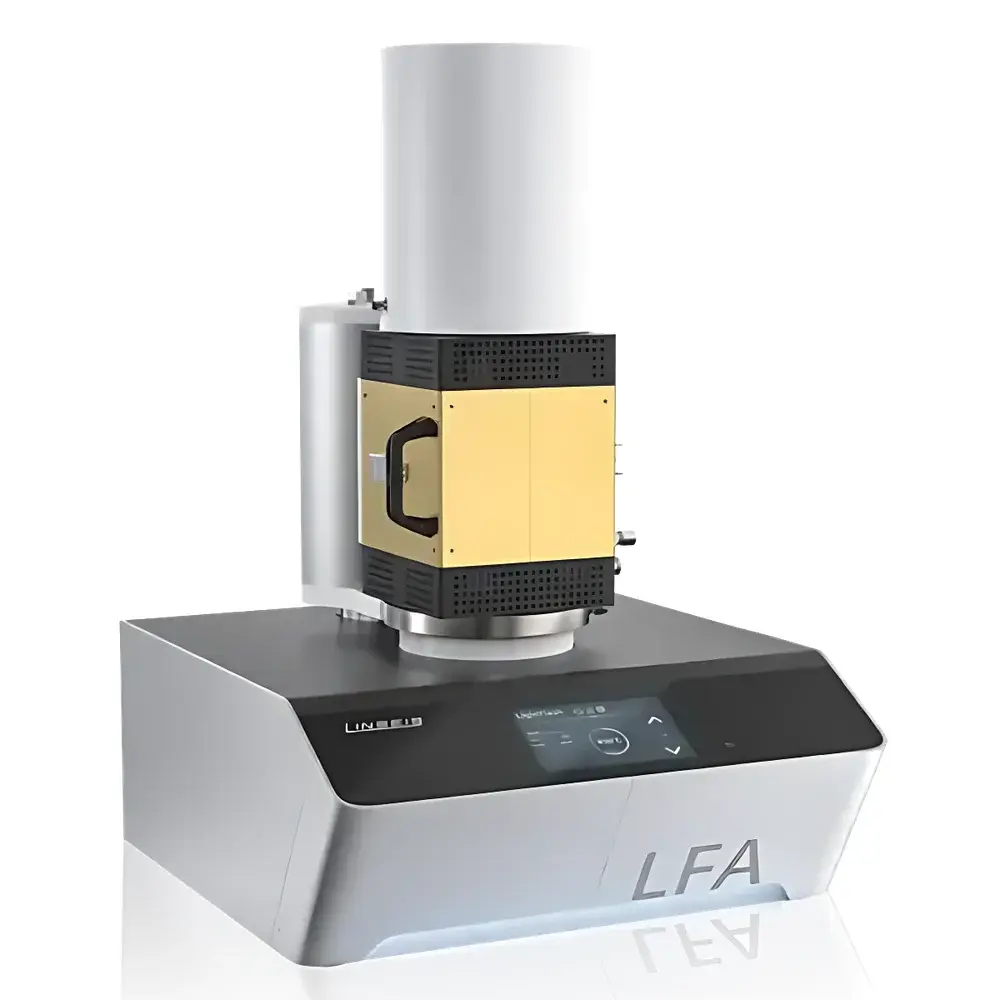
LINSEIS LFA L51 Laser Flash Analyzer
| Brand | LINSEIS |
|---|---|
| Origin | Germany |
| Model | LFA L51 |
| Measurement Principle | Laser Flash Method (LFA) |
| Temperature Range | −100 °C to 1250 °C |
| Thermal Diffusivity Range | 0.01–2000 mm²/s |
| Thermal Conductivity Range | 0.1–4000 W/(m·K) |
| Accuracy | ±2.4% (typical for homogeneous solids) |
| Pulse Source | Adjustable Xenon Flash Lamp (up to 15 J/pulse) |
| Atmosphere Control | Inert, Reducing, Vacuum |
| Sample Capacity | Up to 18 samples (auto-sampler) |
| Sample Geometry | Circular (Ø 3–25.4 mm), Square (10×10 mm or 20×20 mm) |
| Sample Thickness | 0.1–6 mm |
| Heating Rate | 0.01–100 °C/min |
| Detector Types | InSb (RT–1250 °C), CMCT (−100–500 °C) |
| Data Acquisition Rate | 2.5 MHz |
| Sample Compatibility | Solids, Powders, Pastes, Liquids |
| Furnace Options | IR heating, Resistive heating (graphite, SiC, Al₂O₃, metal crucibles) |
| Interface | USB |
| Software Compliance | Supports ASTM E1461, ISO 22007-4, and GLP/GMP audit trails (21 CFR Part 11 optional) |
Overview
The LINSEIS LFA L51 Laser Flash Analyzer is an advanced thermal property characterization system engineered for high-precision, high-reproducibility determination of thermal diffusivity (α), specific heat capacity (cp), and thermal conductivity (λ) across an exceptionally broad temperature range—from cryogenic conditions at −100 °C up to ultra-high temperatures of 1250 °C. Based on the standardized laser flash method (ASTM E1461, ISO 22007-4), the LFA L51 delivers quantitative thermal transport data by measuring the transient surface temperature rise following a short, uniform energy pulse applied to the rear face of a thermally insulated sample. This non-contact, absolute measurement technique eliminates calibration dependencies associated with steady-state methods and enables rapid, repeatable analysis of diverse material classes—including metals, ceramics, polymers, composites, graphite, microcrystalline glasses (e.g., Pyroceram®), and even challenging forms such as powders, slurries, and thin films—without requiring prior knowledge of thermal contact resistance.
Key Features
- Modular furnace architecture supporting interchangeable heating modules: resistive (graphite, SiC, Al₂O₃, metal) and infrared configurations—enabling optimal thermal stability and homogeneity for each application domain.
- Programmable xenon flash lamp with variable pulse energy (0.1–15 J/pulse) and software-controlled pulse width—ensuring optimal signal-to-noise ratio across low- and high-diffusivity materials.
- Integrated high-speed infrared detection system with dual-sensor capability: InSb detector for measurements up to 1250 °C and CMCT for sub-ambient operation down to −100 °C—both synchronized to a 2.5 MHz data acquisition rate for sub-millisecond temporal resolution.
- Automated 18-position sample changer with precise positional repeatability—facilitating unattended multi-sample campaigns under identical thermal and atmospheric conditions.
- Full atmosphere control: vacuum (<10−3 mbar), inert (N₂, Ar), or reducing (H₂/N₂, CO) environments—critical for oxidation-sensitive materials (e.g., graphite, SiC) and high-temperature stability studies.
- Robust mechanical design with active vibration isolation and thermal shielding—minimizing environmental interference and ensuring long-term measurement integrity in shared laboratory spaces.
Sample Compatibility & Compliance
The LFA L51 accommodates standard geometries—circular discs (Ø 3, 6, 10, 12.7, or 25.4 mm) and square specimens (10×10 mm or 20×20 mm)—with thicknesses ranging from 0.1 to 6 mm. Non-standard forms—including layered stacks, coated substrates, porous compacts, and encapsulated liquids—are supported via custom sample holders and furnace inserts. All measurements adhere to internationally recognized standards: ASTM E1461 (standard test method for thermal diffusivity), ISO 22007-4 (plastics—determination of thermal conductivity and thermal diffusivity—Part 4: Laser flash method), and ISO 18434-1 (condition monitoring—thermography—Part 1: General procedures). Optional 21 CFR Part 11-compliant software modules provide electronic signatures, audit trails, and role-based access control—meeting stringent GLP and GMP documentation requirements for regulated R&D and quality control laboratories.
Software & Data Management
The LINSEIS ThermoSoft® platform provides fully integrated instrument control, real-time visualization, and advanced post-processing. Raw thermogram data are acquired at 2.5 MHz and stored in lossless binary format. Built-in algorithms apply standard evaluation models (Cowley–Gustafson, Freitas, and iterative curve-fitting) to extract α with uncertainty quantification. When combined with independent cp (from DSC) and density (from dilatometry or pycnometry), λ is calculated via λ = α·ρ·cp. The software supports batch processing, statistical reporting (mean, SD, CV%), outlier detection, and export to CSV, Excel, or HDF5. All data files embed metadata (operator ID, timestamp, furnace ID, atmosphere log, pulse parameters), enabling full traceability and seamless integration into LIMS or ELN systems.
Applications
The LFA L51 serves as a primary tool in materials science, aerospace, nuclear engineering, battery R&D, and electronics thermal management. It has been validated for quantitative thermal characterization of PTFE across 25–150 °C under inert atmosphere—revealing stable λ except at the solid–solid phase transition near 30 °C. For nuclear-grade graphite, vacuum-based measurements from RT to 1100 °C demonstrate decreasing λ with rising temperature, plateauing of α above 500 °C, and monotonic cp increase—data essential for reactor core thermal modeling. In microcrystalline glass validation studies (Pyroceram®), 18 replicate measurements show ≤±1% variation up to 600 °C—confirming instrument robustness for inter-laboratory round-robin testing and reference material certification.
FAQ
What standards does the LFA L51 comply with for thermal diffusivity measurement?
ASTM E1461, ISO 22007-4, and ISO 18434-1.
Can the system measure liquid or paste samples?
Yes—using sealed quartz or sapphire capsules compatible with inert or vacuum atmospheres.
Is specific heat capacity measured directly or derived?
cp is not measured directly by LFA; it must be supplied externally (e.g., from DSC) to calculate thermal conductivity.
How is calibration performed?
No routine calibration is required—the LFA method is absolute. Certified reference materials (e.g., NIST SRM 710a, graphite) are used for verification and performance qualification.
Does the system support automated reporting for regulatory submissions?
Yes—optional 21 CFR Part 11 software module enables compliant audit trails, electronic signatures, and secure data archiving.



