
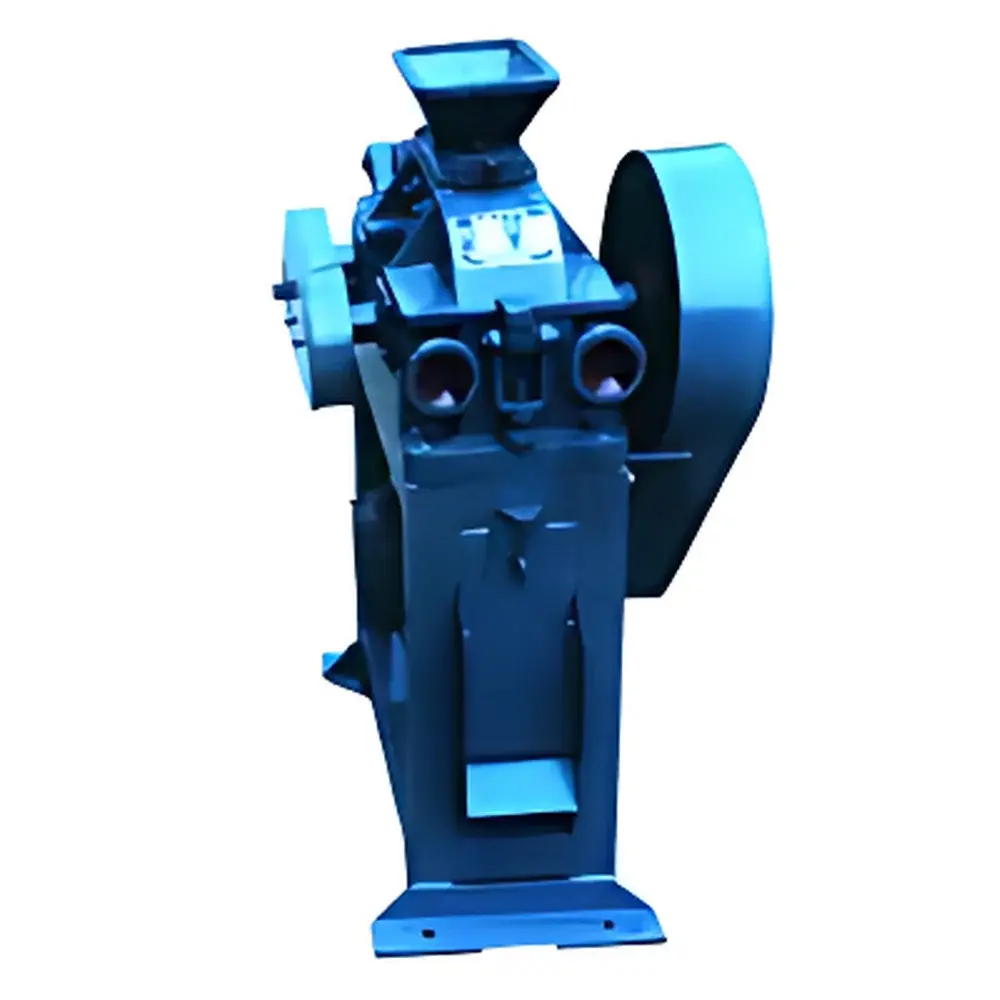
KER-200×75 Dual-Roll Crusher
| Feed Size | ≤13 mm |
|---|---|
| Output Size | 1–3 mm (adjustable) |
| Capacity | 200 kg/h |
| Motor Power | 1.5 kW |
| Voltage | 3-phase 380 V AC |
| Weight | 230 kg |
| Dimensions (L×W×H) | 640×455×875 mm |
Overview
The KER-200×75 Dual-Roll Crusher is an industrial sample preparation instrument engineered for consistent size reduction of medium-hard, friable materials—primarily coal—under laboratory and pilot-scale quality control environments. It operates on the principle of compressive shearing between two counter-rotating rolls with differential surface velocities, generating controlled mechanical stress to fracture particles without excessive pulverization or heat generation. Unlike high-speed impact or jaw-type crushers, this design minimizes fines generation and preserves particle morphology integrity, making it particularly suitable for applications where representative sub-sampling and downstream analytical reproducibility are critical—such as proximate/ultimate analysis, calorimetry, and ash fusion testing per ASTM D3172, ASTM D3176, and ISO 1171.
Key Features
- Dual-roll configuration with precisely engineered speed differential ensures uniform compression and shear forces across the entire feed zone.
- Roll surfaces undergo specialized hard-facing treatment and micro-texturing to eliminate material adhesion—especially critical for high-moisture or bituminous coals—reducing carryover and cross-contamination between batches.
- Adjustable roll gap mechanism (mechanical micrometer scale) enables fine-tuned output particle size control within the 1–3 mm range, verified via sieve analysis in accordance with ASTM D4788.
- Robust cast-iron frame and sealed roller bearings support continuous operation under variable load conditions while maintaining dimensional stability over extended service life.
- Integrated safety interlock system halts motor operation when access guards are disengaged, compliant with IEC 60204-1 requirements for electrical equipment of machines.
- Low-noise, low-vibration operation (≤72 dB(A) at 1 m) facilitates integration into shared laboratory spaces without requiring dedicated acoustic enclosures.
Sample Compatibility & Compliance
The KER-200×75 is validated for use with coal (bituminous, sub-bituminous, lignite), coke, limestone, shale, clay, and other non-abrasive to moderately abrasive materials with Mohs hardness ≤5. It is not intended for siliceous ores, hardened slag, or materials containing metallic contaminants. The unit meets structural and operational requirements outlined in ISO 17025:2017 for test equipment used in accredited laboratories, and its mechanical design aligns with EN 13230-2 for crushing equipment in solid fuel sampling systems. All electrical components conform to CE marking directives (EMC Directive 2014/30/EU and Low Voltage Directive 2014/35/EU).
Software & Data Management
As a standalone electromechanical crusher, the KER-200×75 does not incorporate embedded digital controls or data logging hardware. However, it is fully compatible with external laboratory information management systems (LIMS) through manual entry of batch identifiers, feed mass, operating duration, and sieve analysis results. For GLP/GMP-regulated environments, users may document operational parameters—including roll gap setting, ambient temperature, and operator ID—in standardized paper-based or electronic batch records traceable to ISO/IEC 17025 clause 7.5. Calibration verification of the gap adjustment scale is recommended quarterly using certified gauge blocks (class B, ISO 3650), with records retained for audit purposes.
Applications
- Preparation of as-received and air-dried coal samples prior to grinding in ring-and-puck mills (e.g., ASTM D2013).
- Reduction of run-of-mine (ROM) coal to intermediate size fractions for homogenization and quartering per ISO 13909-2.
- Production of consistent feed material for automated ash determination systems (e.g., ASTM D3174) and sulfur analyzers (ASTM D3177).
- Sample conditioning in geological core processing workflows where preservation of lithological layering is essential.
- Supporting QA/QC protocols in thermal power plants, coal blending facilities, and third-party inspection laboratories accredited to ISO/IEC 17020.
FAQ
What standards govern the use of this crusher in coal testing?
ASTM D2013, ISO 13909-2, and GB/T 474 specify dual-roll crushers as acceptable primary reduction devices for coal sample preparation when operated within defined feed size and throughput limits.
Can the output size be verified independently?
Yes—users must perform dry sieve analysis using standardized test sieves (ISO 3310-1, aperture tolerances ±2.5%) and report cumulative undersize distribution in accordance with ASTM D6913.
Is routine maintenance required beyond cleaning?
Daily removal of residual material from roll surfaces and feed chute is mandatory; biannual inspection of bearing preload and gear meshing is recommended per manufacturer’s service schedule.
Does this unit comply with explosion-proof requirements for underground coal mine labs?
No—the KER-200×75 is not certified for Zone 1/21 hazardous areas; ATEX or IECEx-rated alternatives must be specified separately.
What documentation accompanies shipment?
Each unit ships with a Declaration of Conformity (CE), mechanical calibration certificate (gap scale), assembly instructions, and preventive maintenance log template aligned with ISO 55001 asset management principles.



