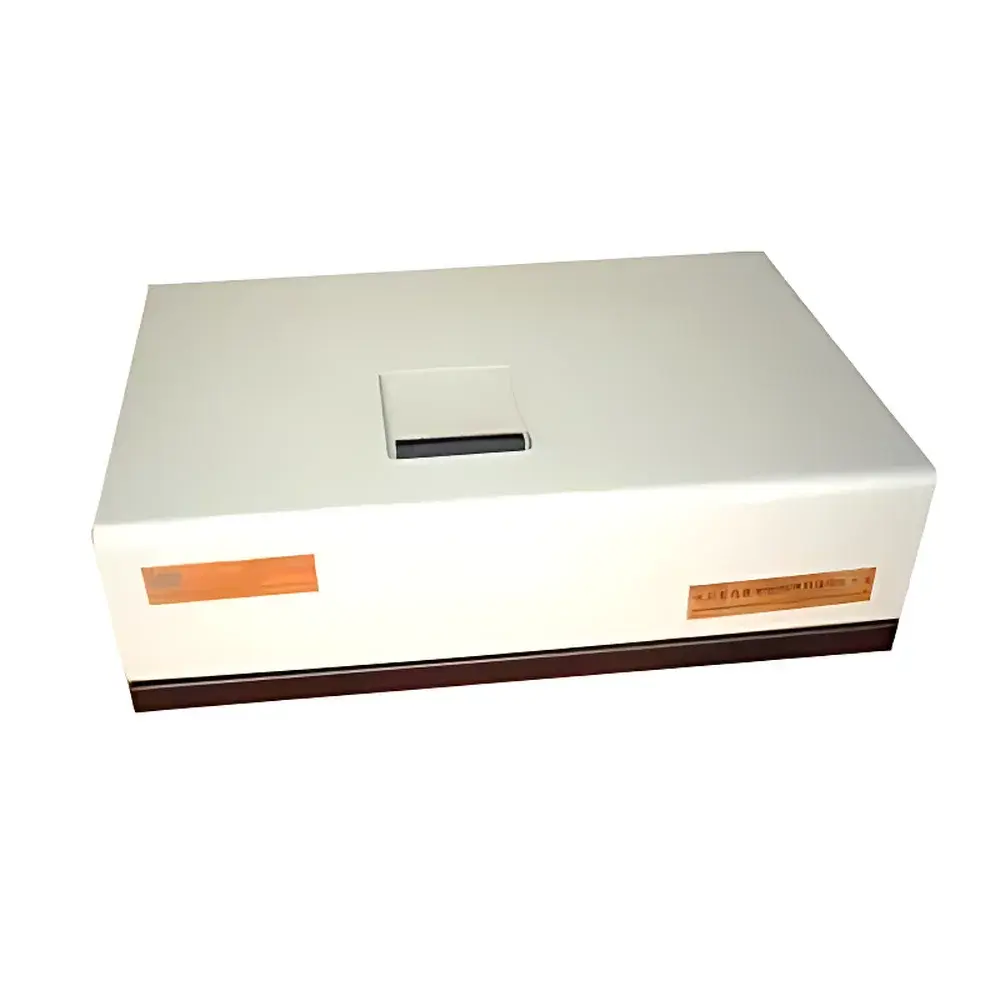
LT-21 Series Infrared Spectrophotometric Oil Analyzer
| Origin | Beijing, China |
|---|---|
| Manufacturer Type | Authorized Distributor |
| Origin Category | Domestic (China) |
| Model | LT-21A / LT-21B / LT-21C |
| Price | Upon Request |
| Measurement Range | 0.003–64,000 mg/L |
| Detection Limit | <0.003 mg/L (practical LOD < 0.3 mg/L) |
| Repeatability | ±2% RSD |
| Accuracy | ±3% error |
| Correlation Coefficient (r) | >0.999 |
| Wavenumber Range | 2800–3100 cm⁻¹ (corresponding to 3.2–3.5 µm) |
| Wavenumber Accuracy | ±2 cm⁻¹ |
| Wavenumber Reproducibility | ±1 cm⁻¹ |
| CH₂/CH₃/Aromatic Resolution | 3% methyl group resolution |
| Auto Zero & Full-Scale Adjustment | Yes |
| Spectral Storage | Yes |
| Statistical Analysis Module | Yes |
| Dimensions | 55 × 37 × 18 cm |
| Net Weight | 16 kg |
| Operating Environment | 10–30°C, 40–80% RH |
Overview
The LT-21 Series Infrared Spectrophotometric Oil Analyzer is a laboratory-grade instrument engineered for the quantitative determination of total petroleum hydrocarbons (TPH), animal and vegetable oils (AVO), and total oil content in aqueous and airborne samples—fully compliant with China’s national standard GB/T 16488–1996 (“Water Quality — Determination of Petroleum Hydrocarbons and Animal/Vegetable Oils — Infrared Spectrophotometry”) and the environmental emission standard GWPB 5–2000 (“Emission Standard for Fume from Catering Services”). Based on dual-beam Fourier-transform or dispersive infrared absorption spectroscopy, the analyzer measures characteristic vibrational absorbances of C–H bonds at three critical wavenumbers: 2930 cm⁻¹ (asymmetric CH₂ stretch), 2960 cm⁻¹ (asymmetric CH₃ stretch), and 3030 cm⁻¹ (aromatic C–H stretch). This multi-wavelength algorithm enables selective quantification of petroleum hydrocarbons (non-polar, silica gel–nonadsorbed fraction) and AVO (silica gel–adsorbed fraction) via differential extraction and spectral subtraction. The system operates using carbon tetrachloride (CCl₄) as the extraction solvent—a requirement stipulated in ISO 9377-2 and harmonized with EPA Method 1664 for hydrocarbon partitioning.
Key Features
- Triple-wavenumber quantification engine supporting simultaneous calculation of petroleum hydrocarbons, animal/vegetable oils, and total oil per GB/T 16488–1996 calibration protocols
- Integrated spectral correction algorithms including wavenumber drift compensation, baseline flattening, and spectral continuity verification (no spectral break points)
- Automated zero/full-scale calibration with thermal drift compensation ensuring long-term photometric stability (±1% zero/full drift over 4 hours)
- High-fidelity optical path design featuring thermally stabilized IR source, precision grating monochromator, and PbS or DTGS detector optimized for 2800–3100 cm⁻¹ range
- Modular platform architecture: LT-21A (benchtop lab-only), LT-21B (field-lab hybrid with DC power input), LT-21C (battery-operated portable unit with >8 h runtime)
- Compliance-ready firmware supporting audit trails, user access levels, and parameter-lock functionality aligned with GLP data integrity requirements
Sample Compatibility & Compliance
The LT-21 Series accepts liquid-phase extracts from water, wastewater, soil leachates, and cooking fume condensates following standardized CCl₄-based liquid–liquid extraction (LLE) or solid-phase extraction (SPE) procedures. Sample compatibility includes both unfiltered and membrane-filtered (0.45 µm) aqueous matrices. For regulatory reporting, the instrument meets method-defined performance criteria under GB/T 16488–1996, including linearity (r > 0.999 across 0–120 mg/L calibration range), repeatability (≤2% RSD, n = 7), and accuracy (±3% bias vs. certified reference materials). While not FDA 21 CFR Part 11–certified out-of-the-box, the software architecture supports optional validation packages for regulated environments requiring electronic signature, change control, and raw spectral archiving. All hardware components comply with IEC 61000-4 electromagnetic immunity standards and operate within ISO 8573-1 Class 4 air purity requirements when used with external desiccant-dried CCl₄ vapor lines.
Software & Data Management
The embedded Windows-based acquisition and analysis suite provides full spectral visualization (absorbance vs. wavenumber), peak integration, regression modeling, and automated coefficient derivation (X, Y, Z, F) per GB/T 16488–1996 Annex B. Users may import pre-validated calibration curves or generate new ones using certified standard oil mixtures—either the n-hexadecane/isooctane/benzene (65:25:10 v/v/v) or n-hexadecane/pristane/toluene (5:3:1) formulations. Raw interferograms and processed spectra are stored in vendor-neutral .csv and .spc formats. Audit logs record all measurement events, parameter modifications, calibration actions, and user logins with timestamps. Export modules support direct output to LIMS via ASTM E1384-compliant structured text files. Optional network interface enables remote monitoring and centralized data aggregation across multi-instrument deployments.
Applications
- Environmental monitoring laboratories performing routine compliance testing for municipal wastewater discharge permits (e.g., Class I–IV effluent standards)
- Industrial hygiene units assessing cooking oil fume emissions from commercial kitchens and food processing facilities
- Ecotoxicology studies evaluating oil-spill impact on aquatic sediment pore water and biota tissue extracts
- Regulatory QA/QC programs validating third-party oil analysis reports submitted to provincial生态环境 departments
- Method development labs cross-validating infrared results against GC-FID or gravimetric reference methods per ISO 9377-2 guidelines
- Field emergency response teams conducting rapid on-site screening of accidental hydrocarbon releases in rivers, harbors, or industrial zones
FAQ
What extraction solvent is required for compliant operation?
Carbon tetrachloride (CCl₄) meeting GB/T 688–2008 specifications (residual oil content < 0.001 mg/L) must be used. Batch consistency across blanks, standards, and samples is mandatory to avoid inter-batch calibration drift.
Can the LT-21 distinguish between diesel, gasoline, and lubricating oil fractions?
No—the instrument quantifies total petroleum hydrocarbons based on bulk CH bond absorbance. Compound-specific identification requires complementary GC-MS or FTIR library matching, which is outside its scope per GB/T 16488–1996.
Is silica gel treatment mandatory for AVO quantification?
Yes. Separation of petroleum hydrocarbons (non-adsorbed) from AVO (adsorbed) requires column chromatography on activated silica gel per Section 8.2 of GB/T 16488–1996. The LT-21 performs only the spectral quantification step.
How often must the instrument be recalibrated?
Daily zero/full calibration is recommended before each analytical batch. Wavenumber accuracy verification using polystyrene film standard should be performed weekly; full multi-point calibration with NIST-traceable oil standards is required quarterly or after optical maintenance.
Does the system support US EPA Method 1664A equivalency?
While not formally validated per EPA protocol, the LT-21’s spectral methodology, CCl₄ extraction workflow, and quantification logic align closely with Method 1664A’s infrared endpoint detection principle—subject to local regulatory acceptance and site-specific method validation.