
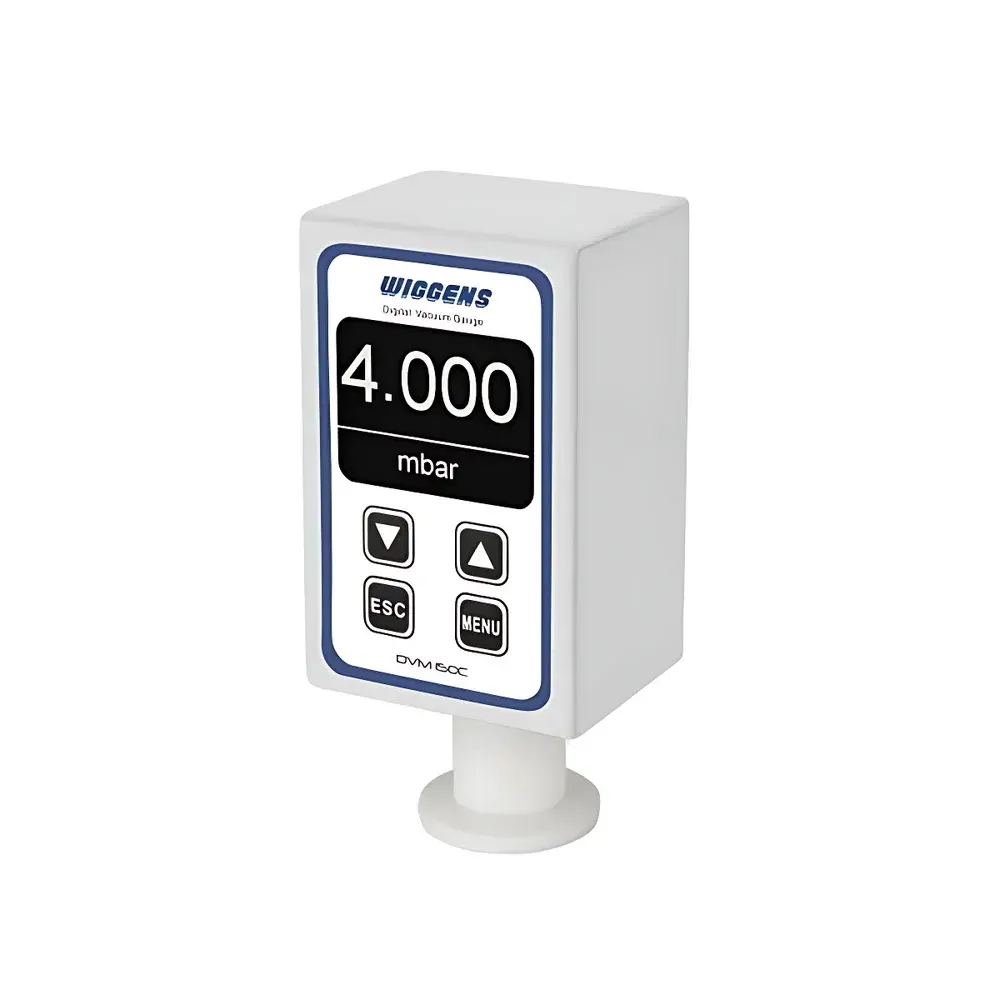
WIGGENS DVM150C Digital Vacuum Gauge
| Brand | WIGGENS |
|---|---|
| Origin | Germany |
| Model | DVM150C |
| Voltage | 100–240 V, 50/60 Hz |
| Display | High-brightness TFT LCD |
| Pressure Range | 0.1–1000 mbar |
| Resolution | 0.1 mbar |
| Accuracy | Class 0.25 |
| Sensor Type | Ceramic with PTFE-wetted parts |
| Gas Compatibility | Resistant to acids, bases, and organic solvents |
| Dimensions (L×W×H) | 100 × 65 × 55 mm |
| Order Code | 15060-01 |
Overview
The WIGGENS DVM150C Digital Vacuum Gauge is a compact, high-reliability pressure measurement instrument engineered for continuous monitoring of vacuum levels in laboratory and pilot-scale vacuum systems. It operates on the principle of ceramic capacitive pressure transduction—where changes in capacitance across a micro-machined ceramic diaphragm are linearly correlated to absolute pressure within the specified range. Unlike thermal conductivity (Pirani) or ionization-based gauges, the DVM150C’s all-ceramic/PTFE sensor architecture ensures long-term stability, zero drift minimization, and immunity to condensable vapors or reactive process gases. Designed for integration with dry, oil-free vacuum pumps—including scroll, diaphragm, and turbomolecular systems—the gauge provides real-time, absolute pressure feedback from rough vacuum (1000 mbar) down to medium vacuum (0.1 mbar), covering critical operational zones for rotary evaporation, freeze drying, vacuum filtration, and solvent degassing.
Key Features
- High-brightness TFT LCD display with 128 × 160 pixel resolution—optimized for legibility at viewing distances up to 3 meters under ambient lab lighting.
- Direct-mount flange interface (KF16 or ISO-KF compatible per configuration) enables leak-tight mechanical integration without intermediate tubing or adapters.
- Ceramic sensing element with fully PTFE-wetted surfaces—validated per ASTM D543 for chemical resistance to concentrated HCl, NaOH, acetone, ethanol, chloroform, and ethyl acetate.
- Class 0.25 accuracy (IEC 60770-1 compliant) over full scale, traceable to national metrology institutes via factory calibration certificate (included).
- Wide operating voltage range (100–240 V AC, 50/60 Hz) with internal switching-mode power supply—eliminates need for external transformers or voltage converters.
- Robust aluminum alloy housing with IP54-rated ingress protection—suitable for benchtop use in environments with moderate particulate or humidity exposure.
Sample Compatibility & Compliance
The DVM150C is explicitly designed for non-corrosive and mildly aggressive gas environments where hydrocarbon contamination must be avoided. Its PTFE-sealed ceramic sensor eliminates elastomer degradation risks common in diaphragm gauges, making it suitable for applications involving halogenated solvents, acidic vapors (e.g., HNO₃, HF traces), and basic condensates (e.g., NH₃). It complies with IEC 61000-6-3 (EMC emission standards) and IEC 61000-6-2 (immunity to electrostatic discharge and RF fields). While not intrinsically safe, it meets CE marking requirements for laboratory equipment under Directive 2014/30/EU (EMC) and 2014/35/EU (LVD). Calibration intervals are recommended annually per ISO/IEC 17025 guidelines when used in GLP-regulated workflows.
Software & Data Management
The DVM150C operates as a standalone instrument with local keypad control—no driver installation or PC dependency required. Analog output (0–10 V DC) and RS485 Modbus RTU interface (optional module) enable seamless integration into SCADA systems, PLC-controlled vacuum sequences, or centralized lab monitoring platforms. When connected via RS485, the device supports time-stamped data logging at user-defined intervals (1 s to 60 min), with audit-trail-capable storage of calibration events, zero adjustments, and firmware version history—aligned with FDA 21 CFR Part 11 expectations for electronic records when deployed in regulated QC/QA laboratories.
Applications
- Routine vacuum level verification during rotary evaporation of heat-sensitive compounds (e.g., pharmaceutical intermediates, natural product extracts).
- Process validation of lyophilization cycles—monitoring chamber pressure stability during primary drying phases.
- Leak rate assessment in vacuum gloveboxes and inert-atmosphere reactors using decay testing protocols (per ASTM E493).
- Performance benchmarking of dry vacuum pumps during preventive maintenance—tracking base pressure attainment and pump-down time consistency.
- Teaching laboratories: Demonstrating gas laws (Boyle’s law, ideal gas behavior) and vacuum system dynamics with real-time quantitative feedback.
FAQ
What vacuum ranges does the DVM150C cover, and how does it differ from the DVM150Pro?
The DVM150C measures from 0.1 to 1000 mbar (absolute), optimized for rough-to-medium vacuum. The DVM150Pro uses a Pirani sensor for 0.001–9.999 mbar—intended for higher vacuum regimes; the two models are not interchangeable due to fundamental sensor physics and calibration traceability.
Can the DVM150C be used with corrosive process gases such as chlorine or sulfur dioxide?
It is rated for general acid/base/organic solvent resistance per ASTM D543, but not validated for oxidizing gases like Cl₂ or SO₂ at elevated partial pressures. Consult WIGGENS technical support for application-specific compatibility assessments.
Is factory calibration traceable to NIST or DAkkS?
Yes—each unit ships with a DAkkS-accredited calibration certificate (D-K-15060-XXXX) valid for 12 months, including uncertainty budgets per GUM (JCGM 100:2008).
Does the gauge support analog output for PLC interfacing?
Standard units include 0–10 V DC output; RS485 Modbus RTU requires optional communication module (order code: DVM-COM-RS485).
What is the maximum allowable ambient temperature for continuous operation?
The specified operating range is 5–40 °C at ≤80% RH non-condensing. Extended operation above 35 °C may reduce long-term zero stability—thermal compensation is active but not certified beyond 40 °C.



