
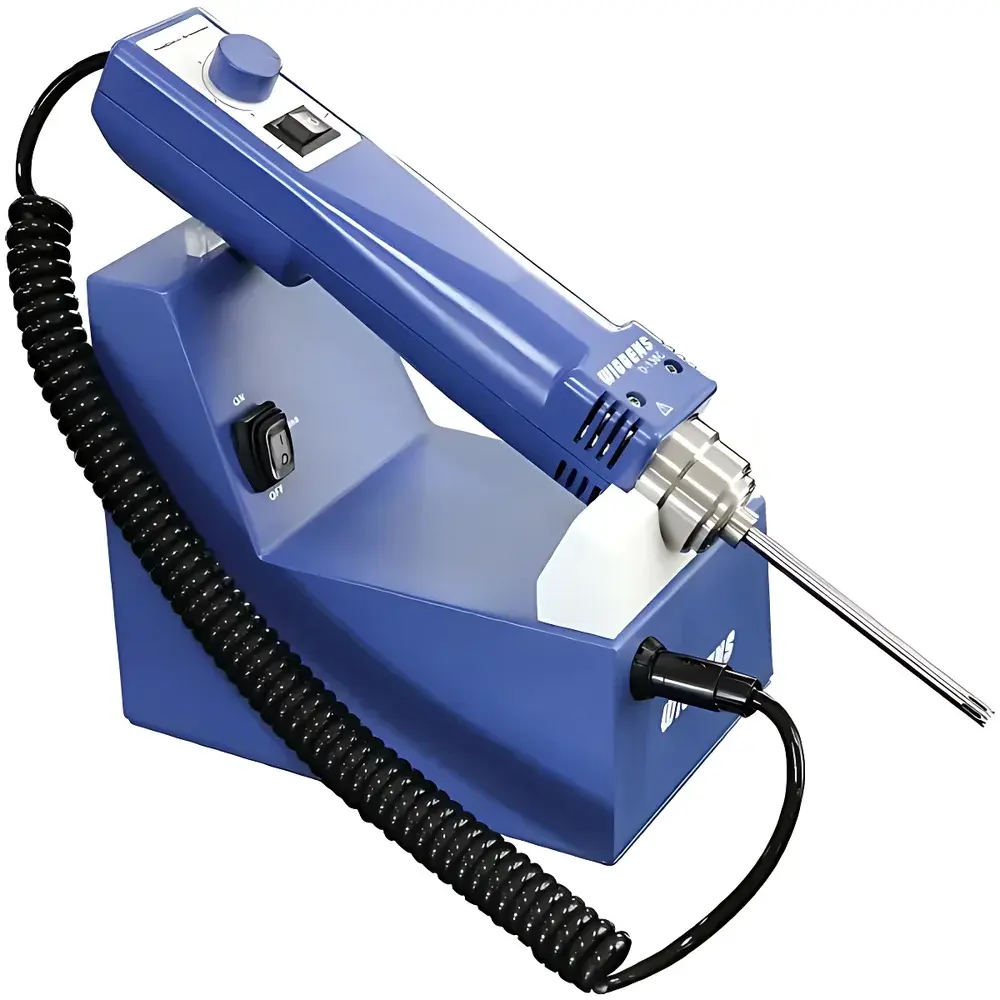
WIGGENS D-130C Handheld High-Shear Rotor-Stator Homogenizer
| Brand | WIGGENS |
|---|---|
| Origin | Germany |
| Model | D-130C |
| Instrument Type | Rotor-Stator Probe Homogenizer |
| Dimensions (W×D×H) | 44 × 58 × 226 mm (handheld unit) |
| Processing Volume Range | 0.2–50 mL (for low-volume probes) / 3–250 mL (for high-volume probes, H₂O-equivalent) |
| No-Load Speed Range | 0–25,000 rpm |
| Motor Power | 100 W |
| Contact Material | ASTM F899 Grade 316L Stainless Steel |
| Ingress Protection Rating | IP30 |
| Shaft Options | Shaft 5E (0.2–50 mL, tip speed 4.7 m/s), Shaft 12E (3–250 mL, tip speed 14.1 m/s) |
| Sterilization Compatibility | Autoclavable (121°C, 20 min), dry heat, and chemical sterilants |
| Control | Analog rotary speed dial with mechanical scale |
| Safety | Dual-switch activation, overload protection, soft-start circuitry |
| Cable | 2 m helical coiled cable for ergonomic handheld operation |
Overview
The WIGGENS D-130C is a precision-engineered handheld rotor-stator homogenizer designed for rapid, reproducible cell disruption, emulsification, dispersion, and particle size reduction in laboratory-scale applications. Operating on the principle of high-shear mechanical homogenization, it utilizes a rotating stainless steel rotor within a fixed concentric stator to generate intense hydrodynamic shear forces—primarily through cavitation, turbulent flow, and velocity gradients—at the narrow gap between rotor and stator surfaces. This mechanism enables efficient lysis of mammalian, bacterial, and plant cells; uniform emulsification of oil-in-water or water-in-oil systems; and consistent deagglomeration of nanoparticles or suspensions. Its compact, ergonomically optimized form factor supports single-hand operation while maintaining full control over speed and immersion depth—critical for sensitive biological samples where thermal denaturation or oxidative damage must be minimized.
Key Features
- Brushless DC motor delivering stable rotational speed across the full 0–25,000 rpm range, with minimal torque fluctuation and low heat generation during extended use.
- Interchangeable 316L stainless steel probe assemblies (Shaft 5E and Shaft 12E) engineered to ASTM F899 standards, fully autoclavable and compatible with ISO 13485-certified cleanroom protocols.
- Quick-coupling probe interface enabling tool-free installation and removal—reducing cross-contamination risk and supporting GLP-compliant workflow documentation.
- Dual-activation safety switch requiring simultaneous press of both thumb-operated controls, preventing accidental start-up and ensuring operator compliance with IEC 61000-4-2 ESD requirements.
- Integrated soft-start circuitry limiting inrush current and minimizing mechanical stress on bearings and drive components—extending service life under repetitive high-load conditions.
- Helical 2 m extension cable with strain relief and reinforced insulation, rated for continuous duty at ambient temperatures up to 40°C and relative humidity ≤80% RH (IEC 60529 IP30).
Sample Compatibility & Compliance
The D-130C accommodates viscous samples up to 10,000 cP when used with appropriate probe geometry and controlled immersion depth. It is routinely validated for use in RNA/DNA extraction workflows per ISO/IEC 17025-accredited laboratories and supports sample preparation aligned with USP sterility testing and FDA 21 CFR Part 11 data integrity requirements when paired with compliant logging software. All wetted parts conform to USP Class VI biocompatibility standards and meet EN 10204 3.1 material certification for traceability. The device complies with CE marking directives (2014/30/EU EMC, 2014/35/EU LVD) and carries RoHS 2011/65/EU conformity documentation.
Software & Data Management
While the D-130C operates via analog speed control without built-in digital connectivity, its mechanical repeatability allows integration into validated SOP-driven environments. When used with optional GS-series dispersion vessels (borosilicate glass or electropolished 316L stainless steel), vortex suppression ensures homogeneous energy distribution—enabling consistent results across replicates required for ISO 5725-2 precision studies. For audit-ready documentation, users may pair the instrument with external time-stamped video recording or third-party RPM loggers meeting GAMP 5 Category 3 validation criteria. Calibration verification can be performed using NIST-traceable tachometers per ASTM E2571.
Applications
- Homogenization of tumor and biopsy tissues for downstream proteomic or genomic analysis (e.g., preparation for LC-MS/MS or qPCR).
- Rapid disintegration of pharmaceutical tablets and coated dosage forms for dissolution testing per USP .
- Cell lysis for subcellular fractionation, organelle isolation, and nucleic acid purification—validated for compatibility with TRIzol®-based RNA extraction protocols.
- Preparation of nanoemulsions and liposomal suspensions for preclinical formulation development.
- Dispersion of carbon nanotubes, graphene oxide, or metal oxide nanoparticles in aqueous or organic media for materials science characterization.
- Homogenization of soil, sediment, or food matrices prior to heavy metal extraction (EPA Method 3050B).
FAQ
What is the maximum recommended operating time per cycle to avoid thermal degradation of heat-sensitive samples?
Continuous operation should not exceed 60 seconds per cycle at speeds >15,000 rpm; allow ≥90 seconds cooling interval between cycles. Use ice-jacketed GS dispersion vessels for thermolabile biomolecules.
Can the D-130C be used with corrosive solvents such as chloroform or concentrated acids?
Only with probes explicitly certified for chemical resistance (e.g., electropolished 316L with passivation per ASTM A967); avoid prolonged exposure to halogenated solvents below pH 2 or above pH 12.
Is the device suitable for GMP manufacturing environments?
Yes—when operated within documented SOPs, with calibrated tachometer verification, probe lot traceability, and maintenance logs compliant with Annex 11 and EU GMP Chapter 4 requirements.
How does the GS dispersion cup improve homogenization efficiency compared to standard cylindrical cups?
Its asymmetric baffle geometry disrupts laminar vortex formation, promoting radial and axial fluid recirculation—increasing effective shear exposure time by ≥40% versus conventional cups, as confirmed by PIV flow visualization per ISO/TR 16937.
What maintenance intervals are recommended for optimal performance?
Inspect rotor/stator alignment and bearing play every 200 hours of cumulative runtime; replace carbon brushes every 1,000 hours; perform full probe sterilization validation annually per ISO 17665-1.



