
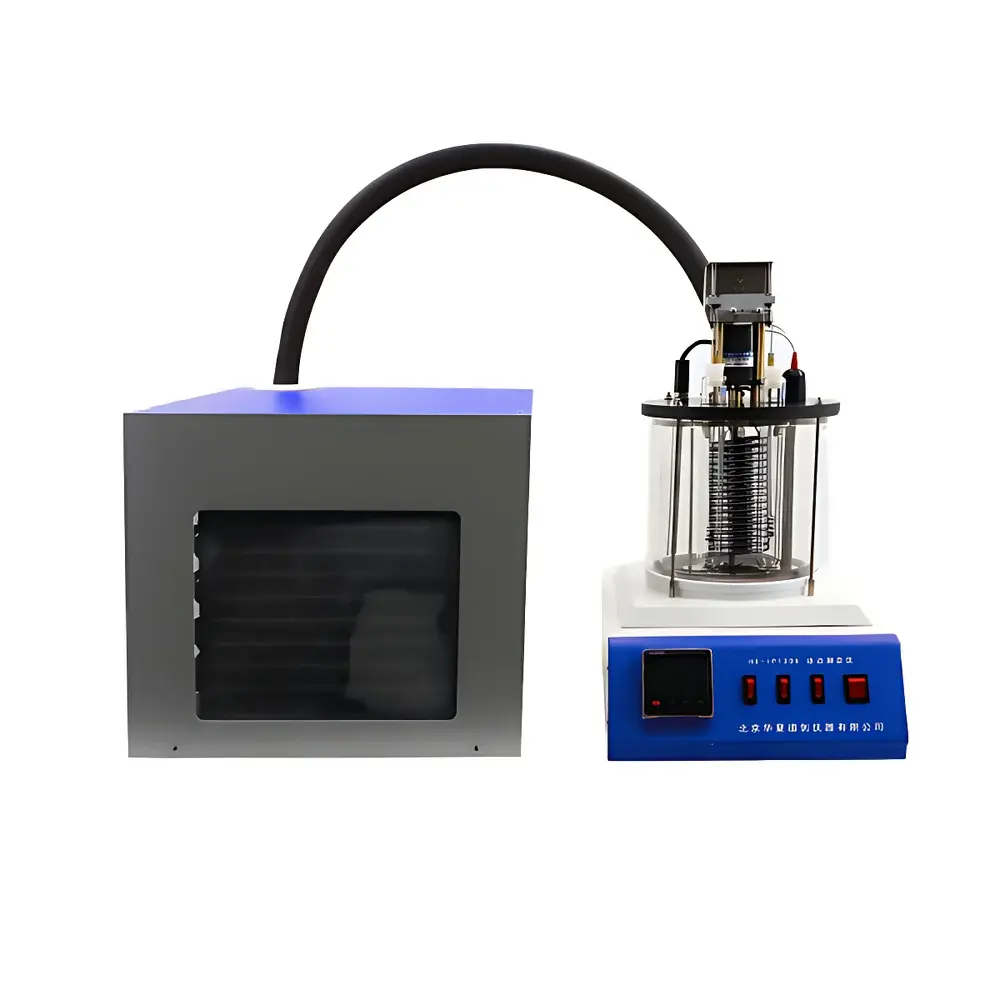
Spectra Invent HX-IP1305 Jet Fuel Freezing Point Analyzer
| Brand | Spectra Invent |
|---|---|
| Origin | Beijing, China |
| Manufacturer Type | Authorized Distributor |
| Country of Manufacture | China |
| Model | HX-IP1305 |
| Price Range | USD 140–14,000 |
| Power Consumption | 600 W |
| Burette Accuracy | 0.1 mL |
| Cooling Bath Temperature Range | −70 °C to Ambient |
| Temperature Resolution | 0.1 °C |
| Heating Power | 600 W |
| Compressor Cooling Power | 800 W |
| Sample Stirring Rate | 60 rpm |
| Bath Agitation | 6 W motor, 1200 rpm |
| Ambient Operating Limit | ≤30 °C, ≤85% RH |
| Electrical Supply | AC 220 V ±10%, 50 Hz |
| Total Power Draw | <2000 W |
| Dimensions (Main Unit) | 400 × 315 × 590 mm |
| Dimensions (Cooling Bath) | 495 × 410 × 395 mm |
| Net Weight | 15.5 kg |
Overview
The Spectra Invent HX-IP1305 Jet Fuel Freezing Point Analyzer is a precision laboratory instrument engineered for the standardized determination of the freezing point of aviation turbine fuels—specifically kerosene-type jet fuels such as Jet A, Jet A-1, and JP-8. It operates on the principle of controlled cooling followed by gradual warming, monitoring the temperature at which solid hydrocarbon crystals—formed during sub-zero conditioning—disappear upon reheating. This thermally reversible phase transition defines the fuel’s freezing point, a critical specification for flight safety, low-temperature operability, and compliance with international fuel quality standards. The instrument implements a dual-stage thermal management system: a high-efficiency compressor-based refrigeration unit cools the double-walled vacuum glass bath to −70 °C, while integrated Peltier-assisted or resistive heating elements enable precise, stepwise warming at programmable rates. Real-time temperature acquisition is performed via a calibrated platinum resistance thermometer (PT100) with 0.1 °C resolution and traceable NIST-equivalent calibration protocols.
Key Features
- Digital microprocessor-controlled temperature regulation with PID algorithm for stable thermal ramping and minimal overshoot.
- Compressor-driven cryogenic cooling system delivering rapid, repeatable bath stabilization down to −70 °C; eliminates reliance on liquid nitrogen or dry ice.
- Automated dual-mode agitation: sample stirring at 60 rpm ensures uniform crystal nucleation and dissolution kinetics, while independent bath circulation (1200 rpm, 6 W motor) maintains thermal homogeneity across the vacuum-jacketed chamber.
- Optically transparent double-layer vacuum glass bath enables unobstructed visual observation of crystal formation and disappearance without compromising thermal insulation or measurement integrity.
- Integrated high-precision temperature sensor with real-time data logging and auto-zero compensation for ambient drift.
- Robust mechanical architecture designed for continuous operation in QC laboratories; meets IEC 61000-4 electromagnetic compatibility requirements and UL/CSA safety certification prerequisites.
Sample Compatibility & Compliance
The HX-IP1305 is validated for use with standard 10–15 mL samples of aviation turbine fuel per ASTM D2386 and GB/T 2430 test methods. Its thermal profile and detection logic conform strictly to the “crystal disappearance” endpoint definition specified in ISO 2531 and IP 16 (Institute of Petroleum). Instrument performance is verified against certified reference materials (CRMs) traceable to NPL (UK) and CNAS-accredited calibration labs. Data output supports audit-ready documentation for GLP and GMP environments; optional firmware upgrade enables 21 CFR Part 11–compliant electronic signatures and audit trail generation. All hardware components contacting fuel are chemically inert (borosilicate glass, PTFE, and stainless-316), ensuring no catalytic interference or leaching during extended testing cycles.
Software & Data Management
The analyzer operates via embedded firmware with a tactile LCD interface and optional USB/RS-232 connectivity for external PC integration. Standard software provides automated test sequencing—including pre-cooling, isothermal hold, controlled warming ramp (0.5–1.0 °C/min), endpoint detection, and final report generation. Raw temperature vs. time datasets are exportable in CSV format for post-processing in LIMS or statistical analysis platforms (e.g., JMP, Minitab). Calibration records, user logs, and method parameters are stored internally with timestamped metadata. Firmware supports user-defined method templates, multi-operator access levels, and password-protected configuration changes—enabling alignment with ISO/IEC 17025 internal quality control requirements.
Applications
- Quality control release testing of jet fuel batches prior to aircraft refueling operations.
- Investigation of fuel cold flow properties during refinery blending optimization.
- Verification of additive efficacy (e.g., cold flow improvers) in fuel formulation R&D.
- Third-party certification testing for military fuel specifications (MIL-DTL-83133, DEF STAN 91-91).
- Environmental stability assessment of bio-derived synthetic paraffinic kerosene (SPK) blends.
- Interlaboratory proficiency testing under ASTM D6708 protocol guidelines.
FAQ
What standards does the HX-IP1305 comply with?
It fully supports GB/T 2430, ASTM D2386, ISO 2531, and IP 16 for jet fuel freezing point determination. Optional validation packages include IQ/OQ documentation aligned with ISO/IEC 17025.
Is the instrument suitable for non-aviation fuels?
No—it is purpose-built for kerosene-based aviation fuels. Diesel, gasoline, or biodiesel require alternative methodologies (e.g., cloud point or pour point analyzers) due to differing crystallization mechanisms.
How often does the temperature sensor require recalibration?
Annual recalibration is recommended using a certified dry-block calibrator; field verification with ice-point reference is supported via built-in diagnostic mode.
Can the HX-IP1305 operate continuously for 8+ hours?
Yes—its thermal management system and power supply are rated for uninterrupted duty cycles under ambient conditions ≤30 °C and ≤85% RH, with active thermal load monitoring to prevent compressor overheat.
Does it support remote monitoring or network integration?
Standard configuration includes RS-232; Ethernet or Wi-Fi modules are available as factory-installed options for integration into centralized lab informatics systems.




