
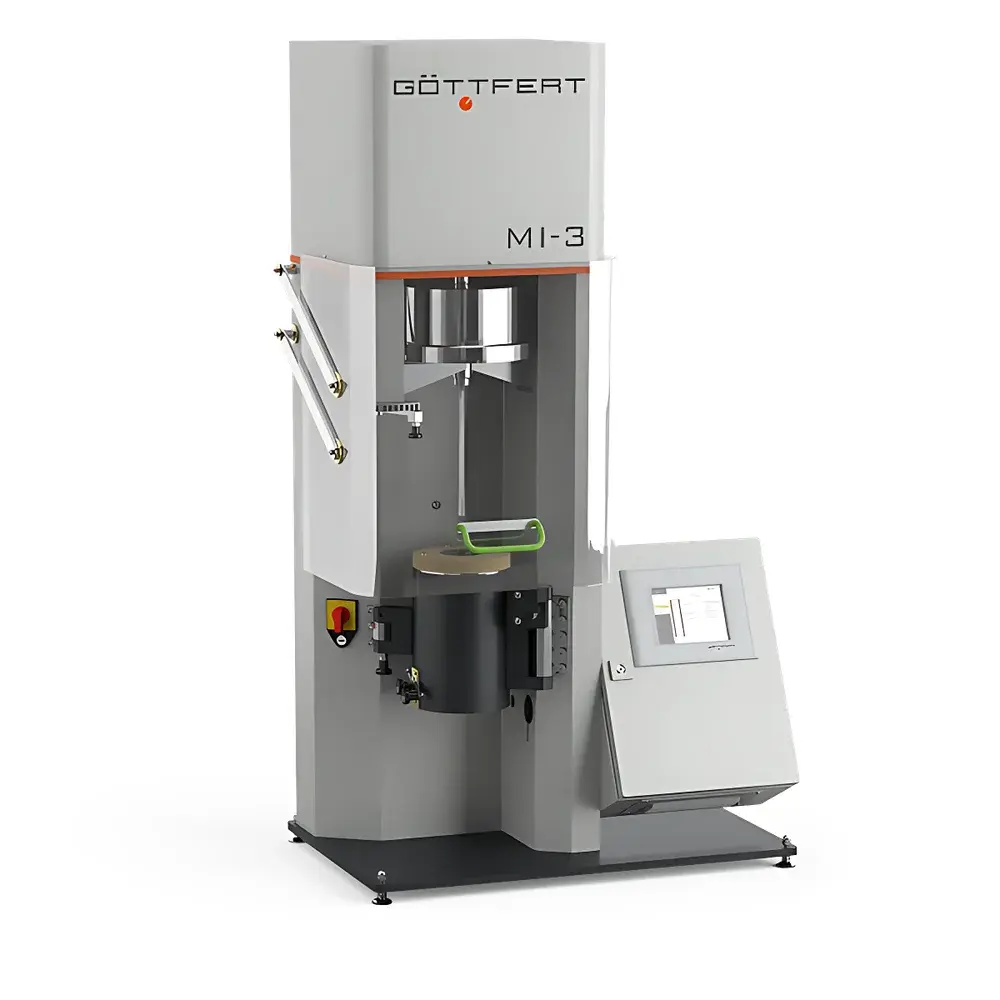
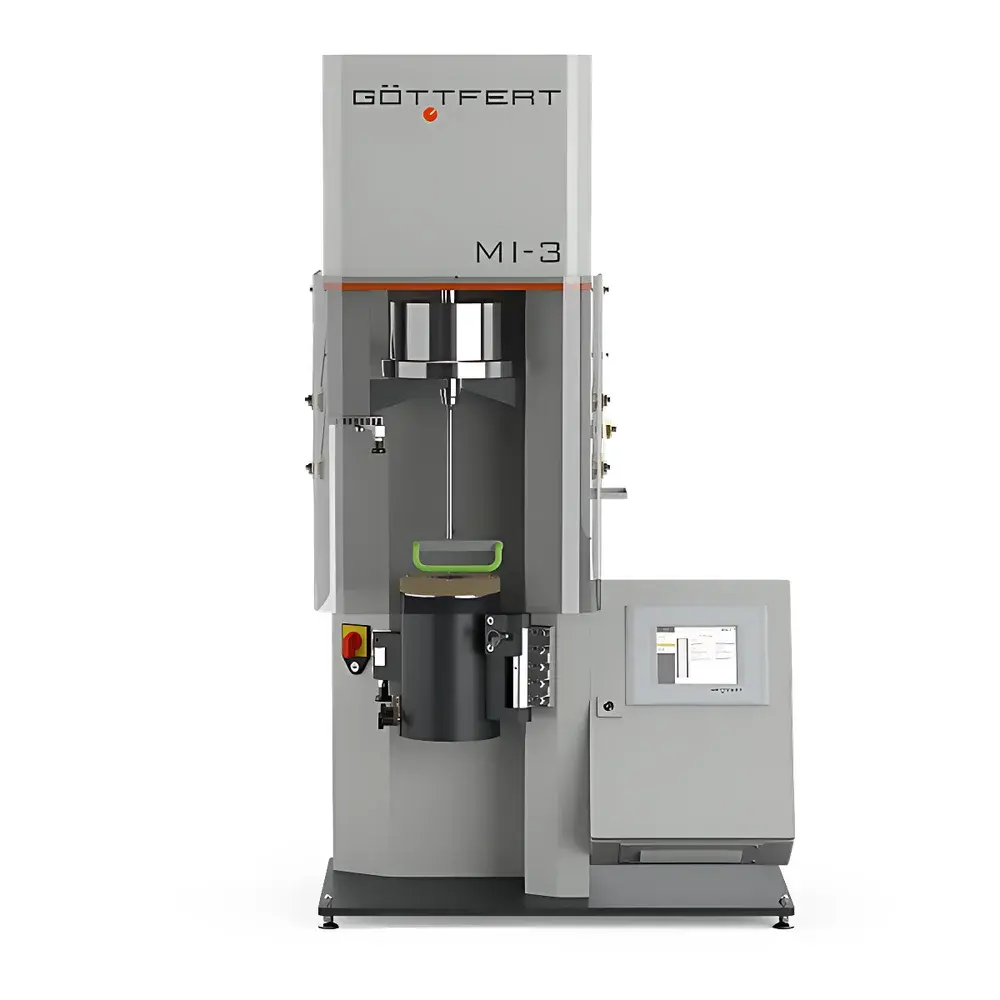
Goettfert MI-3 Semi-Automatic Melt Flow Indexer
| Brand | Goettfert |
|---|---|
| Origin | Germany |
| Model | MI-3 |
| Temperature Range | 60.00–400.00 °C (optional up to 500 °C) |
| Die Diameter | 2.095 ± 0.003 mm, Length: 8.00 ± 0.025 mm |
| Die Material | Tungsten Carbide |
| Piston Diameter | 9.48 ± 0.01 mm |
| Barrel ID | 9.555 ± 0.01 mm |
| Standard Weights | 1.200, 2.16, 3.8, 5.0, 10.0, 21.6 kg (±0.5 % tolerance) |
| Timer Resolution | < 0.001 s |
| MFR Range | 0.01 cm³/min to 2500 g/10 min (with die inserts) |
| Touchscreen | 5.7″ full-color capacitive display |
| Connectivity | Ethernet port for LIMS integration, dual USB ports |
| Compliance | ISO 1133, ASTM D1238 (Methods A, B, C) |
Overview
The Goettfert MI-3 Semi-Automatic Melt Flow Indexer is a precision-engineered instrument designed for the quantitative determination of melt mass-flow rate (MFR) and melt volume-flow rate (MVR) of thermoplastic polymers under standardized thermal and mechanical conditions. Operating on the principle of extrusion rheometry—where molten polymer is forced through a calibrated capillary die under defined temperature and load—the MI-3 delivers metrologically traceable results aligned with international standards. Its core architecture integrates a high-stability heating system, tungsten carbide die and barrel assembly, and a microprocessor-controlled electromechanical weight selection mechanism. Unlike fully manual or legacy semi-automatic systems, the MI-3 eliminates operator-induced variability in weight handling while preserving methodological transparency required for GLP-compliant QC laboratories and R&D environments.
Key Features
- Full-color 5.7-inch capacitive touchscreen interface with intuitive navigation, real-time parameter monitoring, and on-device result visualization—including graphical MFR/MVR trend overlays and pass/fail indicators against user-defined specification limits.
- Electromechanically actuated weight selector enabling rapid, tool-free switching between six certified standard weights (1.200, 2.16, 3.8, 5.0, 10.0, and 21.6 kg), each calibrated to ±0.5 % tolerance per ISO 1133 Annex B requirements.
- High-resolution linear position sensor (sub-micron resolution) coupled with a timer subsystem achieving <0.001 s temporal resolution—critical for accurate MVR calculation and low-flow-rate measurements down to 0.01 cm³/min.
- Rotatable barrel assembly permitting 90° lateral swing-out, significantly improving accessibility during sample loading, die insertion, and post-test cleaning—reducing downtime and minimizing cross-contamination risk.
- Native Ethernet interface supporting direct integration into laboratory information management systems (LIMS) without requiring host PC software; test data exported in CSV or XML format with embedded metadata (operator ID, timestamp, method ID, calibration status).
- Dual USB ports enabling direct connection to external storage (USB flash drives) and line printers for audit-ready hardcopy output—fully compliant with FDA 21 CFR Part 11 requirements when paired with appropriate electronic signature and audit trail configurations.
Sample Compatibility & Compliance
The MI-3 accommodates a broad spectrum of thermoplastic resins—including polyolefins (PP, PE), engineering plastics (PA6, PA66, POM), high-performance polymers (PEEK, PSU), and filled compounds—across viscosity ranges spanning ultra-low (e.g., LDPE) to highly viscous (e.g., fluoropolymers). Its tungsten carbide die and barrel ensure long-term dimensional stability and resistance to abrasive fillers (e.g., glass fiber, mineral additives). The instrument is fully validated for conformance with ISO 1133-1:2011 (determination of MFR/MVR by extrusion plastometer) and ASTM D1238-22 (Standard Test Method for Melt Flow Rates of Thermoplastics by Extrusion Plastometer), supporting all three procedural variants (Method A: mass-based; Method B: volume-based; Method C: multi-weight sequential testing). Optional nitrogen purge capability enables inert-atmosphere testing for oxidation-sensitive materials such as polyacetals or certain polyesters.
Software & Data Management
While the MI-3 operates autonomously via its onboard firmware, it supports centralized control via Goettfert’s optional MI-Link software suite—enabling remote configuration, batch scheduling, and synchronized operation of up to four MI-3 units from a single workstation. All test records include immutable timestamps, weight/die identification codes, temperature ramp profiles, and raw sensor traces (piston displacement vs. time). Data export formats comply with ISO/IEC 17025 documentation requirements, including digital signatures, revision history, and calibration certificate linkage. When integrated into GMP-regulated environments, the system supports configurable audit trails, role-based access control (RBAC), and electronic record retention policies aligned with Annex 11 and ALCOA+ principles.
Applications
The MI-3 serves as a foundational tool in polymer manufacturing quality assurance, incoming raw material inspection, formulation development, and regulatory submission support. Typical use cases include: verification of resin lot consistency prior to extrusion or injection molding; evaluation of thermal degradation effects after multiple processing cycles; correlation of MFR with mechanical properties (e.g., tensile strength, impact resistance); validation of stabilizer package efficacy; and generation of technical data sheets for customer-facing specifications. Its extended MFR range (0.01–2500 g/10 min) and compatibility with heated die inserts make it suitable for both commodity-grade polyolefins and specialty elastomers requiring precise low-load characterization.
FAQ
Does the MI-3 require a dedicated PC for routine operation?
No. The instrument functions independently using its embedded OS and touchscreen interface. A PC is only needed for advanced data aggregation, multi-unit coordination, or LIMS synchronization.
Can the MI-3 perform both MFR and MVR determinations in a single test cycle?
Yes—when equipped with the optional automatic melt cutter and volumetric measurement module, the MI-3 calculates both values concurrently from one extrusion event.
Is calibration traceable to national standards?
All certified weights are supplied with DAkkS-accredited calibration certificates (traceable to PTB, Germany). Temperature sensors are verified using NIST-traceable reference thermometers per ISO 1133 Annex D.
What maintenance intervals are recommended for the tungsten carbide die and barrel?
Under typical QC usage (≤10 tests/day), visual inspection and dimensional verification are advised every 6 months; replacement is typically required after ≥5,000 test cycles or upon detection of surface wear exceeding 0.005 mm radial deviation.
How does the MI-3 handle non-standard test conditions, such as elevated temperatures beyond 400 °C?
An optional high-temperature upgrade extends the operating range to 500 °C, incorporating upgraded heating elements, ceramic insulation, and temperature-compensated PID algorithms—validated per ASTM D1238 Annex A3.






