
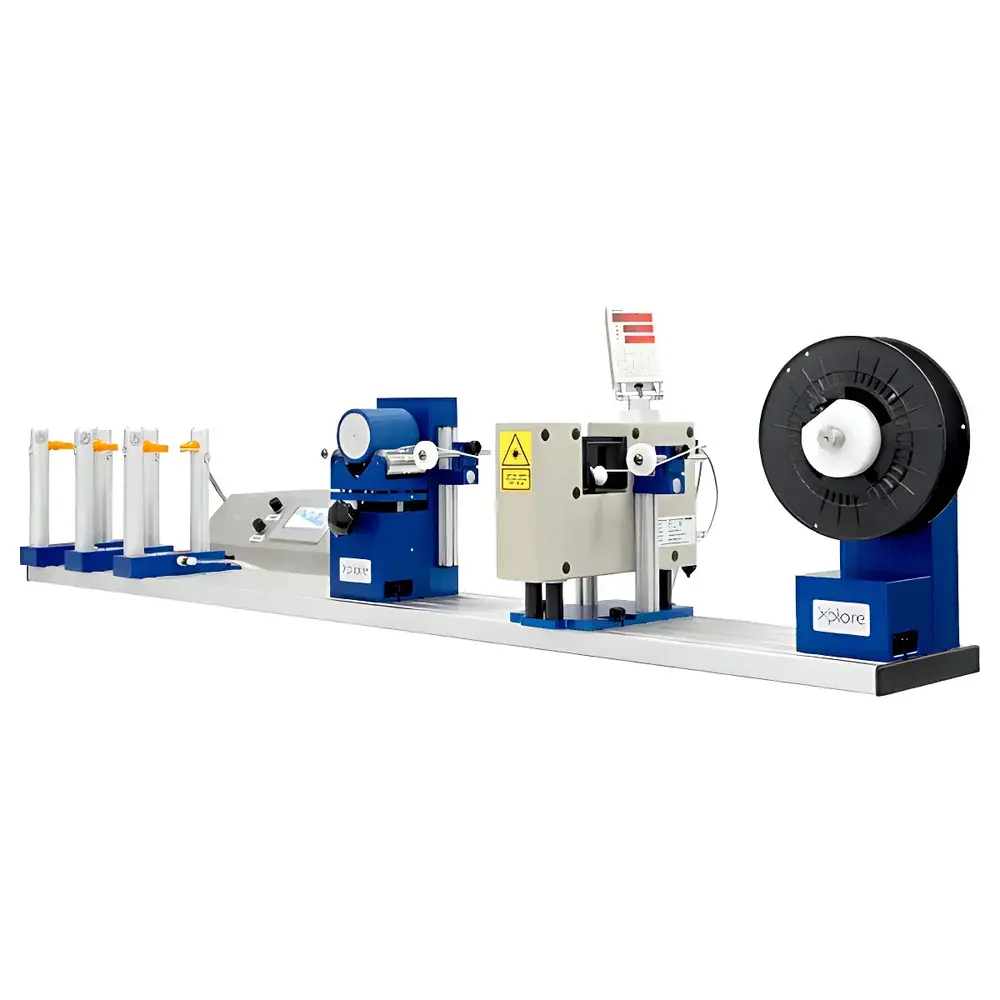
Xplore MC Series 3D Printing Filament Screening Line
| Brand | Xplore Instruments BV |
|---|---|
| Origin | Netherlands |
| Model | Filament Screening Add-on for MC 15 HT / MC 40 Micro Compounders |
| Application | Lab-scale FFF (Fused Filament Fabrication) Filament Development |
| Compatibility | Integrates with Xplore MC 15 HT, MC 40, and retrofittable to legacy MC 15 micro-compounders |
| Die Options | 1.75 mm & 2.85 mm standard filament diameters |
| Line Speed Range | 0.1–10 m/min (adjustable via precision volumetric feeder) |
| Temperature-Controlled Die Head | Equipped with ±0.5 °C PID thermal regulation |
| Optional Accessories | Heated/cooled water bath, filament water separator, industrial spool winder |
Overview
The Xplore MC Series Filament Screening Line is a modular, benchtop-scale extrusion system engineered specifically for rapid formulation screening and process development of thermoplastic filaments used in Fused Filament Fabrication (FFF) additive manufacturing. Unlike conventional pilot-scale extruders, this system integrates directly with Xplore’s MC 15 HT or MC 40 micro-compounders—high-precision, temperature-controlled twin-screw micro-compounding platforms—enabling gram-to-gram material efficiency without compromising rheological fidelity or dimensional reproducibility. The core principle relies on Couette-driven melt conveyance through a temperature-stabilized die head, where precise volumetric feeding ensures consistent mass flow rate, thereby minimizing diameter variation at the die exit. This architecture directly addresses one of the most critical failure modes in filament R&D: inconsistent linear density due to melt flow instability or thermal gradient-induced draw resonance. By decoupling compounding, homogenization, and extrusion into a single synchronized workflow, the system supports closed-loop development from polymer blend design to spooled filament ready for printability assessment.
Key Features
- Gram-scale operation: Processes as little as 5–20 g of polymer per formulation trial, significantly reducing raw material cost and waste during early-stage screening.
- Volumetric feeding integration: Synchronized with Xplore’s gravimetric or loss-in-weight feeders to maintain ±1% mass flow accuracy across variable line speeds (0.1–10 m/min).
- Thermally stabilized die head: Equipped with dual-zone PID control (±0.5 °C stability) and low-resonance geometry to suppress melt fracture and diameter oscillation at the extrudate exit.
- Modular die interchangeability: Standard 1.75 mm and 2.85 mm diameter dies included; optional sub-mm or multi-orifice configurations available for specialty applications.
- Retrofit compatibility: Adaptable to legacy Xplore MC 15 vertical micro-compounders via mechanical and electrical interface kits (requires firmware update v3.2+).
- Integrated spooling: Direct winding onto ISO-standard 3D printing spools (e.g., 200 mm OD, 50 mm ID) with tension-controlled take-up and automatic layer winding logic.
Sample Compatibility & Compliance
The system is validated for standard FFF-compatible thermoplastics including poly(lactic acid) (PLA), acrylonitrile butadiene styrene (ABS), polyethylene terephthalate glycol (PETG), thermoplastic polyurethane (TPU), and engineering-grade blends (e.g., PC/ABS, PA6/66). All wetted components—including screw elements, barrel segments, and die inserts—are manufactured from corrosion-resistant, high-hardness tool steel (HRC ≥ 60) and comply with EU Machinery Directive 2006/42/EC and PED 2014/68/EU for pressure equipment up to 10 bar. Temperature sensors are calibrated per IEC 60751 Class A, and all thermal zones meet ASTM D3835 requirements for laboratory extrusion instrumentation. Data acquisition and parameter logging support audit-ready traceability aligned with GLP and GMP documentation frameworks.
Software & Data Management
Control is managed via Xplore’s proprietary Compounding Studio software (v5.4+), which provides real-time monitoring of torque, melt pressure, barrel zone temperatures, feeder mass flow, and line speed. All operational parameters are timestamped and stored in HDF5 format with built-in metadata tagging (formulation ID, operator, date/time, instrument serial number). Export options include CSV, Excel, and XML for integration with LIMS or statistical analysis platforms (e.g., JMP, MATLAB). The software supports FDA 21 CFR Part 11-compliant user authentication, electronic signatures, and immutable audit trails for regulated environments.
Applications
- Rapid formulation screening of filled polymers (e.g., carbon fiber-, glass bead-, or metal-loaded PLA) for mechanical property optimization.
- Process window mapping for thermal degradation-sensitive biopolymers under low-shear, short residence time conditions.
- Development of conductive, magnetic, or radiopaque filaments requiring tight diameter tolerance (< ±15 µm) and uniform filler dispersion.
- Feasibility studies for recycling streams (e.g., post-industrial ABS regrind) prior to full-scale extrusion trials.
- Calibration reference filament production for in-house printer validation and ISO/ASTM print quality benchmarking (e.g., ISO/ASTM 52900, ASTM D638).
FAQ
Can this system produce filament compliant with ISO/ASTM dimensional standards for FFF?
Yes—when operated within its validated line speed and temperature envelope, the system consistently achieves diameter tolerances of ±15 µm for 1.75 mm filament, meeting ISO/ASTM 52921 Annex A requirements for research-grade filament.
Is offline rheological characterization supported?
The system includes standardized melt sample ports compatible with capillary rheometers (e.g., Göttfert Rosand) and rotational rheometers (e.g., TA AR-G2) for parallel viscoelastic property measurement.
Does the water bath option support both heating and cooling modes?
Yes—the optional recirculating bath operates from 5 °C to 95 °C with ±0.3 °C stability, enabling controlled crystallinity modulation (e.g., annealing PETG) or rapid quenching (e.g., amorphous TPU).





