
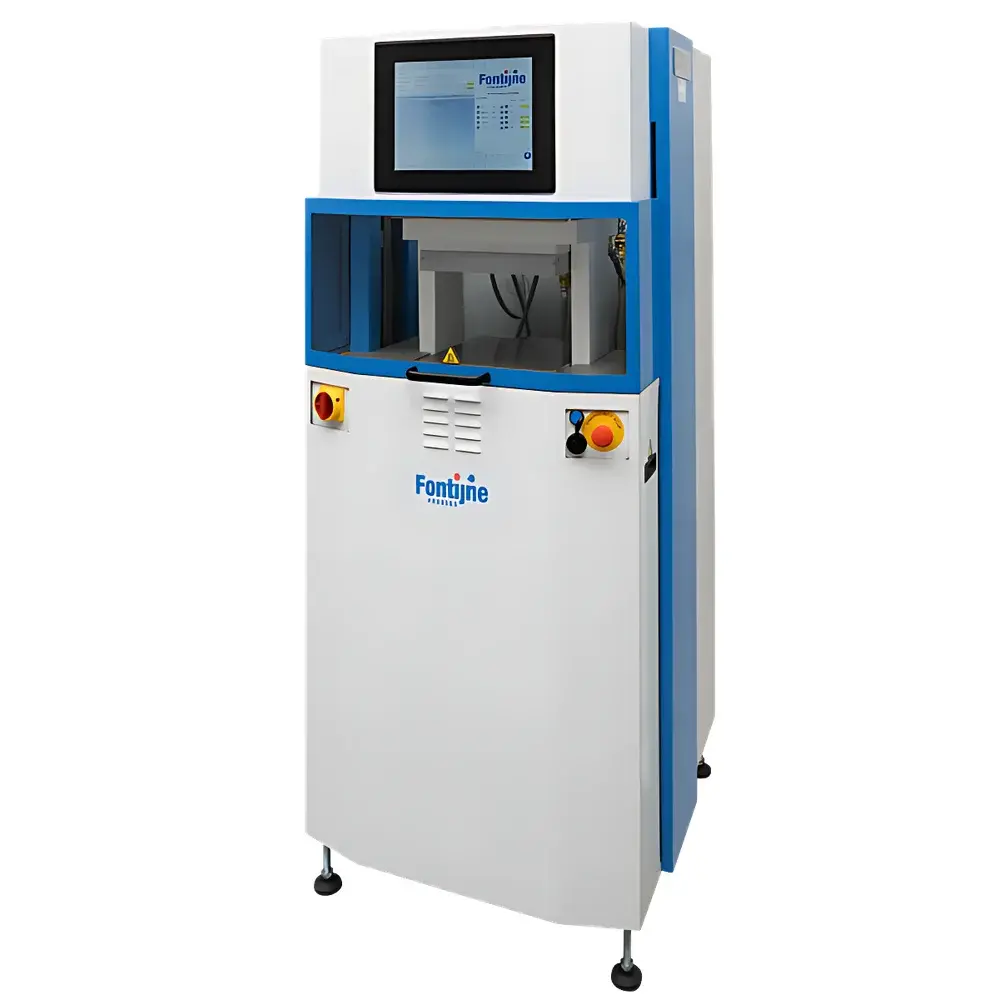
Fortelab LabEcon Series Hydraulic Hot Press /平板硫化机
| Key | Brand: Fortelab |
|---|---|
| Origin | Netherlands |
| Model | LabEcon |
| Force Capacity | 300 / 600 / 1000 kN |
| Platen Size | 320×320 / 400×400 / 500×500 mm |
| Max Temperature | 300 °C (optional 400 °C) |
| Control System | TP Control (8.4″ touchscreen) or Pro-View Control (15″ touchscreen) |
| Power Supply | 3×400 V / 50 Hz or 3×480 V / 60 Hz |
| Weight | 600 / 800 / 1000 kg |
| Compliance | ASTM, DIN, ISO |
Overview
The Fortelab LabEcon Series Hydraulic Hot Press is a precision-engineered laboratory-scale hot press and平板硫化机 (flat-bed vulcanizer), designed for reproducible sample preparation of polymeric, ceramic, composite, and elastomeric materials under controlled temperature, pressure, and dwell time. Operating on the principle of uniaxial hydraulic compression combined with uniform resistive heating of parallel platens, the LabEcon system delivers high-force, high-temperature consolidation essential for standardized pellet formation (e.g., KBr pellets for FTIR), thermoplastic compression molding, rubber vulcanization, and sintering preforms. Its dual-column rigid frame ensures exceptional platen parallelism (< 5 µm deviation across full surface), critical for uniform density distribution in pressed samples and consistent cross-linking in elastomer curing. The system complies with fundamental requirements of ASTM D3182 (rubber compounding), ASTM E2922 (FTIR pellet preparation), ISO 527-2 (tensile test specimen molding), and DIN 53505 (rubber hardness testing prep), making it suitable for GLP-compliant laboratories and quality control environments.
Key Features
- Two-column monolithic frame with high rigidity and optimized column spacing — enables easy sample loading/unloading while maintaining < 0.01 mm platen parallelism over full stroke
- Fixed upper platen and motorized lower platen — ensures stable thermal boundary conditions and eliminates drift during dwell phase
- High-precision hydraulic pressure regulation — maintains set force within ±0.5% of full scale via closed-loop servo-valve control
- Uniform platen temperature distribution — achieved through embedded cartridge heaters and PID-controlled thermocouple feedback (±0.5 °C stability at 200 °C)
- Programmable multi-step cycles — independently configurable ramp rates for heat-up, pressurization, hold, and cooling phases
- Dual control platform options: TP Control (8.4″ industrial touchscreen, method storage for up to 100 protocols) and Pro-View Control (15″ HMI with variable-speed hydraulic actuation, audit trail logging, and user-level access management)
- Integrated safety architecture — includes dual-channel emergency stop, mechanical overload protection, platen gap sensors, and automatic pressure relief on power loss
- Compact footprint design — vertical column layout minimizes lab floor space without compromising structural integrity or thermal isolation
Sample Compatibility & Compliance
The LabEcon accommodates a broad range of sample geometries and material classes: thermoplastics (PP, PE, PEEK), thermosets (epoxy, phenolic), elastomers (NR, SBR, EPDM), inorganic powders (metal oxides, ceramics), and spectroscopic matrices (KBr, CsI). Optional configurations include multi-zone platen heating (for gradient sintering), stainless-steel or chrome-plated platens (for corrosive or high-adhesion formulations), vacuum-assisted degassing modules, and external chiller integration (for rapid quenching below 40 °C). All standard models meet CE Machinery Directive 2006/42/EC and are supplied with Factory Acceptance Test (FAT) documentation. Software controls support 21 CFR Part 11 readiness when configured with Pro-View Control — including electronic signatures, change history, and immutable audit logs for GMP-regulated environments.
Software & Data Management
Both TP and Pro-View control systems record real-time temperature, pressure, position, and time data at ≥1 Hz sampling rate. Experimental methods are stored as encrypted XML files with versioned metadata (operator ID, timestamp, calibration status). Data export supports CSV, PDF report generation, and direct transfer via Ethernet or USB. Pro-View adds role-based authentication (admin/operator/auditor), automated backup to network drives, and configurable alarm thresholds with email/SNMP notification. All firmware updates are digitally signed and validated prior to installation. Calibration certificates traceable to NIST or EU-accredited labs are provided with initial commissioning.
Applications
- Preparation of infrared-transparent pellets for quantitative FTIR analysis (ASTM E1421)
- Vulcanization of rubber compounds per ASTM D3182 and ISO 34-1
- Compression molding of polymer test specimens for mechanical testing (ISO 527, ASTM D638)
- Densification of ceramic green bodies prior to sintering
- Hot pressing of battery electrode coatings onto current collectors
- Consolidation of metal powder compacts for metallurgical analysis
- Thermal lamination of multilayer polymeric films
FAQ
What is the maximum recommended operating temperature for standard LabEcon models?
Standard configurations are rated to 300 °C; an optional high-temperature package extends capability to 400 °C with upgraded insulation, thermocouples, and platen coatings.
Can the LabEcon be integrated into a laboratory automation workflow?
Yes — Ethernet/IP and Modbus TCP interfaces are available for SCADA or LIMS integration; custom API scripting support is offered under extended service agreements.
Is platen parallelism verified during factory calibration?
Yes — each unit undergoes optical interferometry verification of platen flatness and parallelism before shipment; a certified calibration report is included.
What maintenance intervals are recommended for hydraulic and heating subsystems?
Hydraulic oil analysis every 2,000 operating hours; heater resistance verification annually; platen surface inspection recommended after every 500 high-temperature cycles.
Does Fortelab provide application-specific method development support?
Yes — application engineers offer remote and on-site protocol optimization for materials ranging from pharmaceutical excipients to aerospace composites, supported by documented SOP templates.



