
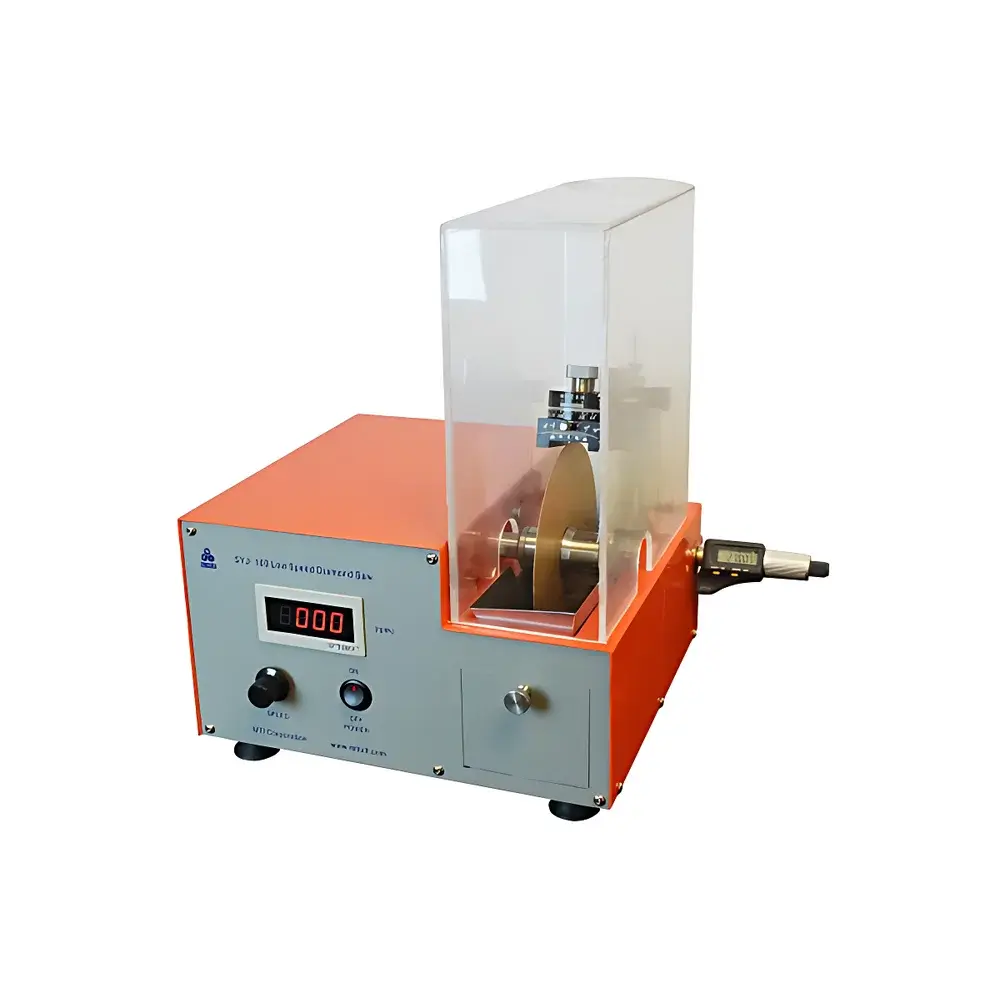
English Product Name
| Brand | Hefei Kejing |
|---|---|
| Origin | Anhui, China |
| Model | SYJ-160 |
| Instrument Type | Metallographic Cutting Machine |
| Spindle Speed Range | 20–600 rpm (stepless, digital display) |
| Feed Positioning Accuracy | 0.01 mm (digital micrometer standard) |
| Maximum Feed Stroke | 50 mm (fine-adjustment range: 25 mm) |
| Biaxial Sample Adjustment | Horizontal rotation 360°, vertical tilt ±15° |
| Blade Diameter | Φ150 mm |
| Power Supply | AC 110 V / 220 V, 70 W |
| Dimensions (L×W×H) | 406 × 310 × 193 mm |
| Weight | 15 kg |
Overview
The Hefei Kejing SYJ-160 Precision Low-Speed Diamond Wafering Saw is an engineered solution for controlled, low-thermal-impact sectioning of brittle, hard, and heterogeneous materials in research and quality control laboratories. Operating on the principle of slow-speed abrasive cutting—typically at rotational speeds between 20 and 600 rpm—the system minimizes mechanical stress and localized heating, thereby preserving microstructural integrity during sample preparation. Unlike high-speed cutoff saws that induce phase transformation or recrystallization in sensitive specimens, the SYJ-160 delivers reproducible planar cuts with minimal kerf loss and negligible subsurface damage. Its design prioritizes dimensional fidelity and positional repeatability, making it especially suitable for preparing specimens for subsequent metallographic analysis, SEM/TEM cross-sectioning, XRD orientation mapping, and thin-film device fabrication. The machine is widely deployed in academic materials science departments, geological core analysis labs, biomedical device R&D centers, and advanced ceramics development facilities where specimen preservation is a prerequisite for valid analytical outcomes.
Key Features
- High-torque, low-noise DC motor drive ensures stable spindle rotation across the full speed range, reducing vibration-induced deviation and improving cut edge straightness.
- Digital micrometer feed system (standard) enables precise 0.01 mm incremental positioning—critical for serial sectioning, thickness-controlled wafering, and multi-layer interface analysis.
- Biaxial adjustable sample stage supports 360° horizontal rotation and ±15° vertical tilt, facilitating angled cuts, oblique sectioning, and optimal grain alignment relative to the cutting plane.
- Integrated coolant delivery system uses blade rotation to lift water-based coolant from the reservoir into direct contact with the cut zone, preventing thermal degradation of temperature-sensitive materials (e.g., polymers, dental composites, frozen biological tissues).
- Programmable mechanical limit switch allows unattended operation for predefined stroke lengths—enhancing workflow efficiency while maintaining operator safety compliance per ISO 13857 and IEC 61000-6-2.
- Modular blade compatibility accommodates sintered diamond, electroplated diamond, silicon carbide, aluminum oxide, and cubic boron nitride blades (Φ150 mm standard), enabling method optimization across material classes without hardware modification.
Sample Compatibility & Compliance
The SYJ-160 is validated for sectioning a broad spectrum of rigid and semi-rigid specimens including single-crystal substrates (Si, GaAs, sapphire), structural ceramics (Al₂O₃, ZrO₂), optical glasses, geological thin sections (basalt, quartzite), metallurgical alloys (Ti-6Al-4V, Inconel), PCB laminates, cardiovascular stents, dental prosthetics, refractory bricks, and construction-grade concrete cores. All standard accessories—including resin-bonded ceramic blocks, aluminum sample plates, and wax mounting rods—are selected to avoid contamination and ensure secure clamping under low-force, high-precision feed conditions. The system conforms to general laboratory equipment safety standards (IEC 61010-1) and supports GLP-compliant documentation when integrated with external logbook systems. While not certified for inert-atmosphere operation (per warning label), its electrical architecture meets CE marking requirements for EMC and LVD directives.
Software & Data Management
The SYJ-160 operates as a standalone electromechanical instrument with no embedded firmware or proprietary software interface. All operational parameters—including spindle speed, feed position, and stroke limits—are set manually via front-panel dials and calibrated micrometers. This analog-digital hybrid architecture eliminates software validation burdens associated with FDA 21 CFR Part 11 or EU Annex 11 compliance, making it suitable for regulated environments where audit trails are maintained externally (e.g., paper-based SOP logs or LIMS-integrated workflow records). Digital micrometer readouts provide traceable, non-volatile positional data that can be transcribed directly into lab notebooks or electronic batch records. Optional calibration certificates for the micrometer and spindle encoder (available upon request) support metrological traceability to NIST-traceable references.
Applications
- Preparation of TEM lamellae from bulk ceramics and intermetallic compounds using sequential low-speed slicing and manual polishing.
- Cutting of fragile semiconductor wafers and photovoltaic cells prior to cross-sectional SEM imaging.
- Sectioning of mineralogically complex rock cores for petrographic analysis and fluid inclusion studies.
- Isolation of discrete layers from multilayered battery electrodes (e.g., NMC cathodes on Cu foil) without delamination.
- Production of standardized tensile bars from additively manufactured metal parts for ASTM E8/E21 mechanical testing.
- Microsectioning of calcified vascular tissue and bone-implant interfaces for histomorphometric evaluation.
FAQ
Can the SYJ-160 operate in an argon glovebox environment?
No. The motor and electrical components are not sealed for inert-gas atmospheres; operation in argon may result in insulation breakdown or short-circuit failure.
What is the maximum recommended sample height for stable clamping?
For optimal rigidity and vibration damping, samples exceeding 40 mm in height should be supported with auxiliary resin mounts or custom-machined jigs.
Is the digital micrometer calibrated at the factory?
Yes—each unit ships with a certificate of conformance indicating verification against traceable gauge blocks; recalibration is recommended annually or after 5,000 operational cycles.
Can the SYJ-160 accommodate blades larger than Φ150 mm?
No. The flange geometry, motor torque profile, and guard clearance are engineered exclusively for Φ150 mm blades; larger diameters compromise mechanical stability and safety interlock functionality.
Does the system meet ISO 14001 or RoHS requirements?
While not formally certified, all plastics, metals, and coatings comply with RoHS Directive 2011/65/EU restrictions on hazardous substances; full environmental management documentation is available upon request.



