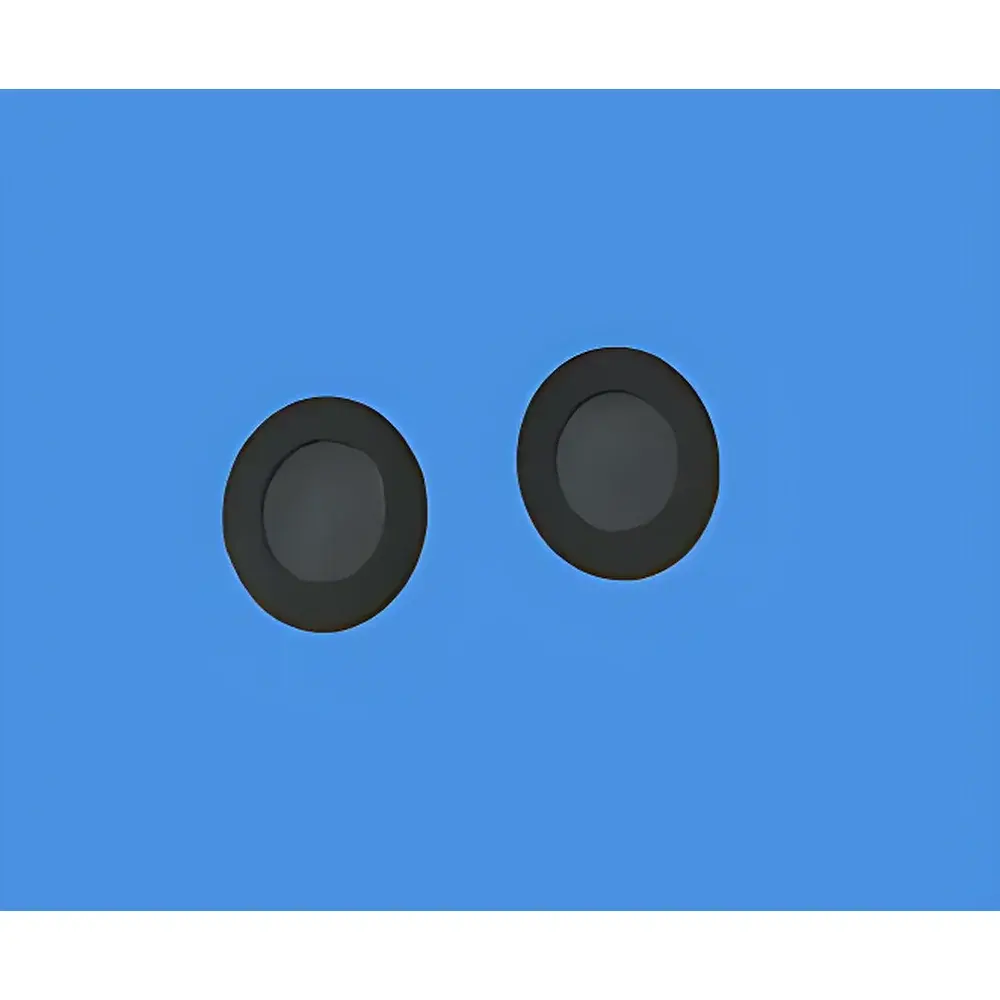
Silicon Non-Diffracting Substrate with Precision Circular Aperture
| Brand | Hefei Kejing |
|---|---|
| Origin | Anhui, China |
| Manufacturer Type | Authorized Distributor |
| Origin Category | Domestic (China) |
| Model | Si Non-Diffracting Substrate with Circular Aperture |
| Pricing | Available Upon Request |
| Dimensions | Ø24.6 × 1.0 mm (aperture Ø10 × 0.2 mm, single- or double-side polished) |
| Optional | Ø32 × 1.0 mm (aperture Ø10 × 0.2 mm, single- or double-side polished) |
| Packaging | Vacuum-sealed in Class 100 cleanroom bags, stored and packaged in Class 1000 cleanroom environment |
Overview
The Si Non-Diffracting Substrate with Precision Circular Aperture is a high-purity, single-crystal silicon wafer engineered for optical and metrological applications where minimal wavefront distortion and controlled beam transmission are critical. Unlike conventional substrates that introduce diffraction artifacts due to edge scattering or surface irregularities, this substrate leverages the intrinsic low-dispersion properties of crystalline silicon combined with precisely defined geometric apertures to suppress higher-order diffraction modes. Its design conforms to principles of scalar diffraction theory—specifically optimized to satisfy the Babinet–Bouguer criterion for aperture-based beam shaping—enabling stable, repeatable illumination profiles in interferometric alignment systems, laser cavity diagnostics, and reference-grade photonic calibration setups. The substrate is fabricated from Czochralski-grown, oxygen-lean silicon (resistivity > 1000 Ω·cm, orientation), ensuring uniform refractive index (n ≈ 3.42 at 1550 nm) and negligible thermal lensing under moderate CW irradiation.
Key Features
- High-precision circular aperture (Ø10.0 ± 0.1 µm) fabricated via deep reactive ion etching (DRIE) with vertical sidewalls (aspect ratio > 5:1) and sub-nanometer surface roughness (Ra < 0.3 nm over aperture region)
- Available in two standard geometries: Ø24.6 × 1.0 mm and Ø32.0 × 1.0 mm wafers, both with identical aperture specification and optional single- or double-side chemical-mechanical polishing (CMP)
- Surface finish certified per SEMI MF1530: total thickness variation (TTV) ≤ 0.5 µm, bow ≤ 5 µm, warp ≤ 8 µm
- Optical transmission profile characterized across 1.2–1.65 µm (C- and L-bands), demonstrating <0.5% RMS deviation from ideal Airy pattern in far-field measurements
- Structural integrity validated per MIL-STD-883H Method 2011.9 (mechanical shock) and Method 2007.2 (vibration), suitable for integration into vacuum-compatible optomechanical mounts
Sample Compatibility & Compliance
This substrate is compatible with standard semiconductor handling protocols and integrates seamlessly into Class 100 cleanroom workflows. It meets ISO 14644-1 Class 5 airborne particulate requirements post-packaging and complies with SEMI S2-0215 safety guidelines for silicon wafer handling. While not certified to ASTM F1529 or ISO 10110-7 for optical surfaces per se, its dimensional and surface specifications exceed typical thresholds for metrology-grade reference substrates used in NIST-traceable calibration laboratories. The vacuum-sealed packaging (Class 100 bag inside Class 1000 cleanroom) ensures contamination control compliant with IEST-STD-CC1246E Level 10 particle limits (<10 particles ≥ 0.1 µm per cm²).
Software & Data Management
No embedded firmware or proprietary software is associated with this passive optical component. However, it is routinely used in conjunction with industry-standard metrology platforms—including Zygo Verifire™ interferometers, Keysight TrueForm waveform generators (for modulated beam profiling), and MATLAB-based diffraction modeling toolchains (e.g., using the Angular Spectrum Method or Fresnel–Kirchhoff integrals). Full traceability documentation—including wafer lot ID, individual substrate serial number, surface map reports (via white-light interferometry), and aperture metrology certificates—is provided with each shipment in PDF format, structured to support GLP-compliant record retention and FDA 21 CFR Part 11 audit readiness when deployed in regulated R&D environments.
Applications
- Laser beam collimation and spatial filtering in ultrafast oscillator cavities
- Reference aperture for calibrating scanning near-field optical microscopy (SNOM) probes
- Mask alignment fiducial in photolithography process development (non-imaging use)
- Wavefront sensor calibration targets for Shack–Hartmann arrays operating in NIR
- Controlled-diffraction test elements in ISO 10110-5 compliant optical testing suites
- Substrate for epitaxial growth of 2D materials where aperture-defined nucleation zones are required
FAQ
Is this substrate anti-reflective coated?
No. It is supplied uncoated to preserve native silicon’s broadband NIR transmission and allow user-specific thin-film deposition (e.g., SiO₂/TiO₂ AR stacks at 1550 nm).
Can custom aperture sizes or shapes be manufactured?
Yes. Custom DRIE apertures down to Ø2 µm (with reduced aspect ratio) or rectangular/slit geometries are available under NRE agreement; lead time extends by 4–6 weeks.
What is the maximum permissible power density for CW laser exposure?
At 1550 nm, continuous-wave exposure up to 5 kW/cm² is supported without measurable thermal deformation, assuming proper heat sinking via kinematic mount.
Are individual substrate certification reports provided?
Yes. Each unit ships with a digital certificate including interferometric surface map, aperture SEM cross-section, and particulate assay data.
Is the substrate suitable for UHV applications?
Yes. Outgassing rate measured per ASTM E595 is <1.0 × 10⁻⁵ g/g/h at 120 °C; no organic residues detected via FTIR reflectance spectroscopy.