
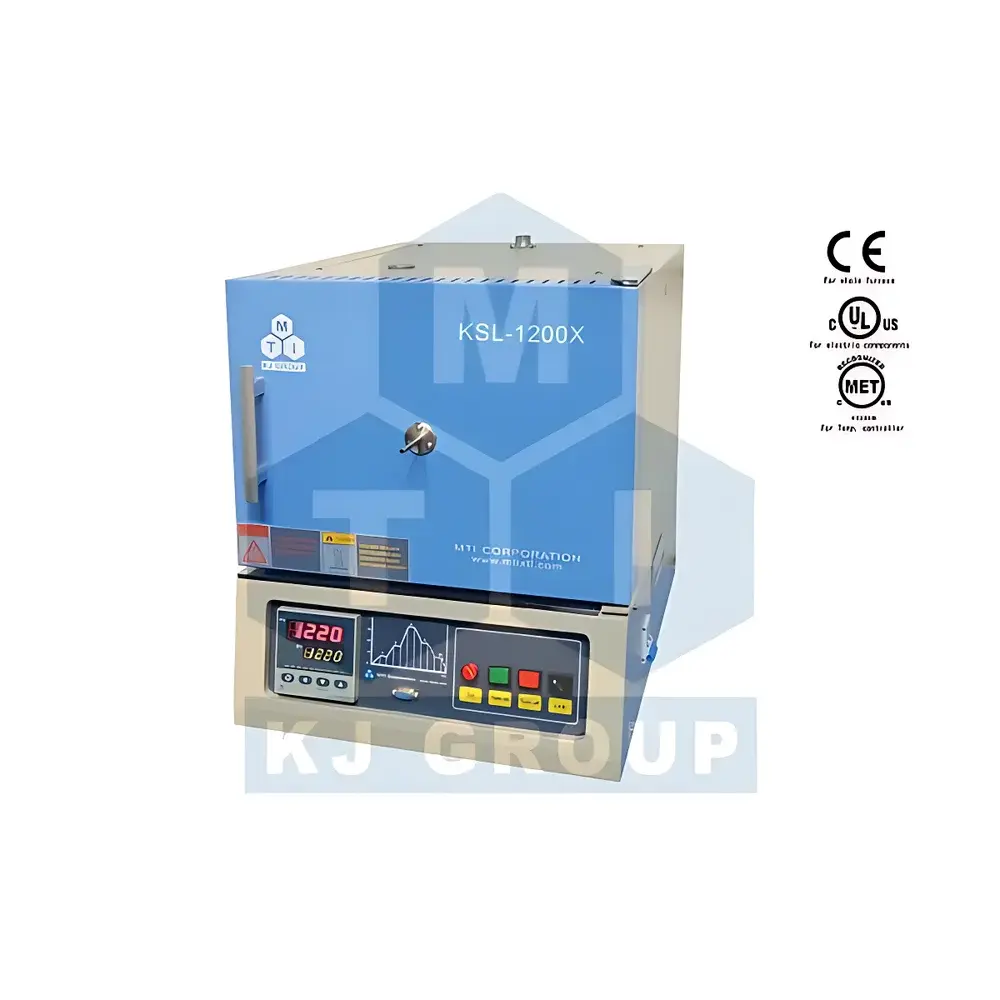
KSL-1200X Desktop Box Furnace (7.2 L, Gas Inlet & Observation Window)
| Brand | Hefei Kejing |
|---|---|
| Origin | Anhui, China |
| Manufacturer Type | Authorized Distributor |
| Product Category | Domestic |
| Model | KSL-1200X |
| Instrument Type | Box-Type Muffle Furnace |
| Maximum Temperature | 1200 °C |
| Continuous Operating Temperature | ≤1100 °C |
| Temperature Uniformity | ±1 °C |
| Heating Rate | Up to 10 °C/min |
| Power Supply | AC 220 V, 50/60 Hz |
| Rated Power | 3.5 kW |
| Chamber Dimensions | 200 × 300 × 120 mm (L×W×H) |
| External Dimensions | 430 × 530 × 500 mm |
| Net Weight | 30 kg |
| Heating Element | Kanthal® A1 Resistance Wire (Swedish) |
| Insulation | Alumina Microcrystalline Fiber |
| Reflective Coating | US-imported 1750 °C-rated Al₂O₃ High-Emissivity Coating |
| Cooling System | Dual-shell Air-Cooling Circulation |
| Thermocouple | K-Type |
| Temperature Controller | 30-Stage Programmable PID Controller |
| Safety Certifications | CE, UL/MET/CSA (for all components >24 V), Optional TÜV or CSA Single-Unit Certification (customer-funded) |
| Gas Inlet | Ø6 mm (replaces observation window when installed) |
| Viewing Port | Integrated quartz-glass observation window |
| Exhaust Port | Dedicated flue outlet |
| Compliance | Designed for GLP-compliant thermal processing |
Overview
The KSL-1200X is a precision-engineered desktop box furnace designed for controlled high-temperature thermal processing in research laboratories and quality assurance facilities. Operating on the principle of resistive heating via Kanthal® A1 alloy wire—known for its oxidation resistance and structural stability up to 1400 °C—the furnace delivers reproducible thermal profiles across a working range of ambient to 1200 °C, with continuous operation rated at ≤1100 °C. Its dual-shell stainless steel construction incorporates an integrated air-cooling circulation system between layers, enabling surface temperatures below 60 °C under full-load conditions while maintaining thermal efficiency. The furnace chamber is lined with high-purity alumina microcrystalline fiber insulation (density ≥128 kg/m³), minimizing heat loss and ensuring rapid thermal response. A proprietary 1750 °C-rated alumina-based reflective coating is applied to the inner chamber walls to enhance radiant heat transfer uniformity and extend refractory service life. Unlike vacuum or inert-atmosphere tube furnaces, the KSL-1200X is configured for ambient-pressure operation with optional gas inlet (Ø6 mm) and visual monitoring capability—making it suitable for oxidative, reductive, or low-flow purged environments where real-time sample observation is critical.
Key Features
- Three-sided Kanthal® A1 heating configuration ensures axial and radial temperature homogeneity within ±1 °C across the 7.2 L effective chamber volume
- 30-stage programmable PID temperature controller with ramp-soak-hold functionality, supporting complex thermal cycles for sintering, annealing, ashing, and calcination protocols
- Quartz-glass observation window (standard) enables non-invasive visual assessment of sample morphology, color transition, or phase change during heating
- Dual-shell structure with forced-air interstitial cooling maintains external casing temperature <60 °C at 1100 °C internal setpoint, enhancing operator safety and lab space compatibility
- UL/MET/CSA-certified electrical components (>24 V) meet North American safety standards; CE marking confirms compliance with EU Machinery Directive 2006/42/EC and EMC Directive 2014/30/EU
- Optional single-unit TÜV or CSA certification available upon customer request and funding, supporting regulatory submissions in pharmaceutical or aerospace QA workflows
Sample Compatibility & Compliance
The KSL-1200X accommodates standard ceramic crucibles (e.g., Al₂O₃, ZrO₂), metal holders, and refractory boats within its 200 × 300 × 120 mm chamber. It supports atmospheric, nitrogen-purged, argon-flushed, or mildly reducing atmospheres—but is explicitly not rated for vacuum, hydrogen-rich, or explosive gas environments. Corrosive gases (e.g., Cl₂, NH₃, HF, SO₂) require prior notification; custom chamber coating or liner upgrades are available to mitigate chemical degradation. Minor hairline cracking in the alumina fiber lining may occur after extended thermal cycling—this is inherent to fibrous insulation materials and does not impair performance or safety. Repairs can be performed using the supplied high-temperature alumina sealant. The furnace conforms to ASTM E1112 (Standard Specification for Laboratory Furnaces) for temperature uniformity verification and aligns with ISO/IEC 17025 clause 6.4.3 regarding equipment suitability for accredited testing.
Software & Data Management
While the KSL-1200X operates via standalone hardware-based PID control, its 30-segment program interface supports manual logging and traceable parameter entry. For laboratories requiring electronic records, the controller’s RS485 port enables integration with third-party SCADA or LIMS platforms via Modbus RTU protocol. All temperature setpoints, dwell times, and ramp rates are retained in non-volatile memory. Audit trails—including operator ID, start/stop timestamps, and deviation alerts—are maintainable through external data acquisition systems compliant with FDA 21 CFR Part 11 requirements when paired with validated software. Firmware updates and calibration certificate documentation are provided with each unit shipment.
Applications
This furnace serves as a core thermal platform in academic materials science labs for ceramic sintering, battery cathode synthesis, and catalyst activation. Industrial users apply it for metallurgical annealing of small-format alloys, residual stress relief in additive-manufactured parts, and ASTM-compliant ash content analysis (ASTM D3174). Quality control departments utilize its stable 1100 °C plateau for refractory brick testing (ASTM C24), glass transition evaluation, and thermal stability screening of polymers and composites. Its compact footprint and side-opening door facilitate rapid sample loading/unloading in high-throughput settings without compromising thermal recovery time.
FAQ
Can the KSL-1200X be used under vacuum or inert gas pressure?
No. This model lacks vacuum sealing and pressure-rated construction. It is intended for ambient-pressure operation only.
What is the recommended maximum heating and cooling rate?
To preserve insulation integrity and thermocouple longevity, a maximum ramp rate of 10 °C/min is advised for both heating and cooling phases.
Is the observation window compatible with high-temperature optical pyrometry?
Yes—the fused quartz viewport transmits visible and near-infrared radiation (350–2200 nm), enabling non-contact temperature measurement using calibrated infrared pyrometers.
How often should the Kanthal® heating elements be replaced?
Under typical usage (≤1100 °C, 4–6 h/day), elements exhibit service life exceeding 2,000 operating hours. Replacement intervals depend on thermal cycling frequency and atmosphere composition.
Does the furnace support GLP or GMP documentation requirements?
Yes—when operated with validated procedures and paired with compliant data logging tools, it meets key GLP (OECD Principles) and GMP (ICH Q7) criteria for equipment qualification and thermal process validation.



