
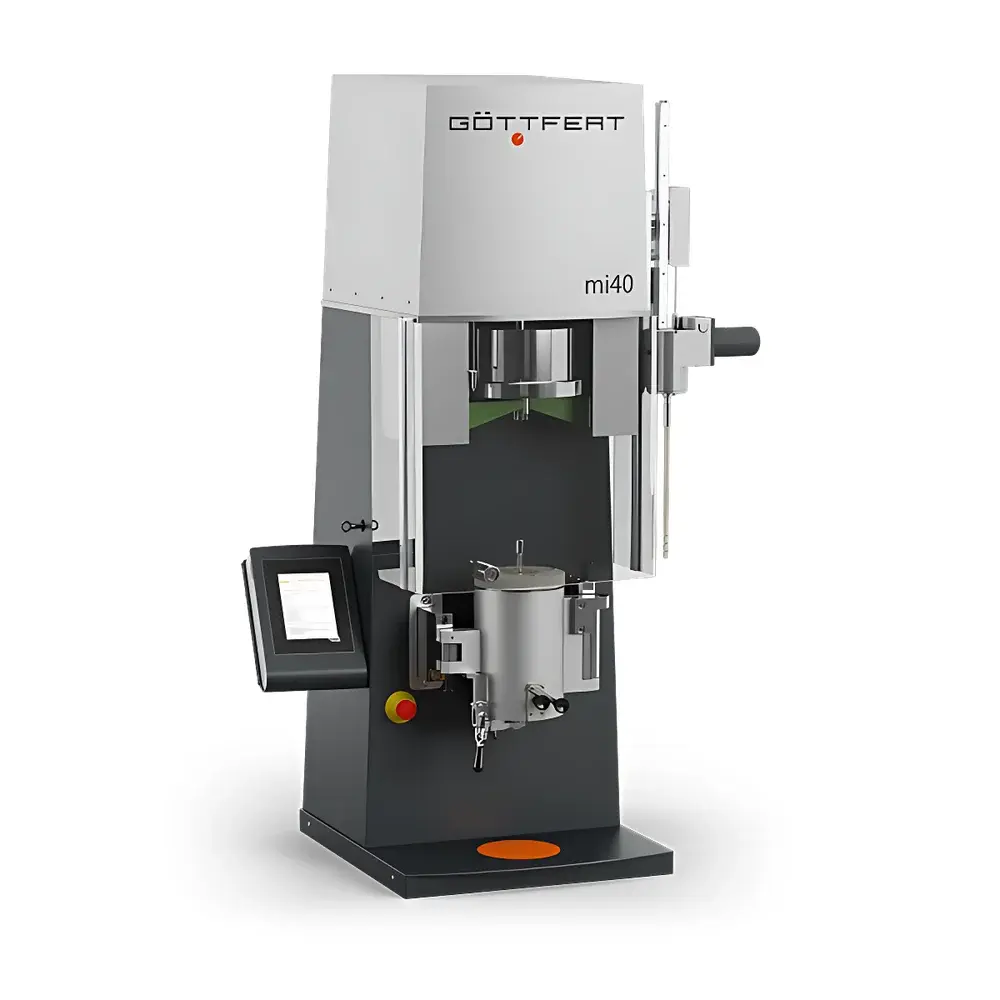
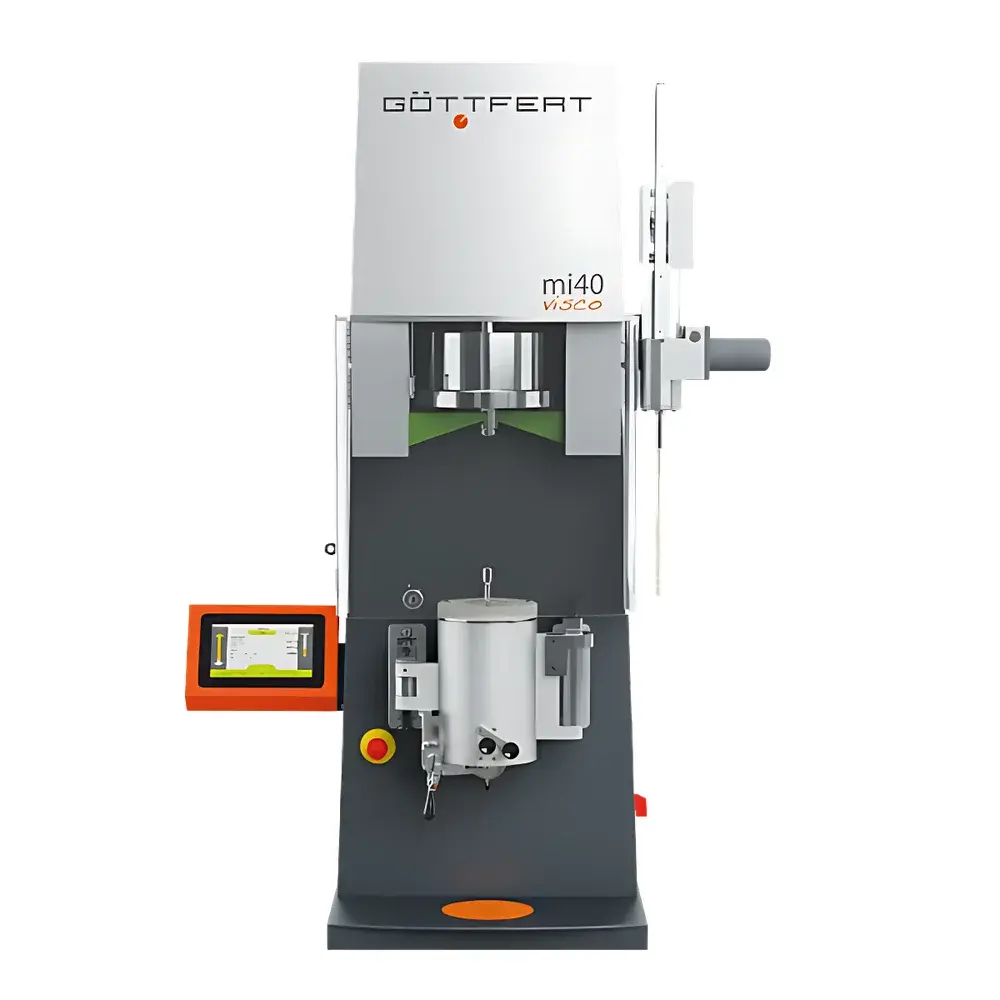
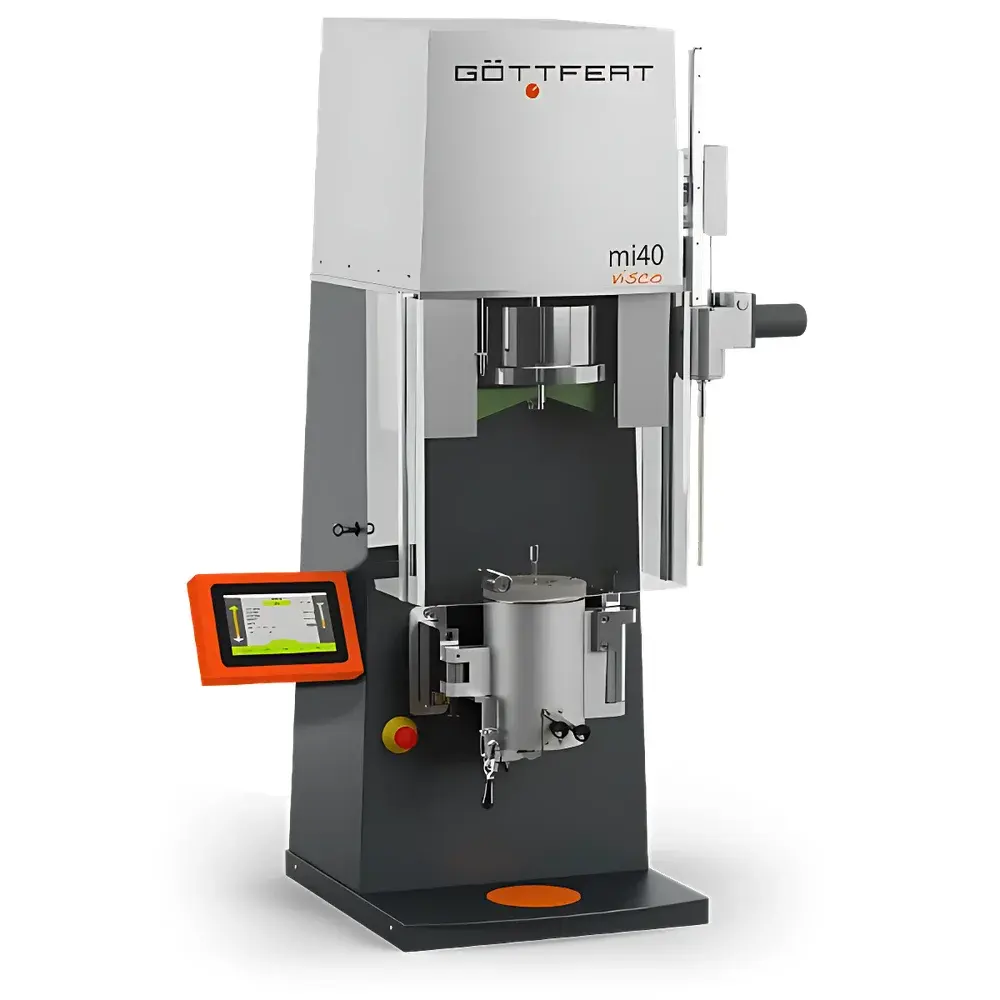
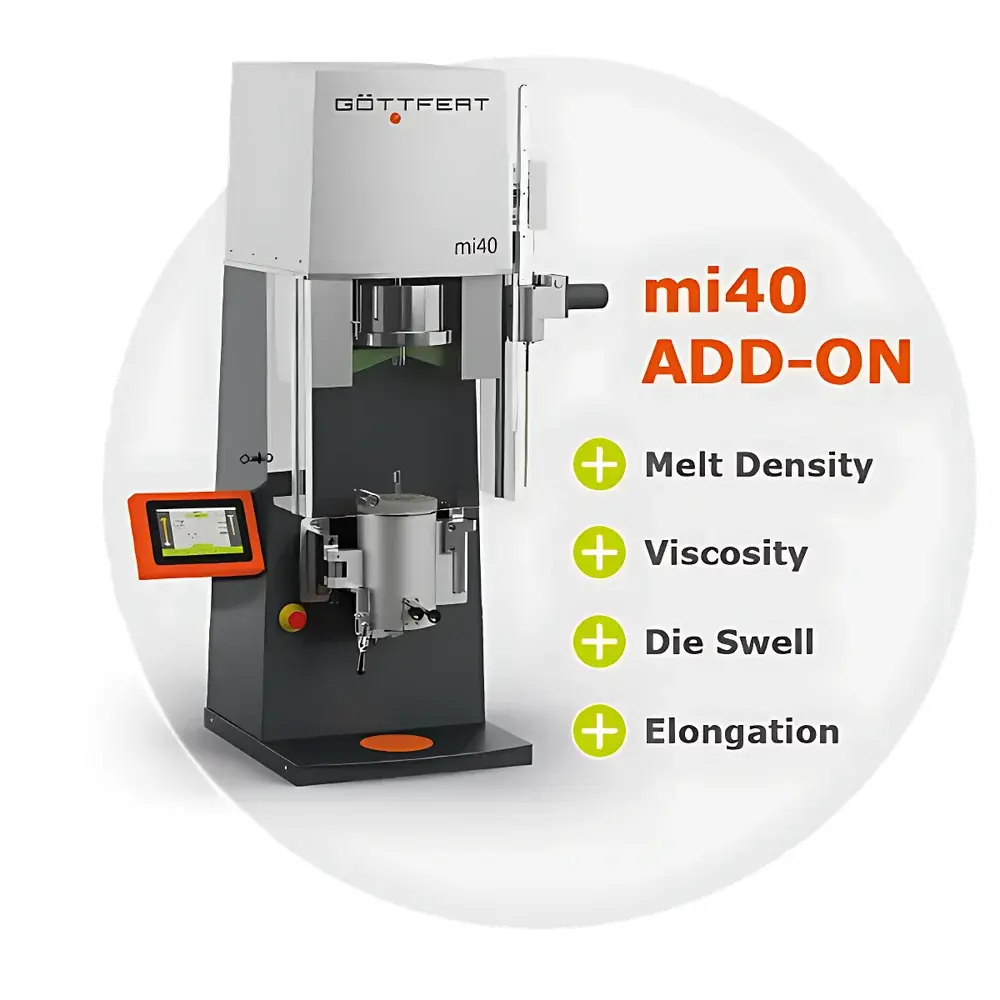
Goettfert MI40 Melt Flow Indexer
| Brand | Goettfert |
|---|---|
| Origin | Germany |
| Model | MI40 |
| Control Interface | 5.7" touchscreen (bilingual: English/Chinese) |
| Load Application | Motor-driven force control up to 60 kg |
| Preload & Post-extrusion Force Control | Yes |
| Standard Weight Loading | ASTM-compliant砝码 set (1.200, 2.16, 3.8, 5.0, 10.0, 21.6 kg |
| Multi-load Testing | Up to 8 programmable weights |
| Barrel Rotation | 90° and 180° for loading/cleaning |
| Temperature Range | 60.00–400.00 °C (optional to 500.00 °C) |
| Die Dimensions | 2.095 ± 0.003 mm diameter, 8.00 ± 0.025 mm length |
| Die Material | Tungsten carbide |
| Piston Diameter | 9.48 ± 0.01 mm |
| Barrel ID | 9.555 ± 0.01 mm |
| Timing Resolution | < 0.001 s |
| Displacement Sensor | High-precision linear encoder |
| Cleaning Options | Rotating cleaning auger (optional), automated barrel cleaning module (optional) |
| Connectivity | Ethernet port for direct LIMS integration, dual USB ports (U-disk & printer) |
| Software Control | Single PC can manage up to four MI40 units |
| Compliance | ISO 1133, ASTM D1238 Method D, ASTM D3364 |
| Optional Modules | Auto-melt cutter, heated/unheated die plugs, nitrogen purge, die swell unit, semi-die, D-MELT melt extension rheology system, corrosion/wear-resistant barrels |
Overview
The Goettfert MI40 Melt Flow Indexer is a precision-engineered, benchtop rotational rheological tester designed for standardized determination of melt mass-flow rate (MFR) and melt volume-flow rate (MVR) of thermoplastic polymers under defined temperature and load conditions. Based on the fundamental principle of extrusion plastometry—where molten polymer is forced through a standardized capillary die under controlled gravitational or motor-driven force—the MI40 implements a rigorously calibrated piston-and-barrel geometry compliant with ISO 1133 and ASTM D1238 Method D. Its motor-driven force application system replaces traditional dead-weight loading with active, closed-loop force control (up to 60 kg), enabling precise preload compaction and post-test residual material expulsion—critical for high-viscosity or shear-sensitive resins. The instrument’s thermally stable, tungsten carbide capillary die (2.095 ± 0.003 mm × 8.00 ± 0.025 mm) and matched piston/barrel geometry (9.48 ± 0.01 mm / 9.555 ± 0.01 mm) ensure dimensional repeatability across thousands of test cycles. With temperature control from 60.00 to 400.00 °C (extendable to 500.00 °C), sub-millisecond timing resolution (<0.001 s), and high-fidelity linear displacement sensing, the MI40 delivers metrologically traceable data essential for QC release, formulation development, and regulatory submission in polymer manufacturing.
Key Features
- Motor-driven force control system enabling programmable pre-compaction and residual melt expulsion—eliminating manual handling variability and improving inter-laboratory reproducibility.
- 5.7-inch industrial-grade touchscreen interface with bilingual (English/Chinese) firmware—supporting intuitive workflow navigation without external PC dependency.
- Barrel rotation mechanism (90° and 180° positions) optimized for ergonomic sample loading and rapid die/barrel access during maintenance.
- Integrated Ethernet port enabling native communication with laboratory information management systems (LIMS) without middleware or proprietary software installation.
- Multi-load capability supporting up to eight user-defined weight configurations—including standard ASTM masses (1.200, 2.16, 3.8, 5.0, 10.0, 21.6 kg, ±0.5% tolerance)—with fully programmable sequence logic per test method.
- Dual USB ports for direct data export to USB storage devices and real-time printing—ensuring audit-ready documentation per GLP/GMP requirements.
- Modular architecture accommodating optional accessories: auto-melt cutter (for high-viscosity modified polymers), heated die plugs (for low-viscosity melts), nitrogen purge kits (for oxidation-sensitive resins), and D-MELT extension modules for uniaxial melt elongation analysis.
Sample Compatibility & Compliance
The MI40 accommodates a broad spectrum of thermoplastic materials including polyolefins (PP, PE), engineering plastics (PA, PC, POM), thermoplastic elastomers (TPE, TPU), and filled or reinforced compounds. Its rigid mechanical design and thermal uniformity meet the stringent spatial and temporal stability requirements of ISO 1133-1:2011 Annex A and ASTM D1238–22 Method D (multi-load protocol). All critical dimensions—including die bore, piston diameter, and barrel internal diameter—are manufactured and certified to metrological tolerances traceable to national standards (e.g., PTB, NIST). The system supports full compliance with FDA 21 CFR Part 11 when deployed with validated software configurations and electronic audit trail logging—making it suitable for regulated environments in medical device polymer production and pharmaceutical excipient qualification.
Software & Data Management
The MI40 operates autonomously via embedded firmware—requiring no host PC for basic operation. For centralized deployment, Goettfert’s MI-Connect software enables remote monitoring, configuration, and synchronized control of up to four MI40 units from a single workstation. Raw test data—including time-stamped displacement curves, calculated MFR/MVR values, temperature profiles, and force application logs—are stored in CSV and XML formats with embedded metadata (operator ID, sample ID, method version, calibration timestamp). All exported files include digital signatures and immutable timestamps, satisfying ALCOA+ data integrity principles. Networked units support automatic push-to-LIMS via HTTP/HTTPS or OPC UA protocols, ensuring seamless integration into enterprise quality systems without manual data re-entry.
Applications
- Quality control of incoming polymer pellets and masterbatches in compounders and converters.
- Process validation and batch release testing in automotive, packaging, and medical polymer manufacturing.
- R&D screening of molecular weight distribution shifts following degradation, blending, or reactive modification.
- Correlation studies between MFR/MVR and end-use properties (e.g., tensile strength, impact resistance, extrudability).
- Regulatory dossier preparation for ISO 13485-certified medical polymer suppliers and USP Class VI material qualification.
- Interlaboratory round-robin testing programs requiring high inter-operator and inter-instrument reproducibility.
FAQ
Does the MI40 require a dedicated PC for operation?
No—the MI40 functions as a standalone instrument with its integrated touchscreen interface and onboard firmware. A PC is only required for advanced fleet management or LIMS integration via MI-Connect software.
Is the temperature range certified to 500 °C as standard?
The base configuration supports 60.00–400.00 °C. Operation up to 500.00 °C requires an optional high-temperature heating module and corresponding calibration certificate.
How is traceability maintained for force and temperature measurements?
All force sensors are calibrated against traceable deadweight standards; temperature sensors are verified using NIST-traceable reference thermometers and documented in the factory calibration report supplied with each unit.
Can the MI40 perform both MFR and MVR determinations in a single run?
Yes—using the integrated high-resolution displacement sensor and sub-millisecond timer, the instrument calculates both MFR (g/10 min) and MVR (cm³/10 min) simultaneously from one extrusion event.
What validation documentation is provided with the instrument?
Each MI40 ships with a full Factory Acceptance Test (FAT) report, ISO/IEC 17025-accredited calibration certificates for temperature, force, and displacement subsystems, and a 21 CFR Part 11 readiness assessment document.





