
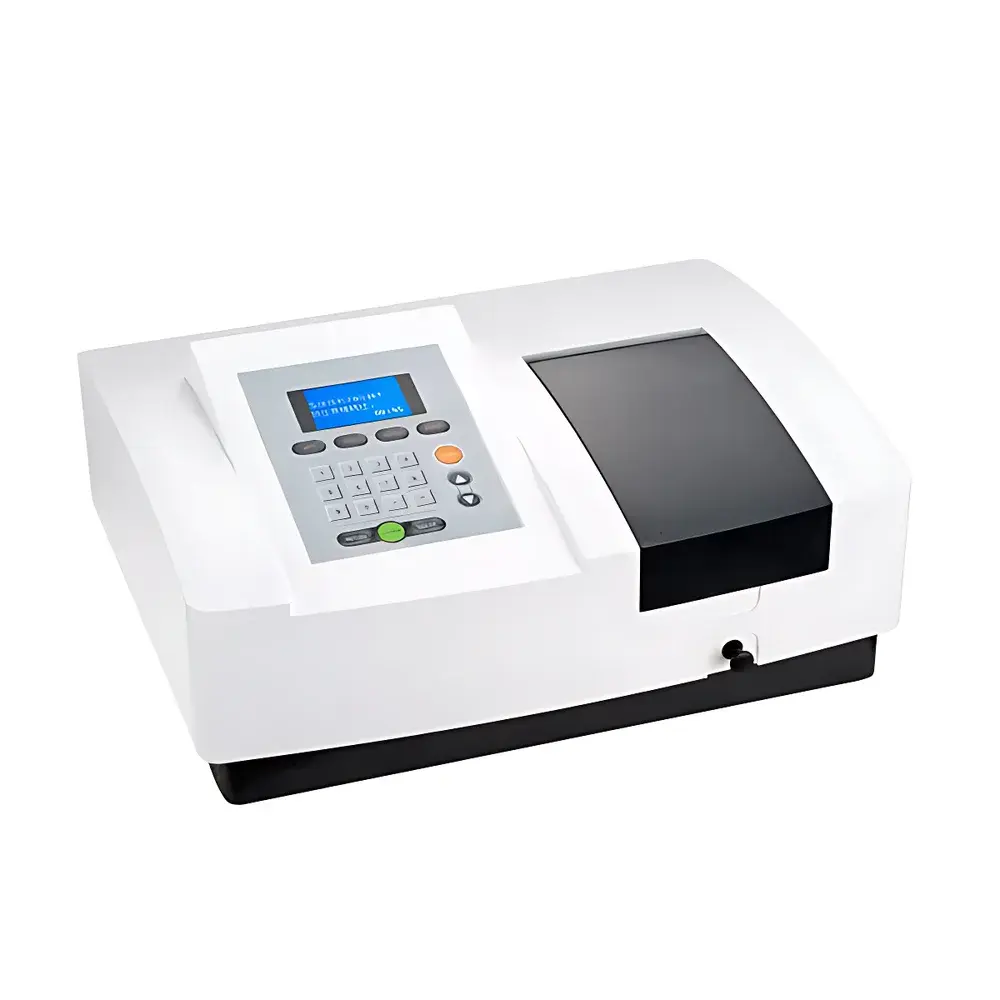
Yoke UV756 Scanning Ultraviolet-Visible Spectrophotometer
| Brand | Yoke |
|---|---|
| Origin | Shanghai, China |
| Manufacturer Type | Direct Manufacturer |
| Instrument Architecture | Single-Beam |
| Detector Type | Photodiode Array (PDA) |
| Wavelength Range | 190–1100 nm |
| Wavelength Accuracy | ±0.5 nm |
| Spectral Bandwidth | 2 nm |
| Stray Light | ≤0.3% T at 220 nm and 360 nm |
| Wavelength Repeatability | ±0.2 nm |
| Photometric Accuracy | ±0.5% T |
| Photometric Repeatability | ±0.2% T |
| Absorbance Range | –0.031 to 2.5 A |
| Transmittance Range | 0.0–125% T |
| Baseline Stability | ±0.002 A/h |
| Data Storage | 50 measurement sets + 10 calibration curves |
| Interface | RS-232 serial port |
| Display | 128 × 64 dot-matrix LCD |
| Software Support | Optional PC-based analysis suite with quantitative module and curve fitting |
Overview
The Yoke UV756 Scanning Ultraviolet-Visible Spectrophotometer is a single-beam, PDA-based optical absorption instrument engineered for routine and research-grade quantitative analysis in academic laboratories, quality control environments, and industrial R&D settings. It operates on the fundamental principle of Beer–Lambert law-based absorbance measurement across a broad spectral range from deep ultraviolet (190 nm) to near-infrared (1100 nm). Its fixed 2 nm spectral bandwidth ensures high-resolution spectral profiling while maintaining robust signal-to-noise performance—ideal for applications requiring reproducible quantification of organic compounds, nucleic acids, proteins, dyes, and pharmaceutical actives. The instrument integrates dual light sources (deuterium arc lamp for UV, tungsten-halogen lamp for visible/NIR), automatically switching between them under microprocessor control to optimize intensity and lifetime. Designed for compliance-ready operation, the UV756 supports traceable wavelength calibration via internal reference standards and delivers photometric stability within ±0.002 A per hour—critical for extended kinetic or multi-sample batch analyses.
Key Features
- High-efficiency 1200 lines/mm holographic grating for improved dispersion linearity and reduced higher-order diffraction effects
- Automated wavelength scanning with real-time peak detection and auto-zero referencing at user-defined start/stop points
- Dual-lamp source management system enabling seamless UV/Vis transition without manual intervention or warm-up delays
- Photodiode array detector providing simultaneous acquisition across the full spectral window—eliminating mechanical slit scanning artifacts
- Onboard 128 × 64 graphical LCD display supporting direct visualization of spectra, calibration curves, and numeric results without external hardware
- Integrated data handling architecture storing up to 50 independent measurement sessions and 10 user-defined calibration functions (linear, quadratic, or multi-point non-linear)
- RS-232 interface compliant with standard laboratory serial protocols; compatible with Windows-based spectral analysis software for advanced curve fitting, derivative spectroscopy, and method validation
Sample Compatibility & Compliance
The UV756 accommodates standard 10 mm pathlength cuvettes (quartz for UV, glass or plastic for visible), with optional accessories supporting 5 mm, 20 mm, 50 mm, and 100 mm cells—including matched quartz cells for high-precision DNA/protein assays. It meets essential performance criteria outlined in ISO 6223:2022 (spectrophotometer verification), ASTM E275–22 (standard practice for UV-Vis spectrophotometry), and USP (Ultraviolet-Visible Spectrophotometry). While not inherently 21 CFR Part 11 compliant out-of-the-box, its RS-232 output enables integration into validated LIMS or ELN platforms where electronic signatures, audit trails, and user access controls are implemented at the system level. All optical components adhere to GLP-aligned maintenance schedules, including lamp replacement logs and wavelength verification records.
Software & Data Management
The optional PC software package provides full remote control, spectral overlay, baseline correction (asymmetric least-squares), and quantitative analysis using single- or multi-standard calibration models. Export formats include CSV, TXT, and JCAMP-DX for interoperability with chemometric tools (e.g., MATLAB, Unscrambler). Each saved dataset includes metadata: date/time stamp, operator ID (manually entered), instrument serial number, lamp usage hours, and calibration validity status. The host firmware maintains an internal event log tracking power cycles, lamp switches, and error codes—supporting root-cause analysis during equipment qualification (IQ/OQ/PQ) procedures.
Applications
- Pharmaceutical QC: Assay of active ingredients per USP monographs (e.g., paracetamol, ibuprofen) using specified wavelengths and tolerance limits
- Molecular biology: Quantification of dsDNA (260 nm), RNA (260 nm), and protein (280 nm) with optional pathlength correction algorithms
- Environmental testing: Nitrate/nitrite determination via colorimetric reaction (e.g., Griess assay), COD estimation, and heavy metal complexation studies
- Food & beverage: Color index (CIE L*a*b* conversion), preservative concentration (sorbic acid, benzoic acid), and antioxidant capacity (DPPH assay)
- Academic teaching labs: Fundamental spectroscopy experiments including solvent polarity effects, conjugation length correlation, and enzyme kinetics (initial rate analysis)
FAQ
What is the maximum supported cuvette pathlength?
The UV756 accommodates up to 100 mm pathlength cuvettes with appropriate sample compartment adapters.
Does the instrument support kinetic measurements?
Yes—time-scan mode allows sequential acquisition at fixed wavelength(s) with programmable intervals from 0.1 s to 999 s.
Can calibration curves be transferred between instruments?
Calibration parameters (slope, intercept, polynomial coefficients) can be exported/imported via ASCII files, though physical verification against local standards is required for regulatory use.
Is the deuterium lamp replaceable by the end user?
Yes—the lamp module is field-replaceable with alignment-free installation; lamp life expectancy exceeds 1,000 hours under typical usage.
How is wavelength accuracy verified?
Using certified holmium oxide or didymium glass filters traceable to NIST SRM 2034 or equivalent national metrology institutes.





