
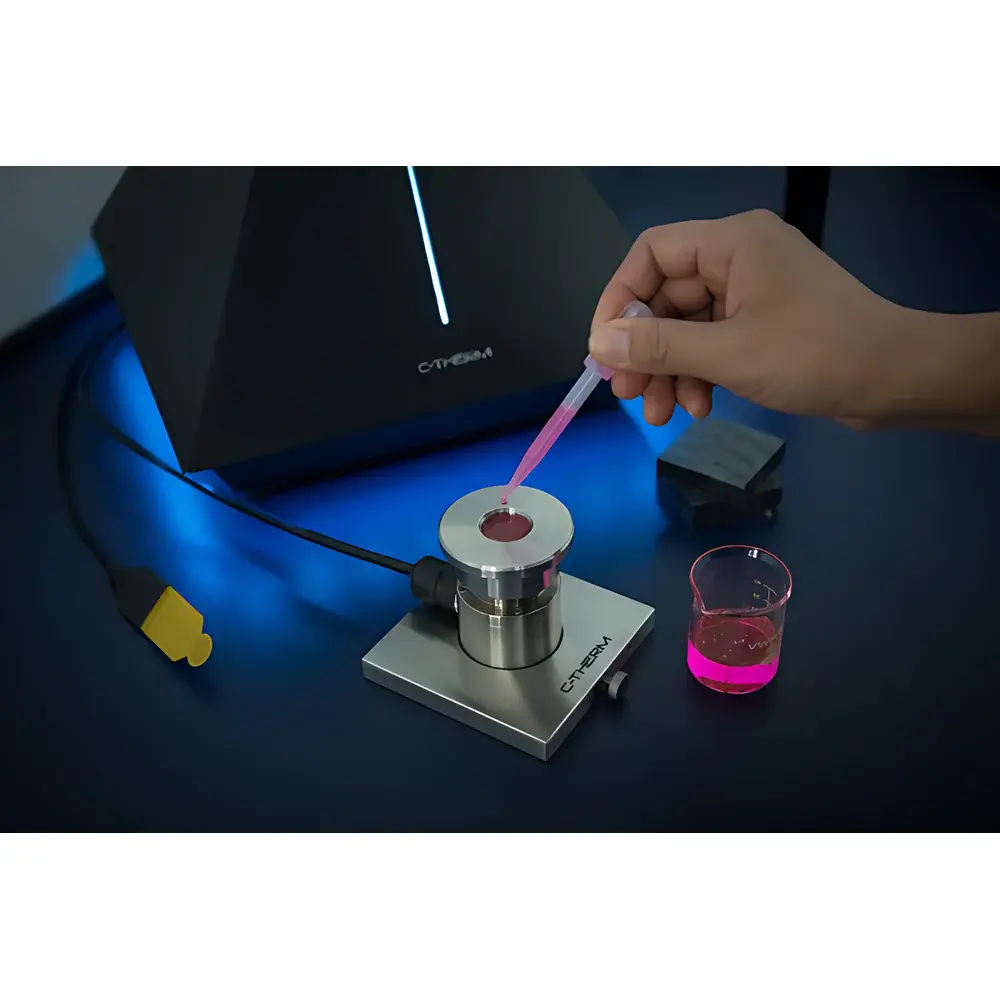
C-Therm Trident Thermal Conductivity Analyzer
| Brand | C-Therm |
|---|---|
| Model | TCi |
| Measurement Principle | Transient Plane Source (TPS) – Multi-Method Platform (MTPS, Flex TPS, Needle TLS) |
| Origin | Canada |
| Dimensions (L×W×H) | 40 × 40 × 40 cm |
| Accuracy | < 5% |
| Repeatability | < 1% |
| Thermal Conductivity Range | 0–2000 W/m·K |
| Thermal Diffusivity Range | 0–1200 mm²/s |
| Specific Heat Capacity Range | up to 5 MJ/m³·K |
| Effusivity Range | 5–40,000 W·s⁰·⁵/m²·K |
| Standards Compliance | ASTM D7984, ASTM D5334, ASTM D5930, ISO 22007-2.2, GB/T 32064, IEEE 442 |
Overview
The C-Therm Trident Thermal Conductivity Analyzer is a modular, multi-method benchtop instrument engineered for high-precision, non-destructive thermal property characterization of solids, liquids, powders, pastes, and anisotropic materials across R&D, quality control, and regulatory environments. At its core, the Trident implements three physically distinct transient measurement methodologies—Modified Transient Plane Source (MTPS), Flexible Transient Plane Source (Flex TPS), and Needle Transient Line Source (Needle TLS)—each optimized for specific material classes, geometry constraints, and thermal property regimes. Unlike steady-state systems requiring long equilibration times or destructive sample preparation, the Trident relies on controlled Joule heating of embedded sensor elements and high-speed thermal response acquisition (sub-millisecond resolution), enabling rapid (< 3 s per test), repeatable, and operator-independent measurements under ambient or controlled environmental conditions. Its architecture is rooted in fundamental heat conduction theory (Fourier’s law and the diffusion equation), with calibration traceability anchored to NIST-traceable reference materials and validated against international round-robin interlaboratory studies.
Key Features
- Triple-method platform: Seamlessly switch between MTPS (for low-conductivity insulators and thin films), Flex TPS (for high-conductivity metals, composites, and anisotropic bulk samples), and Needle TLS (for soft, granular, or in-situ applications such as soils, gels, and slurries).
- Wide dynamic range: Measures thermal conductivity from 0.001 W/m·K (aerogels, foams) up to 2000 W/m·K (copper, diamond, graphite composites) without hardware modification.
- Simultaneous multi-parameter output: Derives thermal conductivity (λ), thermal diffusivity (α), volumetric heat capacity (ρcp), and thermal effusivity (e = √(λρcp)) from a single transient test—no separate instrumentation required.
- Minimal sample prep: No cutting, polishing, or vacuum chamber needed for most tests; surface contact is sufficient for MTPS/Flex TPS; needle insertion suffices for TLS mode.
- Robust temperature operation: Compatible with optional environmental chambers (-40 °C to +200 °C) and integrated temperature-controlled stage for isothermal or ramped thermal property profiling.
- ISO/IEC 17025-aligned uncertainty budgeting: Software-generated uncertainty reports include contributions from sensor calibration, ambient drift, contact resistance, and signal-to-noise ratio—essential for GLP/GMP audits.
Sample Compatibility & Compliance
The Trident accommodates heterogeneous and challenging sample forms—including aerogels, phase-change materials (PCM), thermal interface materials (TIM), polymer nanocomposites, carbon fiber laminates, battery electrode slurries, ceramic coatings, and hydrated soils—without compromising measurement integrity. Its method-specific probe designs eliminate edge effects and minimize interfacial thermal resistance artifacts. All three methods comply with globally recognized standards: MTPS aligns with ASTM D7984 for insulating materials; Flex TPS conforms to ISO 22007-2.2 and GB/T 32064 for solid polymers and composites; Needle TLS satisfies ASTM D5334 (soils), ASTM D5930 (plastics), and IEEE 442 (electrical insulation). The system supports full 21 CFR Part 11 compliance when deployed with C-Therm’s validated software suite, including electronic signatures, audit trails, and role-based access control for regulated laboratories.
Software & Data Management
TridentControl™ v5.x provides intuitive workflow-driven operation, real-time thermal decay visualization, and automated parameter fitting using Levenberg-Marquardt nonlinear regression against analytical solutions of the heat diffusion equation. Raw voltage vs. time datasets are stored in HDF5 format with embedded metadata (operator ID, timestamp, environmental conditions, calibration certificate IDs). Export options include CSV, Excel, and XML for LIMS integration. Advanced features include batch processing for statistical analysis (CpK, GR&R), comparative trend reporting across material lots or process variables, and customizable PDF test reports compliant with ISO/IEC 17025 documentation requirements. Remote monitoring and diagnostics are supported via secure HTTPS API for enterprise lab networks.
Applications
- Aerospace: Characterizing thermal management performance of lightweight composites, ablative coatings, and heat shield materials under simulated re-entry thermal loads.
- Battery R&D: Quantifying through-plane and in-plane λ of electrode stacks, separators, and thermal runaway barrier films at varying state-of-charge and temperature.
- Building science: Validating declared thermal resistance (R-value) of novel insulation systems—including vacuum panels, silica aerogels, and bio-based foams—in accordance with ASTM C518 and ISO 10456.
- Electronics cooling: Benchmarking TIM bondline thickness effects, pump-out resistance, and aging-induced λ degradation in CPU/GPU thermal interface assemblies.
- Geotechnical engineering: In-situ and lab-based thermal property mapping of soil strata for ground-source heat pump design and permafrost stability modeling.
- Pharmaceuticals: Measuring thermal effusivity of lyophilized protein cakes and polymer-based controlled-release matrices to correlate with structural integrity and dissolution kinetics.
FAQ
Does the Trident require reference standards for every measurement?
No. While factory calibration uses NIST-traceable standards (e.g., Pyroceram® 9606, copper, and fused quartz), daily verification employs a single stable reference sample—reducing operational overhead while maintaining metrological rigor.
Can the Trident measure anisotropic materials like unidirectional carbon fiber laminates?
Yes. Flex TPS mode enables directional λ measurement by rotating the sensor relative to fiber orientation; combined with orthogonal mounting fixtures, it delivers tensor-level resolution for principal thermal conductivities (λ11, λ22, λ33).
Is the Needle TLS method suitable for highly viscous pastes or cured elastomers?
The Needle TLS probe is designed for semi-solid media with penetration resistance ≤ 1 MPa. For fully cured elastomers (> 5 MPa Shore A), MTPS or Flex TPS is recommended due to superior surface contact fidelity.
How does the Trident handle air gaps or imperfect sample contact?
MTPS and Flex TPS incorporate proprietary contact resistance compensation algorithms based on early-time thermal response slope analysis—validated against micro-CT quantified gap distributions in interfacial studies.
What validation documentation is provided for regulated industries?
Each system ships with a full IQ/OQ/PQ protocol package, 3Q validation templates aligned with ASTM E2500, and a Certificate of Conformance listing all installed firmware, calibration dates, and uncertainty budgets per ISO/IEC 17025:2017 Annex A.2.



