
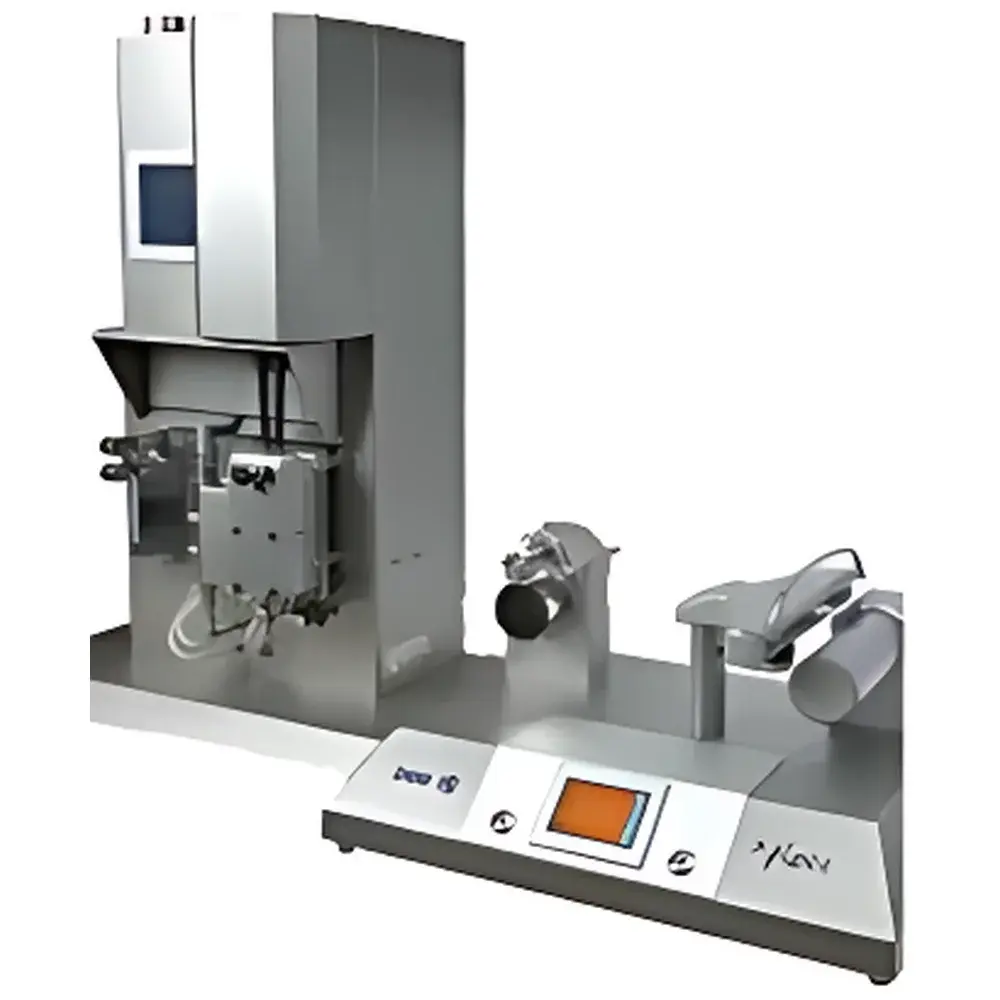
DSM Xplore Microscale Melt Spinning Line
| Origin | Netherlands |
|---|---|
| Manufacturer Type | Authorized Distributor |
| Origin Category | Imported |
| Model | Xplore Microspinning Line |
| Pricing | Available Upon Request |
Overview
The DSM Xplore Microscale Melt Spinning Line is a precision-engineered laboratory-scale fiber extrusion system designed for rapid prototyping and formulation development in polymer science, specialty fibers, and advanced material research. Based on melt extrusion and controlled thermal drawing principles, the system enables continuous single-filament production from as little as 2–5 g of polymer feedstock—significantly reducing raw material consumption, energy use, and development cycle time compared to conventional pilot- or industrial-scale spinning lines. Its modular architecture integrates a micro-compounder (optional but recommended), a precision metering extruder, a high-speed winding unit, and a thermally regulated draw-down station—each engineered for reproducible rheological control, dimensional stability, and process traceability under laboratory conditions.
Key Features
- Two-stage modular design: independent high-speed winding unit (up to 200 m/min) and low-speed thermal draw-down unit (0.5–90 m/min) with synchronized speed control
- Integrated touch-screen controller with graphical user interface (GUI) for real-time parameter monitoring, recipe storage, and audit-ready event logging
- Adjustable fiber take-up geometry: lateral traverse pitch programmable from 0.1 to 4.0 mm (0.1 mm increments) for precise filament laydown pattern control
- Dual heating modalities in draw zone: radiation-heated quartz tubes (max. 300 °C, ±1 °C stability) or conductive metal mandrels for uniform thermal conditioning of nascent filaments
- No external gear pump required—fiber diameter stability achieved via precise volumetric extrusion control from the integrated micro-compounder or gravimetric feeder
- “Soft-start” routine to eliminate breakage during initial draw-in; first meters of filament routed to a dedicated waste spool until steady-state tension and temperature profiles are established
- Interchangeable spinneret dies (0.25–1.5 mm orifice diameter, 0.25 mm increments) and optional 90° horizontal die adapters for enhanced flow alignment and reduced die swell
- 75 mm aluminum spools compatible with standard bobbin cores; dual spool lifters enable uninterrupted long-run collection
Sample Compatibility & Compliance
The Xplore Microspinning Line accommodates thermoplastic polymers including polyolefins (PP, PE), polyesters (PET, PBT), polyamides (PA6, PA66), polylactide (PLA), thermoplastic elastomers (TPEs), and filled or nanocomposite formulations. It supports solvent-free melt processing only—no solution spinning capability. All electrical components comply with CE, IEC 61000-6-3 (EMC), and IEC 61000-6-4 standards. The GUI-based controller supports timestamped data export (CSV, PDF) and meets basic requirements for GLP-compliant documentation. Optional firmware upgrades provide 21 CFR Part 11–compatible electronic signatures and audit trail functionality for regulated R&D environments.
Software & Data Management
The embedded control software provides full parametric control over extrusion rate, winding speed, traverse frequency, heater setpoints, torque feedback, and draw ratio (programmable from 1:1 to 1:10). Process sequences can be saved as reusable methods with versioned naming. Real-time plots display tension vs. time, surface temperature vs. position, and linear velocity deviation. All operational logs—including start/stop timestamps, parameter changes, alarm events, and manual overrides—are stored locally with automatic backup to USB drive. Data exports include raw sensor values (±0.1% FS accuracy), calculated metrics (draw ratio, specific energy input), and annotated video snapshots (if optional camera module installed).
Applications
- Rapid screening of polymer melt rheology and spinnability prior to pilot-scale trials
- Development of functional fibers: conductive, antimicrobial, phase-change, or drug-loaded filaments
- Optimization of additive dispersion and interfacial adhesion in filled systems (e.g., carbon nanotube-, graphene-, or mineral-reinforced fibers)
- Thermo-mechanical characterization of fiber crystallinity evolution during hot-drawing (via inline DSC coupling or post-process XRD/DSC)
- Validation of computational fluid dynamics (CFD) models for die flow and fiber attenuation behavior
- Teaching labs: hands-on demonstration of polymer processing fundamentals—extrusion, viscoelastic draw resonance, orientation development, and structure–property relationships
FAQ
What minimum sample quantity is required for a complete test run?
Typical runs consume 2–5 g of polymer, depending on target filament length, diameter, and draw ratio. Pre-drying and purging steps may increase total usage by ~0.5 g.
Can the system produce multi-filament yarns or bicomponent fibers?
Yes—multi-orifice spinnerets (up to 12 holes) and co-extrusion modules (with optional dual-barrel micro-compounder) are available as factory-configured options.
Is offline tensile testing integration supported?
The system outputs standardized filament samples (10–50 cm lengths, wound on labeled spools) fully compatible with ISO 527-3 and ASTM D3822 test fixtures. Custom mounting jigs for Instron or Zwick machines can be supplied.
What maintenance intervals are recommended?
Daily visual inspection of die orifices and guide rollers; monthly lubrication of traverse mechanism; annual calibration of thermocouples and load cells per ISO/IEC 17025 guidelines.
Is remote diagnostics or OEM service support available?
DSM Xplore offers remote troubleshooting via secure VNC connection and maintains certified service engineers across EMEA, North America, and APAC regions. Extended warranty and preventive maintenance contracts are available.






