
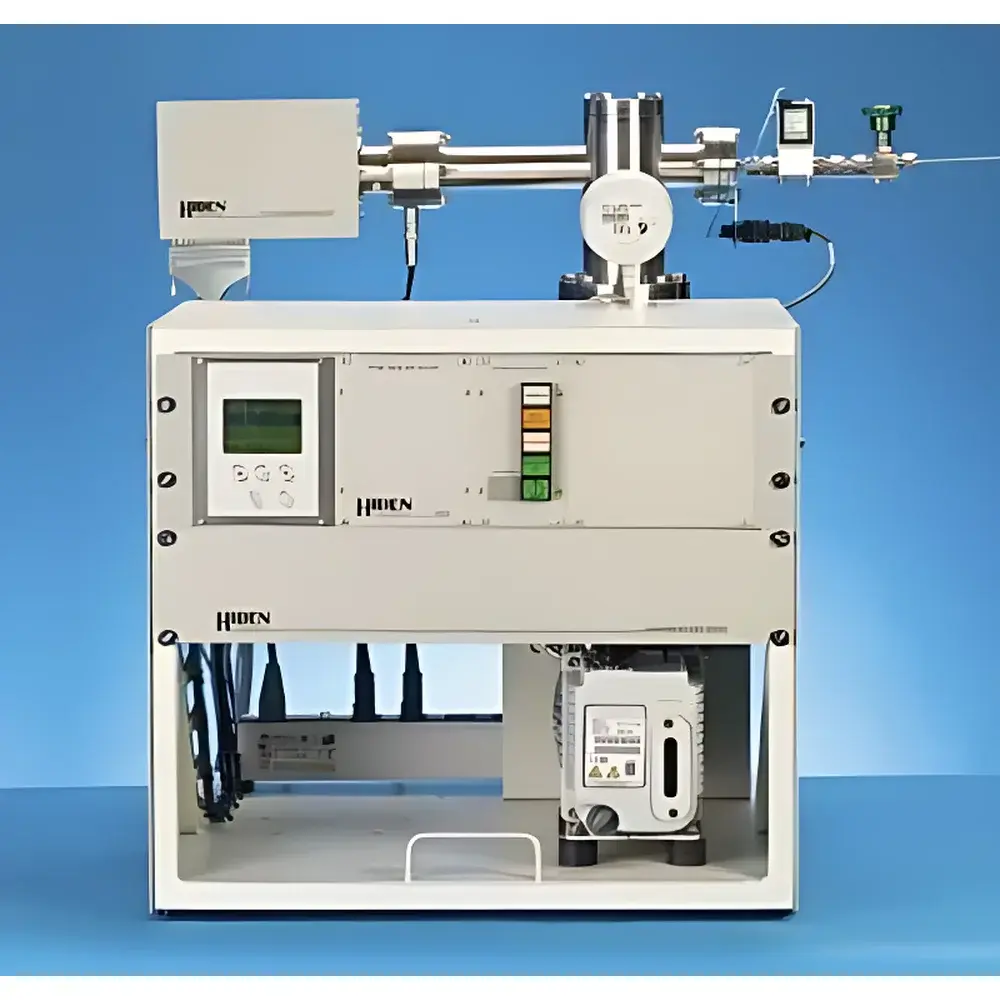
Hiden HPR40 Membrane Inlet Mass Spectrometer (MIMS)
| Brand | Hiden |
|---|---|
| Origin | United Kingdom |
| Model | HPR40 |
| Mass Range | 1–200 amu (optional 300 amu) |
| Detection Limit | 0.1 ppm (or 5 ppb) |
| Minimum Scan Step | 0.01 amu |
| Detector | Faraday Cup / Electron Multiplier |
| Quantitative Output Units | ppm, ppb, % |
| Ionization Mode | Soft Ionization |
| Software | Windows-based acquisition, real-time display & spectral analysis |
| Safety Feature | Fast-acting isolation valve for membrane breach protection |
| Sample Interface | Gas-permeable membrane probe or recirculating water sampler |
Overview
The Hiden HPR40 Membrane Inlet Mass Spectrometer (MIMS) is a purpose-engineered analytical platform for real-time, quantitative detection of dissolved gases in aqueous and liquid-phase systems. It operates on the principle of selective gas permeation through a hydrophobic polymer membrane—typically polytetrafluoroethylene (PTFE) or silicone—mounted at the tip of a stainless-steel sampling probe or integrated into a recirculating water loop. Dissolved volatile species diffuse across the membrane under partial pressure gradient, enter the high-vacuum ion source chamber (<10⁻⁶ mbar), undergo electron impact (EI) or soft ionization (e.g., low-energy EI or chemical ionization variants), and are resolved by a quadrupole mass analyzer. The resulting ion currents are measured via dual-mode detection—Faraday cup for high-concentration stability and electron multiplier for trace-level sensitivity—enabling robust quantification across six orders of magnitude. Designed for unattended operation in process-critical environments, the HPR40 delivers sub-second response times and maintains calibration integrity during extended deployment in field or laboratory settings.
Key Features
- Integrated fast-acting isolation valve system that seals the vacuum interface within <50 ms upon detection of liquid ingress—preventing contamination of the quadrupole analyzer and detector, thereby extending instrument uptime and reducing maintenance intervals.
- Modular inlet architecture supporting both direct immersion probes (for in-situ water column profiling) and recirculating flow cells (for controlled sample conditioning and bubble-free introduction).
- Switchable mass range configuration: standard 1–200 amu mode optimized for common environmental gases (O₂, N₂, CO₂, CH₄, H₂, Ar, He, N₂O, SF₆); optional extended-range version up to 300 amu for halogenated compounds or larger organic volatiles.
- Dual-detector electronics with automatic gain switching, enabling seamless transition between Faraday (linear dynamic range >10⁶) and electron multiplier (detection limit down to 5 ppb for CH₄ in deionized water, typical).
- Soft ionization capability via adjustable electron energy (10–70 eV), minimizing fragmentation for improved speciation of labile compounds such as hydrogen sulfide or nitric oxide.
- Front-panel status indicators and RS-232/Ethernet communication ports compliant with Modbus TCP and OPC UA protocols for integration into SCADA or DCS environments.
Sample Compatibility & Compliance
The HPR40 interfaces with natural waters (freshwater, seawater, groundwater), fermentation broths, electrochemical electrolytes, soil leachates, and bioreactor effluents without requiring pre-concentration or derivatization. Its membrane inlet eliminates particulate carryover and suppresses matrix-induced suppression effects common in direct liquid injection methods. The system complies with ISO/IEC 17025 requirements for testing laboratories when operated under documented SOPs; data acquisition software supports audit-trail logging and user-access controls aligned with FDA 21 CFR Part 11 expectations for electronic records and signatures. All wetted components meet USP Class VI biocompatibility standards, and the probe housing is rated IP68 for continuous submersion up to 10 m depth.
Software & Data Management
Acquisition and analysis are managed via Hiden’s QGA (Quantitative Gas Analysis) software suite, a Windows-native application supporting real-time spectral visualization, multi-point calibration (internal standard or external gas standard), kinetic time-series trending, and automated peak integration using centroid or valley-to-valley algorithms. Raw data files (.qga) store full mass spectra, timestamped metadata, and hardware configuration logs in ASCII-readable format. Export options include CSV, Excel, and XML for LIMS integration. Batch processing modules enable retrospective re-calibration and isotopic ratio correction (e.g., ¹³CH₄/¹²CH₄) without raw data re-acquisition. Software validation documentation (IQ/OQ/PQ templates) is provided for GxP-regulated users.
Applications
- Environmental monitoring of dissolved greenhouse gases (CH₄, CO₂, N₂O) in rivers, lakes, estuaries, and aquifers—supporting IPCC Tier 2 emission reporting protocols.
- In-line tracking of metabolic gas evolution (O₂ uptake, CO₂ production, H₂ release) during microbial cultivation, enzymatic assays, and anaerobic digestion optimization.
- Real-time control of electrochemical gas evolution (e.g., H₂ and O₂ during water electrolysis or CO₂ reduction) in flow cell reactors.
- Soil gas flux studies using equilibration chambers coupled to the recirculating inlet, enabling high-temporal-resolution measurement of vadose zone dynamics.
- Fermentation process analytics—including early detection of contamination events via anomalous O₂/CO₂ ratios—and feed-forward control of sparging rates.
- Corrosion studies involving hydrogen permeation monitoring in pipeline steels using palladium-coated membrane variants.
FAQ
What types of membranes are supported, and how often do they require replacement?
Standard configurations use 25 µm PTFE or 100 µm silicone membranes; lifetime depends on sample fouling but typically exceeds 6 months in clean freshwater. Replacement kits and torque-controlled installation tools are supplied.
Can the HPR40 be used for semi-volatile organic compounds (SVOCs)?
Only compounds with vapor pressure >10⁻³ Torr at ambient temperature and sufficient membrane permeability (e.g., BTEX, chloromethanes) yield reliable signals; quantitative analysis requires compound-specific calibration and membrane selection.
Is remote diagnostics and firmware updates supported?
Yes—via secure SSH-enabled Ethernet connection; Hiden’s remote support portal allows authorized engineers to perform health checks, log analysis, and verified firmware upgrades without onsite intervention.
How is calibration performed, and what standards are recommended?
Calibration uses certified gas standards (NIST-traceable) delivered via permeation tubes or dynamic dilution systems; multi-point linear or quadratic fits are stored per mass channel and applied automatically during acquisition.
Does the system meet ATEX or IECEx requirements for hazardous area deployment?
The standard HPR40 is not intrinsically safe; however, explosion-proof enclosures (ATEX II 2G Ex d IIB T4) and purged cabinet options are available as factory-configured variants upon request.
Related Products





