
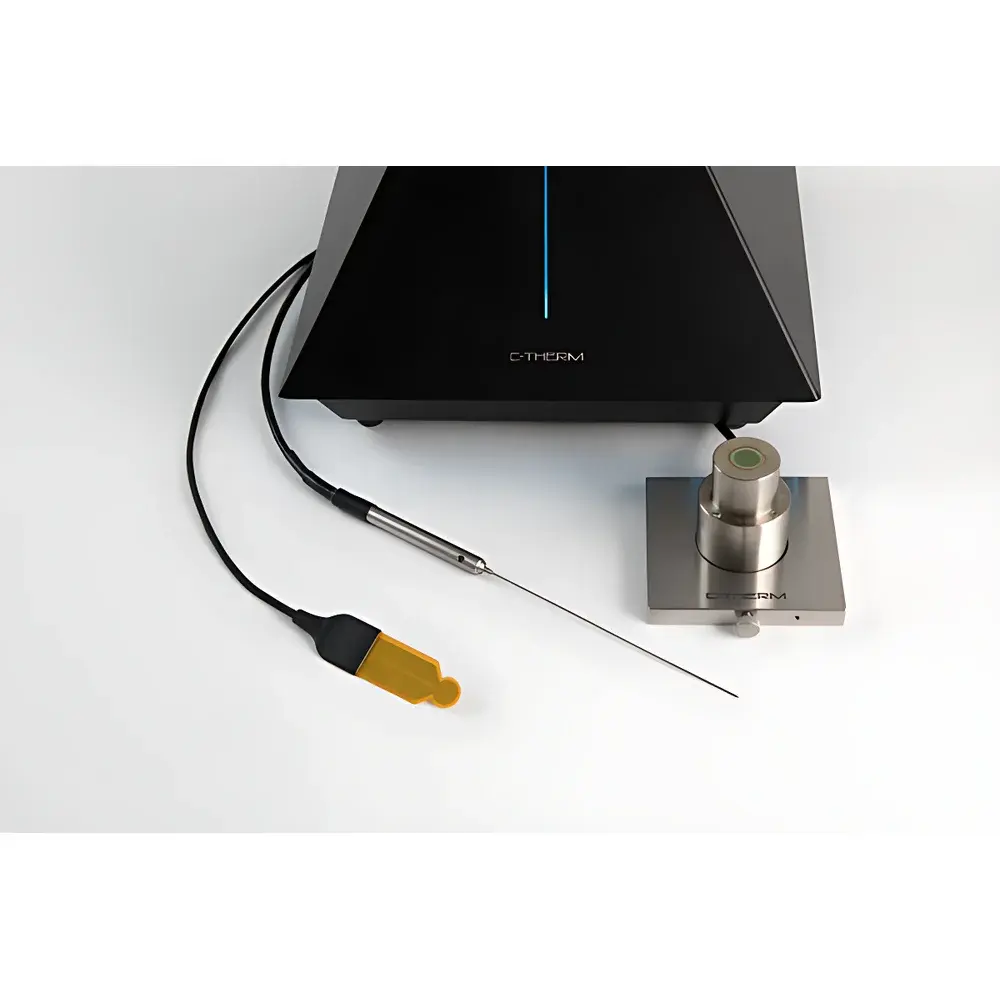
C-Therm Trident MTPS Thermal Conductivity Analyzer
| Brand | C-Therm |
|---|---|
| Origin | Canada |
| Model | Trident MTPS |
| Measurement Principle | Modified Transient Plane Source (MTPS) |
| Dimensions (L×W×H) | 40 × 40 × 40 cm |
| Accuracy | < 5% |
| Thermal Conductivity Range | 0 – 2000 W/m·K |
| Repeatability | < 1% |
| Thermal Diffusivity Range | 0 – 1200 mm²/s |
| Specific Heat Capacity Range | 0 – 5 MJ/m³·K |
| Effusivity Range | 0 – 40,000 W·s⁰·⁵/m²·K |
| Test Duration | 0.8 – 180 s |
| Compliance | ISO 22007-2, ASTM D7984, ASTM D5334, ASTM D5930, GB/T 32064 |
Overview
The C-Therm Trident MTPS Thermal Conductivity Analyzer is a benchtop, multi-method thermal property measurement system engineered for precision, flexibility, and traceable compliance in R&D and quality control laboratories. At its core, the instrument implements the Modified Transient Plane Source (MTPS) method—a standardized, non-destructive, single-sided technique defined in ISO 22007-2 and ASTM D7984—where a thin, insulated sensor acts simultaneously as heat source and temperature detector. Upon applying a constant power step, the sensor records the transient temperature rise; thermal conductivity is derived from the slope of the temperature vs. square-root-of-time curve in the early-time regime. This physics-based approach eliminates assumptions about sample geometry or contact resistance that plague steady-state methods, enabling robust measurements on solids, powders, pastes, thin films, and anisotropic materials without requiring dual-sample mounting or extensive calibration artifacts.
Key Features
- Triple-method platform supporting MTPS (standard), Flex TPS (for high-conductivity solids and layered structures), and TLS (Transient Line Source) for liquids, gels, and soft materials—all operated within a unified software environment with automatic method selection and parameter mapping.
- Integrated sensor architecture with active temperature stabilization and real-time drift compensation, ensuring measurement integrity across ambient fluctuations and extended test sequences.
- Modular hardware design compatible with external environmental chambers (temperature-controlled enclosures: −40 °C to +200 °C), gloveboxes (inert or controlled-atmosphere), and high-pressure cells (up to 10 MPa), enabling thermal property characterization under application-relevant conditions.
- No sample machining required for most configurations; accommodates irregular surfaces, low-density foams, and fragile phase-change materials with minimal preparation.
- Self-validating operation: built-in reference standards (certified graphite, stainless steel, and polyimide) allow daily performance verification aligned with ISO/IEC 17025 metrological traceability requirements.
Sample Compatibility & Compliance
The Trident MTPS supports a broad spectrum of material classes critical to advanced thermal management, energy storage, and aerospace applications—including polymer composites, carbon-fiber laminates, metal matrix composites, thermal interface materials (TIMs), aerogels, battery electrode slurries, molten salts, and thermoelectric ceramics. Its MTPS configuration meets the geometric and thermal boundary condition requirements specified in ISO 22007-2 for isotropic and moderately anisotropic solids ≥ 1 mm thick. For directional materials, optional anisotropy analysis modules apply tensor-based fitting algorithms compliant with ASTM D7984 Annex A2. All measurement workflows generate audit-ready reports containing raw time-series data, curve-fit residuals, uncertainty budgets per GUM (Guide to the Expression of Uncertainty in Measurement), and digital signatures satisfying FDA 21 CFR Part 11 and EU Annex 11 electronic record requirements.
Software & Data Management
TridentControl™ v5.2 is a Windows-based, GLP-compliant application featuring role-based access control, full electronic lab notebook (ELN) integration, and automated metadata tagging (operator ID, instrument serial, environmental log, calibration certificate ID). Each test session exports structured CSV and XML files conforming to ASTM E2918 for thermal property data exchange. Advanced users may access Python and MATLAB APIs for custom algorithm development, batch processing of multi-condition datasets, and integration with LIMS or MES platforms. All raw sensor voltage vs. time traces are retained indefinitely with SHA-256 hash integrity verification, supporting retrospective re-analysis and regulatory inspection readiness.
Applications
- Thermal interface material (TIM) qualification for semiconductor packaging and EV battery module design, where interfacial resistance and pressure-dependent conductivity must be quantified at 0.1–5 MPa contact loads.
- High-throughput screening of phase-change materials (PCMs) for building envelope thermal buffering, measuring both solid- and liquid-phase conductivity with <1% repeatability across melt transitions.
- Quality assurance of aerospace-grade insulation blankets, verifying in-plane and through-thickness conductivity gradients in multilayered flexible composites.
- Development of next-generation thermoelectrics, where simultaneous determination of κ (thermal conductivity), α (thermal diffusivity), and ρcp (volumetric heat capacity) enables direct calculation of ZT = σS²T/κ without destructive cross-property correlation.
- Regulatory submission support for medical device thermal safety testing (ISO 10993-5), including transient heating profiles of polymer implants under simulated physiological loading.
FAQ
What standards does the Trident MTPS comply with for thermal conductivity measurement?
It is fully compliant with ISO 22007-2 (MTPS method), ASTM D7984 (TPS for solids), ASTM D5334 (TLS for soils and soft materials), ASTM D5930 (line-source method), and GB/T 32064 (Chinese national standard for thermal conductivity analyzers).
Can the system measure anisotropic materials such as graphite or unidirectional composites?
Yes—using the optional anisotropy module and Flex TPS sensor orientation, the system calculates principal thermal conductivity components (kx, ky, kz) via multi-angle transient modeling validated against NIST SRM 1470.
Is calibration traceable to national metrology institutes?
All factory calibrations are performed using NIST-traceable reference materials (e.g., NIST SRM 1464, 1470, and 1484), with full uncertainty budgets documented per ISO/IEC 17025 and available upon request.
Does the software support 21 CFR Part 11 compliance for pharmaceutical or medical device labs?
Yes—TridentControl™ includes electronic signatures, audit trails with immutable timestamps, user authentication, and role-based permissions, all configurable to meet FDA 21 CFR Part 11 and EU Annex 11 requirements.
What is the minimum sample thickness required for reliable MTPS measurement?
For standard MTPS, the recommended minimum thickness is 1 mm for isotropic solids; thinner films (≥50 µm) can be measured using the TLS method with appropriate substrate correction protocols.



