
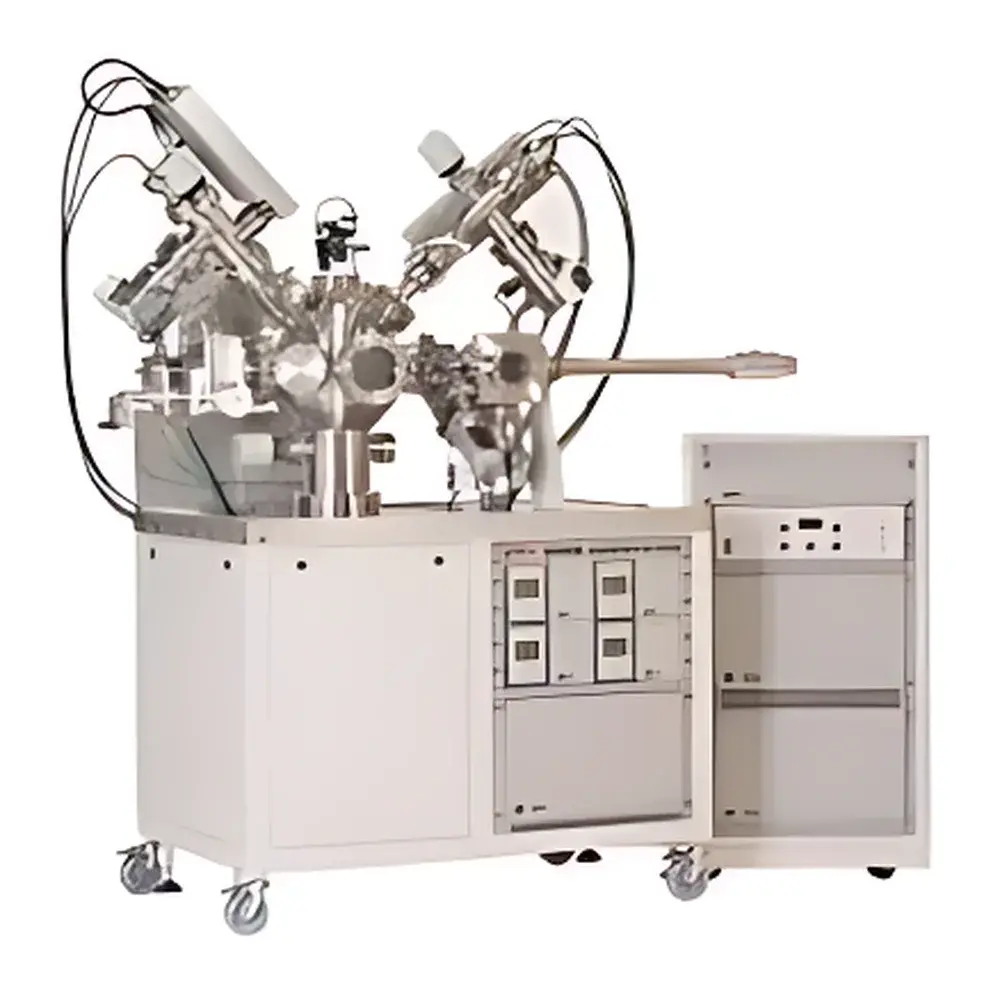
Hiden SIMS Workstation – Advanced Surface Analysis System for UHV Secondary Ion Mass Spectrometry
| Brand | Hiden |
|---|---|
| Origin | United Kingdom |
| Model | SIMS |
| Vacuum Compatibility | Ultra-High Vacuum (UHV) |
| Ion Sources | IG20 Ion Gun (differential pumping), IFG200 FAB Source, Liquid Gallium Liquid Metal Ion Gun (LMIG) |
| Detection Limit | <1 ppb (for selected elements under optimized conditions) |
| Sample Manipulator | 4-Axis (X, Y, Z, θ) UHV-Compatible |
| Charge Neutralization | Electron Flood Gun |
| Cryogenic Capability | Integrated Liquid Nitrogen Cold Trap |
| Vacuum System | Bakeable UHV Chamber with RGA Monitoring |
| Mass Analyzer | Hiden EQS Quadrupole Mass Spectrometer |
| Control & Acquisition Software | MASsoft Operating System with ESM LabVIEW Interface and SIMS Imaging Module |
| Compliance | Designed for GLP/GMP-adjacent surface analysis workflows |
Overview
The Hiden SIMS Workstation is a fully integrated ultra-high vacuum (UHV) secondary ion mass spectrometry platform engineered for quantitative and qualitative elemental, isotopic, and molecular surface analysis at sub-monolayer sensitivity. Operating on the fundamental principle of sputter-induced ion emission—where a focused primary ion beam bombards a solid sample surface to eject secondary ions subsequently mass-analyzed—the system delivers high spatial resolution depth profiling, static SIMS molecular fingerprinting, and dynamic SIMS trace impurity detection. Its architecture centers on a bakeable stainless-steel UHV chamber (<1×10⁻⁹ mbar base pressure), equipped with residual gas analysis (RGA) for real-time vacuum integrity verification and process monitoring. The workstation is not a standalone detector but a complete analytical facility: it unifies ion generation, charge compensation, mass filtering, signal detection, and multi-dimensional data reconstruction into a single, co-aligned optical train—enabling reproducible, standards-compliant surface metrology for semiconductor metrology, thin-film development, catalyst characterization, and biomaterial interface studies.
Key Features
- UHV-integrated quadrupole mass spectrometer (Hiden EQS) with mass range up to 300 amu and unit-mass resolution, optimized for secondary ion transmission efficiency and low-noise detection.
- Multi-source compatibility: selectable primary ion beams including O₂⁺, Cs⁺, Ga⁺ (from liquid metal ion gun), and cluster ions (e.g., Bi₃⁺, C₆₀⁺ via optional FAB source IFG200), supporting both dynamic and static SIMS regimes.
- Automated ion optical tuning: real-time lens voltage optimization guided by MASsoft software ensures consistent mass calibration and peak shape stability across extended acquisition sessions.
- Dedicated electron flood gun for charge neutralization on insulating substrates (e.g., oxides, polymers, glasses), enabling artifact-free depth profiling without surface potential drift.
- 4-axis UHV manipulator (X, Y, Z, θ) with precision micrometer drives and load-lock sample transfer, facilitating rapid sample exchange without breaking vacuum.
- Liquid nitrogen cold trap integrated into the chamber base minimizes hydrocarbon background and enhances signal-to-noise ratio during low-abundance species detection.
Sample Compatibility & Compliance
The SIMS Workstation accommodates planar solid samples up to 25 mm in diameter and 10 mm in thickness—including Si wafers, III–V compound semiconductors, metallic alloys, dielectric thin films, organic monolayers, and biological tissue sections mounted on conductive substrates. All mechanical and electrical interfaces conform to ISO-KF and CF flange standards. The system supports ASTM E1527-22 (Standard Guide for Specification of Secondary Ion Mass Spectrometry Instruments) and ISO 18115-2:2015 (Surface chemical analysis — Vocabulary — Part 2: Terms used in secondary ion mass spectrometry). Data acquisition and processing comply with ALCOA+ principles (Attributable, Legible, Contemporaneous, Original, Accurate, Complete, Consistent, Enduring, Available); MASsoft provides audit-trail logging, user access control, and electronic signature support aligned with FDA 21 CFR Part 11 readiness requirements for regulated laboratories.
Software & Data Management
Control, acquisition, and interpretation are unified under MASsoft—an embedded real-time operating system developed specifically for Hiden mass spectrometers. MASsoft manages hardware synchronization (ion beam pulsing, detector gating, stage movement), auto-calibrates mass scale using reference peaks (e.g., ¹²C⁺, ¹⁶O⁺), and executes batch-mode depth profiling protocols with automated layer-by-layer quantification. Complementing MASsoft, the ESM LabVIEW-based interface enables custom scripting for advanced experimental sequences (e.g., raster-synchronized imaging, energy-resolved ion yield mapping). The SIMS Imaging Module supports pixel-by-pixel spectral reconstruction, overlay with SEM or AFM topography, and export to standard formats (CSV, HDF5, .ims) for third-party multivariate analysis (e.g., PCA, MCR-ALS). Static SIMS spectral libraries (NIST-traceable reference spectra) are embedded and searchable by functional group or molecular fragment.
Applications
- Depth-resolved dopant profiling in advanced logic and memory devices (e.g., FinFET gate stacks, DRAM capacitor layers).
- Interface chemistry analysis of solid-electrolyte interphases (SEI) in battery electrode materials.
- Molecular mapping of lipid bilayers and protein domains in frozen-hydrated biological sections.
- Trace contaminant identification (e.g., Fe, Cu, Na) in photovoltaic absorber layers (CIGS, perovskites).
- Isotopic ratio measurement for geochemical tracer studies and nuclear fuel forensics.
- Surface oxidation kinetics of catalytic nanoparticles under controlled reactive gas environments (via optional gas dosing module).
FAQ
What vacuum level is required for optimal SIMS performance, and how is it maintained?
The system achieves and sustains a base pressure ≤1×10⁻⁹ mbar via turbomolecular pumping backed by dry scroll pumps, combined with in-situ chamber baking (up to 150 °C) and continuous cryo-trapping. RGA integration allows continuous monitoring of partial pressures for H₂O, CO, CO₂, and hydrocarbons.
Can the workstation perform both static and dynamic SIMS on the same sample?
Yes—by switching between low-dose cluster ion beams (e.g., Bi₃⁺ at 10¹³ ions/cm²·s) for sputter-driven depth profiling, all under identical UHV conditions.
Is quantitative analysis supported, and what standards are used?
Quantitative SIMS relies on relative sensitivity factors (RSFs) derived from certified reference materials (e.g., NIST SRM 2137, IARM Si-Ge standards). MASsoft includes RSF libraries and supports matrix-matched standard calibration curves.
How is data integrity ensured during long-duration depth profiling runs?
MASsoft implements cyclic checksum validation of raw transient signals, automatic gain stabilization via Faraday cup reference measurements, and time-stamped metadata embedding (including lens voltages, beam current, and chamber pressure) in every acquired spectrum.




