
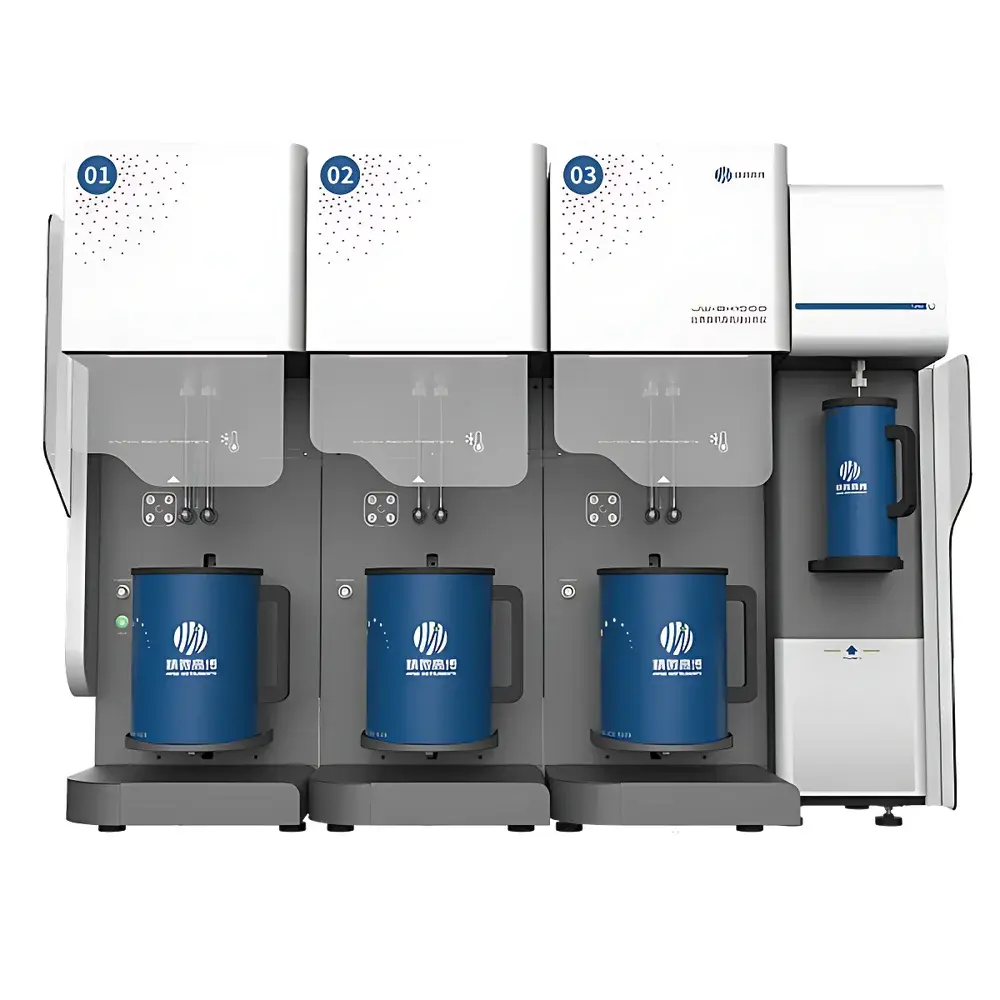
JWGB JW-BK1000 Series High-Performance Specific Surface Area and Pore Size Analyzer
| Brand | JWGB |
|---|---|
| Origin | Beijing, China |
| Manufacturer Type | Direct Manufacturer |
| Instrument Type | Specific Surface Area and Pore Size Analyzer |
| Principle | Static Volumetric Method |
| Analysis Stations | 12 (configurable up to 3 cascaded units) |
| Pore Diameter Range | 0.35 nm – 500 nm |
| Relative Pressure Range | 1×10⁻⁸ – 0.998 |
| Repeatability | ≤0.02 nm (most probable pore diameter, standard sample) |
| Ambient Temperature | 15°C – 40°C |
| Vacuum System | Imported mechanical vacuum pump + imported turbo-molecular pump (ultimate vacuum: 1×10⁻⁸ Pa) |
| BET Surface Area Detection Limit | ≥0.0005 m²/g (RSD ≤1.0%, certified reference material) |
| Total Pore Volume Detection Limit | ≥0.0001 cm³/g |
| Degassing Temperature | Ambient – 400°C (customizable to higher) |
| Valve Box Temperature Control | Up to 45°C ±0.5°C (uniformity <1°C across chamber) |
Overview
The JWGB JW-BK1000 Series High-Performance Specific Surface Area and Pore Size Analyzer is an engineered solution for precise, high-throughput characterization of porous solids using the static volumetric gas adsorption method. Based on rigorous application of IUPAC-recommended physisorption principles, the system quantifies specific surface area (SSA), pore volume distribution, and pore size distribution across microporous (50 nm) regimes—spanning a validated analytical range from 0.35 nm to 500 nm. Its modular architecture supports up to three independently operable units, each configurable with micro- or mesopore analysis stations, enabling parallel measurement of up to 12 samples under identical or differentiated conditions. The instrument operates under ultra-high vacuum (1×10⁻⁸ Pa), ensuring minimal background interference and high signal-to-noise ratio during low-pressure isotherm acquisition—critical for accurate micropore analysis via t-plot, HK, SF, DR, or DFT modeling.
Key Features
- Modular Cascaded Architecture: Supports 1–3 independent working units; each unit hosts up to 4 analysis stations, scalable to 12 total stations. Units operate autonomously—enabling concurrent experiments with distinct gases, temperatures, or protocols.
- Dual-Pump Vacuum System: Integrated mechanical pump + turbo-molecular pump delivers ultimate vacuum ≤1×10⁻⁸ Pa—essential for reliable sub-monolayer nitrogen adsorption at p/p₀ <10⁻⁷ and robust CO₂ adsorption at 273 K for ultramicropore characterization.
- Thermally Stable Valve Box: Actively temperature-controlled to 45°C ±0.5°C with spatial uniformity <1°C. Minimizes thermal drift in pressure transducers and valves, directly improving repeatability of low-pressure measurements.
- Independent Gas Inlet Management: Each unit features dedicated gas inlet ports; optional multi-gas manifold supports up to 18 programmable gas channels (N₂, Ar, CO₂, Kr, O₂, CH₄, H₂, C₂H₆), with automatic valve sequencing and leak-tight switching.
- In-Situ Sample Conditioning: Four-zone programmable heating furnace per unit (ambient–400°C, customizable to 600°C); integrated air-bath thermal enclosure ensures uniform degassing and prevents condensation during cool-down.
- Real-Time Operational Feedback: LED status indicators per station (white = standby, orange = heating, green = active adsorption, red = fault) provide immediate visual diagnostics without software interaction.
- Integrated Safety Protocol Stack: Real-time monitoring of pressure, temperature, and cryogen level triggers automatic shutdown, audible alarm, and red LED alert. Front-mounted sliding safety shield mitigates liquid nitrogen splash risk during cryogenic operation.
Sample Compatibility & Compliance
The JW-BK1000 accommodates solid powders, granules, monoliths, and catalyst pellets (max. Ø 12 mm × H 25 mm). It complies with ASTM D3663 (BET surface area), ISO 9277 (gas adsorption surface area), ISO 15901-2 (pore size distribution by gas adsorption), and USP (porosity testing for pharmaceutical excipients). Data acquisition and reporting support 21 CFR Part 11-compliant audit trails—including user authentication, electronic signatures, and immutable metadata logging—ensuring suitability for GLP/GMP-regulated environments. All calibration standards (e.g., NIST-traceable silica gel, activated carbon) are documented per ISO/IEC 17025 requirements.
Software & Data Management
JW-Analyzer v5.2 provides full control over isotherm acquisition, degassing scheduling, and model-based interpretation. It implements IUPAC-recognized methods including BET (multi-point and single-point), Langmuir, t-plot, BJH, DH, HK, SF, DR, MP, and non-local DFT kernel libraries (NLDFT, QSDFT) for slit/cylindrical/helium-corrected pore models. Raw data (pressure, time, temperature) are stored in HDF5 format with embedded metadata (instrument ID, operator, timestamp, environmental logs). Export options include ASTM E131-compliant CSV, PDF reports with uncertainty propagation, and direct integration with LIMS via RESTful API. Audit trail records all parameter changes, manual overrides, and report generations with timestamps and user IDs.
Applications
- Catalyst development: Quantifying metal-support interface area, pore confinement effects on turnover frequency, and thermal stability of mesostructured oxides (e.g., SBA-15, MCM-41).
- Pharmaceutical formulation: Assessing amorphous content via surface area correlation, excipient porosity impact on dissolution kinetics, and lyophilized protein matrix characterization.
- Energy materials: Evaluating electrode porosity in Li-ion battery cathodes/anodes, MOF/COF surface accessibility for gas storage (H₂, CH₄), and carbon aerogel hierarchy for supercapacitors.
- Environmental sorbents: Measuring activated carbon micropore volume for VOC capture efficiency, zeolite Si/Al ratio correlation with CO₂ selectivity, and biochar pore network resilience under humid aging.
- Advanced ceramics: Monitoring sintering-induced pore closure in alumina/zirconia compacts and correlating green-body surface area with binder burnout profiles.
FAQ
What adsorption models are natively supported for micropore analysis?
The system includes t-plot, αs-plot, HK (Horvath-Kawazoe), SF (Saito-Foley), DR (Dubinin-Radushkevich), and MP (Micropore Plot) methods, plus optional NLDFT/QSDFT kernel libraries for slit, cylindrical, and ink-bottle pore geometries.
Can the instrument perform simultaneous multi-gas analysis on different stations?
Yes—each working unit has independent gas routing; with the multi-gas manifold option, up to six gases can be assigned to distinct stations within one unit, enabling comparative isotherms (e.g., N₂ at 77 K vs. CO₂ at 273 K) without cross-contamination.
Is remote monitoring and control supported?
JW-Analyzer v5.2 supports secure remote access via TLS-encrypted VNC or web-based dashboard (optional add-on), with role-based permissions and session logging compliant with ISO 27001 information security controls.
How is calibration traceability maintained?
Pressure transducers are calibrated annually against NIST-traceable dead-weight testers; temperature sensors are verified using PT100 reference probes (±0.1°C accuracy). Certificate of Calibration includes as-found/as-left data and measurement uncertainty budgets per ISO/IEC 17025.
What sample preparation accessories are included?
Standard delivery includes four degassing tubes (Ø12 mm), quartz sample pans, stainless steel transfer tools, and a vacuum-compatible desiccator. Optional accessories include high-temperature degassing kits (600°C), magnetic stirrer-integrated tubes, and automated sample loader modules.



