
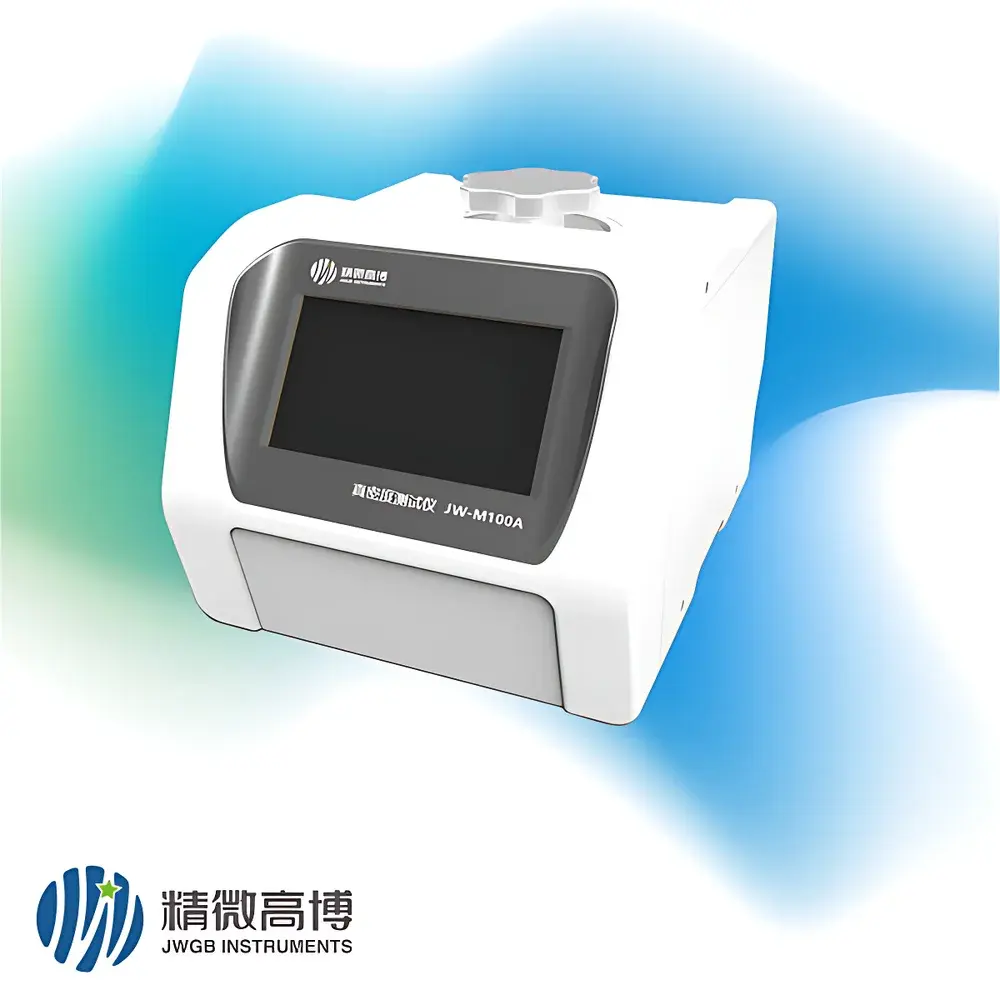
JWGB JW-M100A Foam-Specific True Density and Porosity Analyzer
| Brand | JWGB |
|---|---|
| Origin | Beijing, China |
| Manufacturer Type | Direct Manufacturer |
| Product Category | Domestic |
| Model | JW-M100A Foam-Specific True Density and Porosity Analyzer |
| Instrument Type | True Density Analyzer |
| Form Factor | Benchtop Laboratory Instrument |
| Sample Type | Solid Materials (Including Rigid & Flexible Foams) |
| Measurement Principle | Gas Displacement Pycnometry (Helium/Nitrogen/Air) |
| Density Range | 0 g/mL to No Known Upper Limit |
| Density Accuracy | ≤ 0.03% (RSD) |
| Resolution | 0.00001 g/mL |
| Temperature Control Range | 0–50 °C |
| Analysis Station | 1 |
| Vacuum System | Integrated Oil-Free Diaphragm Pump |
| Pressure Sensor | Imported High-Stability Transducer, 0.04% FS Accuracy, Long-Term Drift ≤ 0.025% FS |
| Pressure Regulation | Fully Automated, Max Pressure ≤ Atmospheric |
| Sample Chamber Volume Options | 10–120 mL (6 Standard Aluminum Cells Supplied) |
| Cycle Time | ≤ 2 Minutes per Measurement |
| Data Interface | Full-Touch LCD Console + USB Export |
| Compliance | CE Certified, Meets JJG 99–2006 (Chinese National Metrology Verification Regulation), Supports GLP Audit Trail via Exported Timestamped Logs |
Overview
The JWGB JW-M100A Foam-Specific True Density and Porosity Analyzer is a benchtop gas displacement pycnometer engineered for high-precision determination of true (skeletal) density, absolute volume, open-cell porosity, and closed-cell porosity in low-density, compressible, and highly porous solid materials—particularly polymeric foams, elastomeric sponges, aerogels, and lightweight composites. It operates on the fundamental principle of gas displacement pycnometry, compliant with ASTM D5550 and ISO 12154 standards for solid density measurement. Unlike liquid immersion methods—which risk pore collapse, surface wetting artifacts, or chemical incompatibility—the JW-M100A uses inert gases (helium preferred for its small kinetic diameter and minimal adsorption) to probe only the non-porous skeletal volume. Its dual-chamber, constant-volume manifold design enables rapid equilibration and high reproducibility by eliminating mechanical drift and thermal lag. The instrument integrates a thermally stabilized aluminum module housing both sample and reference chambers, ensuring isothermal conditions across all pressure transients—a critical requirement for accurate porosity partitioning in heterogeneous foam structures.
Key Features
- Integrated oil-free diaphragm vacuum pump with quiet operation and zero hydrocarbon contamination—essential for maintaining gas purity and avoiding baseline drift during repeated evacuation cycles.
- Imported high-stability pressure transducers (0.04% full-scale accuracy, ≤0.025% FS long-term drift) calibrated traceably to NIST standards, enabling sub-millitorr resolution in differential pressure measurement.
- Patented non-heating solenoid valves with zero reverse leakage, ensuring precise gas dosing and pressure step fidelity—critical for reliable open/closed porosity discrimination.
- Modular aluminum sample chamber assembly with six standardized cell volumes (10 mL, 20 mL, 30 mL, 50 mL, 80 mL, 120 mL), each CNC-machined for dimensional repeatability and surface passivation to prevent gas adsorption artifacts.
- Active temperature stabilization system maintaining ±0.1 °C uniformity between sample and reference chambers over the full 0–50 °C operating range—minimizing thermal expansion errors and enhancing inter-run reproducibility.
- Self-contained touchscreen interface (7″ capacitive LCD) with embedded firmware; no external PC required. All calibration, measurement, and export functions managed locally with timestamped audit logs.
- USB data export supporting CSV and XML formats compatible with LIMS integration, statistical process control (SPC) software, and regulatory reporting workflows.
Sample Compatibility & Compliance
The JW-M100A is validated for use with rigid polyurethane (PU), flexible polyethylene (PE), ethylene-vinyl acetate (EVA), silicone sponge, melamine foam, and metallic foams—including those with bulk densities as low as 5 kg/m³. Its low-pressure, non-destructive methodology preserves structural integrity during analysis, avoiding compression-induced closure of open cells. The system complies with CE marking requirements and meets the metrological specifications outlined in JJG 99–2006 (People’s Republic of China National Verification Regulation for Pycnometers). While not inherently 21 CFR Part 11–compliant, exported data files include digital signatures, operator ID, date/time stamps, and version-controlled firmware metadata—supporting GLP/GMP-aligned documentation practices when integrated into validated laboratory workflows.
Software & Data Management
The embedded firmware implements a deterministic finite-state machine architecture for measurement sequencing, eliminating race conditions during valve actuation and pressure sampling. Each test cycle records raw pressure-time series, temperature readings, and calculated density/porosity values with 6-digit decimal precision. Calibration routines include standard reference material (SRM) verification using certified fused silica or stainless steel spheres (supplied with instrument). Data export supports batch-mode retrieval via USB mass storage mode; files contain header metadata describing instrument ID, firmware revision, operator code, ambient conditions, and uncertainty estimates derived from sensor error propagation models. Optional CSV parsing scripts (Python/MATLAB) are available for automated SPC chart generation and trend analysis across production lots.
Applications
This analyzer serves quality control and R&D laboratories in polymer science, battery electrode development, acoustic insulation engineering, biomedical scaffold characterization, and lightweight structural composites. Typical use cases include: quantifying closed-cell content in automotive seat foams per ISO 845; verifying density homogeneity in lithium-ion battery anode foils; validating pore structure retention after thermal cycling in aerospace-grade syntactic foams; and benchmarking porosity distributions across additive-manufactured metal lattice structures. It is routinely deployed in facilities producing catalyst supports, filtration membranes, and pharmaceutical excipient foams where skeletal density directly correlates with mechanical resilience and mass transport efficiency.
FAQ
What gases are compatible with the JW-M100A?
Helium is recommended for highest accuracy due to its low molecular weight and minimal adsorption; nitrogen and dry air are acceptable alternatives for routine screening where absolute precision is secondary to throughput.
Can the instrument differentiate between open and closed porosity in irregularly shaped foam samples?
Yes—by performing sequential measurements under atmospheric and vacuum-degassed conditions, the firmware calculates open-cell fraction based on gas-accessible void volume, while closed-cell content is inferred from the residual non-accessible volume.
Is external computer hardware required for operation or data analysis?
No—the integrated touchscreen console handles all instrument control, real-time visualization, and local data storage; external PCs are optional only for advanced statistical modeling or enterprise LIMS integration.
How is temperature stability maintained during extended testing sessions?
A proprietary aluminum thermal bus couples the sample and reference chambers, while a PID-controlled Peltier element maintains setpoint accuracy within ±0.1 °C across ambient fluctuations up to ±5 °C.
Are calibration standards included with the instrument?
Yes—certified reference materials (e.g., fused silica spheres, stainless steel cylinders) are supplied for initial validation and periodic recalibration, traceable to national metrology institutes.



