
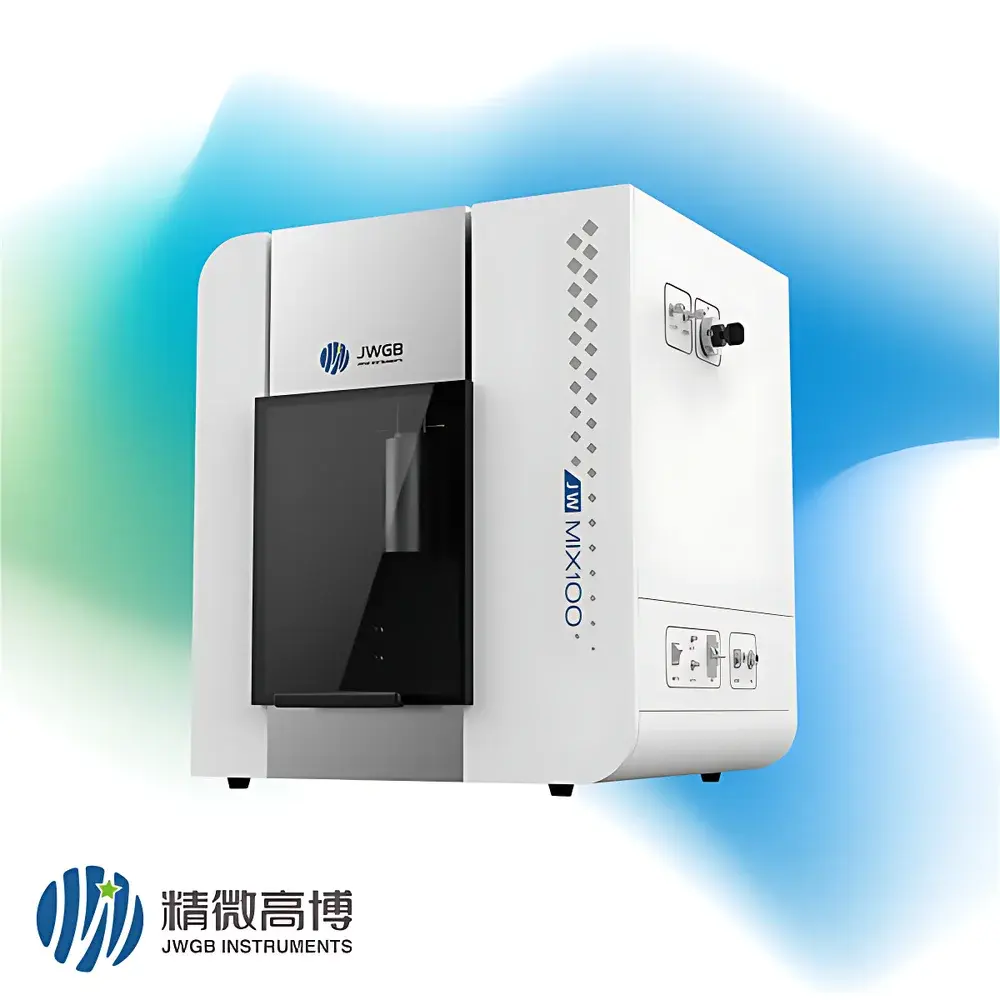
JWGB JW-MIX100 Pro Breakthrough Curve and Mass Transfer Analyzer
| Brand | JWGB |
|---|---|
| Origin | Beijing, China |
| Manufacturer Type | Direct Manufacturer |
| Origin Category | Domestic (China) |
| Model | JW-MIX100 Pro |
| Gas Range | Customizable |
| MFC Count | 4 |
| Column Configuration | Customizable |
| Maximum Adsorption Pressure | 100 bar |
| Detector | TCD (Thermal Conductivity Detector) |
Overview
The JWGB JW-MIX100 Pro Breakthrough Curve and Mass Transfer Analyzer is an advanced dynamic gas-phase adsorption system engineered for quantitative characterization of mass transfer kinetics and equilibrium behavior in porous adsorbents under realistic process conditions. It operates on the principles of dynamic breakthrough chromatography and zero-length column (ZLC) methodology—two rigorously validated techniques widely adopted in adsorption science for determining intraparticle diffusion coefficients, surface diffusion rates, and kinetic selectivity in multicomponent systems. Unlike static volumetric or gravimetric analyzers, the JW-MIX100 Pro enables real-time monitoring of concentration fronts as gas mixtures flow through a packed bed under controlled temperature, pressure, and flow rate. This facilitates high-fidelity reconstruction of breakthrough curves, enabling derivation of effective diffusivities, axial dispersion coefficients, and time-resolved adsorption capacities—critical parameters for pressure swing adsorption (PSA), temperature swing adsorption (TSA), and membrane–adsorption hybrid process design.
Key Features
- Four independent, high-precision mass flow controllers (MFCs) support precise binary and ternary gas mixture generation with reproducible composition control (±0.5% full scale).
- Modular column manifold accommodating customizable breakthrough columns—including stainless steel, quartz, or Hastelloy configurations—with standardized Swagelok® end fittings for leak-tight operation up to 100 bar.
- Integrated TCD detector with dual reference cells ensures stable baseline performance and high signal-to-noise ratio across wide thermal gradients (ambient to 200 °C).
- ZLC mode implemented via ultra-short bed geometry (<1 mm bed height) and rapid pulse injection, enabling direct measurement of desorption kinetics without axial dispersion interference.
- Full-pressure-range operation (vacuum to 100 bar) with active pressure regulation and real-time feedback control, compliant with ISO 15901-2 and ASTM D6877 guidelines for high-pressure adsorption testing.
- Robust thermal management system with dual-zone PID-controlled ovens (±0.1 °C stability) for independent column and detector temperature regulation.
Sample Compatibility & Compliance
The JW-MIX100 Pro accommodates powdered, pelletized, extruded, or monolithic adsorbent forms—including zeolites, MOFs, activated carbons, silica gels, and carbon molecular sieves—with particle size ranges from 20 µm to 5 mm. Sample holders are designed for minimal dead volume and uniform flow distribution. All wetted parts comply with ASTM A269/ASME BPE standards for corrosion resistance. The instrument meets essential requirements for GLP-compliant laboratories: audit-trail-enabled data logging, user-access-level controls, electronic signature support, and alignment with FDA 21 CFR Part 11 data integrity principles when operated with optional validated software modules.
Software & Data Management
JWGB’s proprietary MIXControl v3.2 software provides synchronized acquisition of pressure, temperature, flow, and TCD voltage signals at up to 100 Hz sampling rate. Real-time visualization includes overlayed breakthrough profiles, derivative analysis (dC/dt), and automated peak integration. Export formats include CSV, ASCII, and HDF5 for seamless integration with MATLAB®, Python (SciPy/Pandas), or Aspen Adsorption modeling environments. Batch processing tools enable comparative analysis across multiple isotherms, temperatures, or gas compositions. Raw data files are timestamped, digitally signed, and stored with metadata (operator ID, method file hash, calibration history)—ensuring traceability per ISO/IEC 17025:2017 clause 7.5.2.
Applications
- Determination of effective diffusivity (Deff) and surface diffusion coefficient (Ds) in microporous materials using ZLC and short-column breakthrough methods.
- Quantification of competitive adsorption selectivity (αA/B) and co-adsorption isotherms for CO2/CH4, H2/CO, N2/O2, and VOC/water vapor systems.
- Validation of kinetic models (e.g., Linear Driving Force, LDF; Surface Diffusion Model, SDM) against experimental transient response data.
- Thermodynamic evaluation of adsorption enthalpy via van’t Hoff analysis across temperature-programmed breakthrough runs.
- Process-relevant testing of adsorbent aging, poisoning, and regeneration efficiency under cyclic loading–purging protocols.
FAQ
What gas species can be analyzed with the JW-MIX100 Pro?
The system supports any non-corrosive, non-polymerizing gases—including He, H2, N2, O2, CH4, CO, CO2, C2H6, and SF6—with custom MFC and column configurations available for reactive or high-boiling-point vapors.
Is zero-length column (ZLC) functionality included as standard?
Yes. ZLC mode is fully integrated, requiring only a dedicated short-bed insert and pulse injection valve—both supplied with the base configuration.
Can the system operate under vacuum or inert purge conditions?
Yes. Equipped with a vacuum-rated manifold and optional turbomolecular pump interface, it supports evacuation to <10−3 mbar prior to adsorption cycles.
Does the software support automated method sequencing for unattended overnight runs?
Yes. Method templates allow full automation of multi-step protocols—including pre-conditioning, equilibration, breakthrough, desorption, and regeneration phases—with conditional logic and failure recovery.
What calibration standards are recommended for TCD response factor determination?
Certified gas mixtures traceable to NIST SRMs (e.g., NIST 2659a for CO2/N2) are recommended; calibration curves are stored per gas pair and automatically applied during quantification.



