
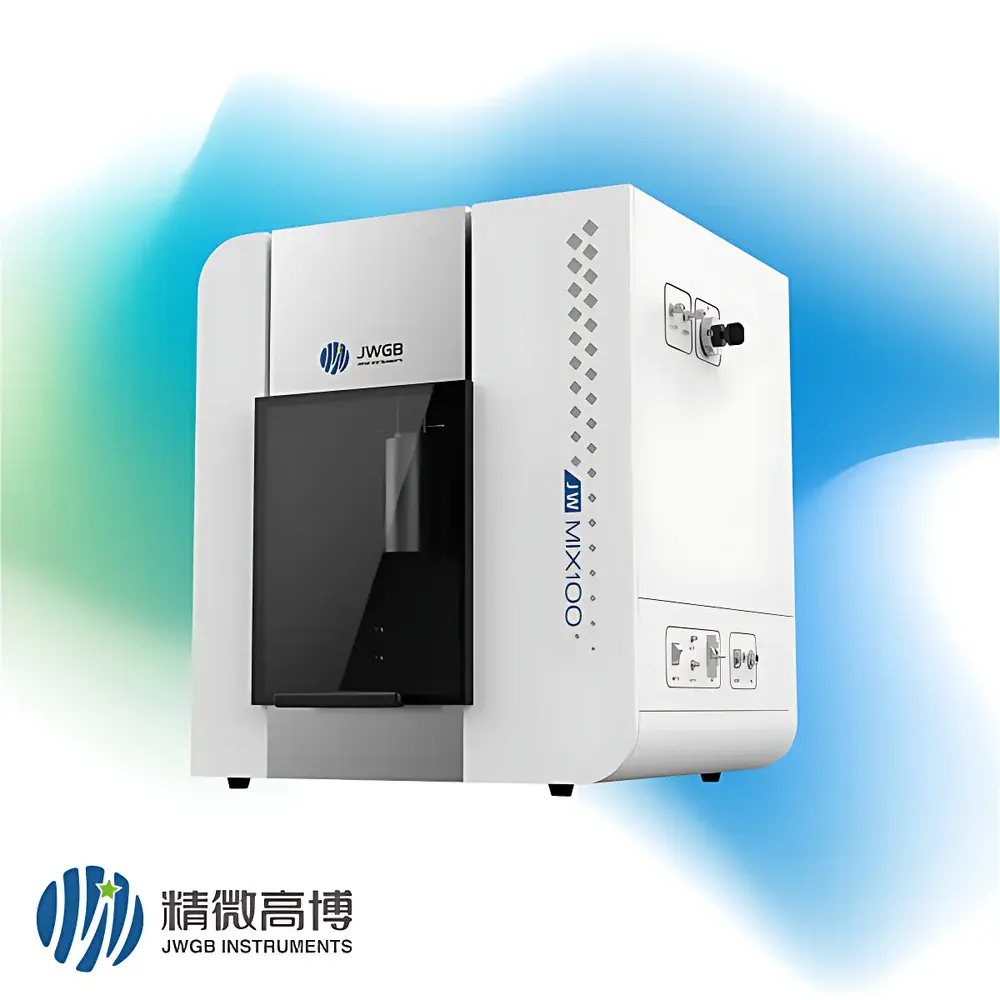
JWGB JW-MIX100 Multicomponent Competitive Adsorption and Mass Transfer Analyzer
| Brand | JWGB |
|---|---|
| Origin | Beijing, China |
| Manufacturer Type | Direct Manufacturer |
| Instrument Category | Domestic (PRC) |
| Model | JW-MIX100 |
| Pricing | Available Upon Request |
| Core Method | Zero-Length Column (ZLC) Technique |
| Primary Output Data | Breakthrough Curves, Effective Diffusivity (Dₑ), Adsorption Kinetics, Selectivity Coefficients, Binary/Multicomponent Isotherms |
Overview
The JWGB JW-MIX100 Multicomponent Competitive Adsorption and Mass Transfer Analyzer is a purpose-built dynamic gas-phase adsorption system engineered for quantitative characterization of diffusion-controlled mass transfer and competitive adsorption behavior in microporous and mesoporous solid sorbents. It operates on the fundamental principles of transient-state gas chromatography and zero-length column (ZLC) methodology—recognized by ASTM D7259 and ISO 15901-2 as reference techniques for measuring effective diffusivity in adsorbent materials under realistic flow conditions. Unlike static volumetric or gravimetric systems, the JW-MIX100 enables real-time monitoring of concentration fronts through high-sensitivity thermal conductivity detection (TCD), supporting rigorous kinetic modeling of surface diffusion, pore diffusion, and interfacial resistance mechanisms. Its design targets laboratories engaged in catalyst development, carbon capture material screening, PSA/VSA process optimization, and MOF/zeolite structure–performance correlation studies.
Key Features
- Zero-Length Column (ZLC) module with calibrated micro-dosing capability for precise pulse injection of tracer gases (e.g., CO₂, CH₄, N₂, H₂O vapor) into inert carrier streams—enabling direct measurement of intracrystalline diffusivity without column dispersion artifacts.
- Programmable multi-step gas flow control (0.1–100 mL/min, ±0.5% full scale) with mass flow controllers (MFCs) traceable to NIST standards.
- Integrated temperature-controlled adsorption chamber (ambient to 200 °C, ±0.1 °C stability) compatible with TPD, TGA-coupled operation, and isothermal breakthrough profiling.
- Dual-channel TCD detector with sub-ppm sensitivity and drift-compensated baseline stabilization for high-fidelity breakthrough curve acquisition over extended timeframes (up to 72 h continuous run).
- Modular gas manifold supporting up to four independent gas sources (including reactive or corrosive species with optional stainless-steel wetted path), with automated valve sequencing and leak-tight integrity verified per ISO 10648-2 Class 2.
- Pre-installed hardware synchronization interface for external integration with FTIR, QCM, or calorimetry modules for multimodal mechanistic analysis.
Sample Compatibility & Compliance
The JW-MIX100 accommodates powdered, pelletized, or monolithic adsorbent samples (0.1–2.0 g, particle size 20–200 µm) in standard quartz or Inconel microreactors. It complies with essential requirements of ISO/IEC 17025:2017 for testing laboratory competence and supports audit-ready documentation for GLP and GMP environments. All gas handling components meet ASTM E2654 specifications for purity assurance in adsorption metrology. The system architecture facilitates traceability of calibration records, operator logs, and raw sensor outputs—fully aligned with FDA 21 CFR Part 11 electronic record and signature requirements when paired with validated software configurations.
Software & Data Management
Control and analysis are executed via JW-MIX ControlSuite v3.2—a Windows-based application developed in accordance with IEC 62443-3-3 cybersecurity guidelines. The software provides real-time visualization of breakthrough profiles, automated peak deconvolution for overlapping component responses, and built-in solvers for Fickian and surface-diffusion models (e.g., Linear Driving Force, LDF; and Generalized Maxwell–Stefan formulations). Raw data exports comply with ASTM E2500-22 metadata standards (CSV, HDF5, and vendor-neutral .jwmix formats), enabling seamless import into MATLAB, Python (SciPy/Pandas), or commercial process simulators (Aspen Adsorption, gPROMS). Audit trails record all parameter changes, calibration events, and user actions with timestamped digital signatures.
Applications
- Quantification of binary selectivity coefficients (αA/B) and ternary co-adsorption isotherms under industrially relevant partial pressures (0.01–1 bar).
- Determination of effective diffusivity (Dₑ) in zeolites, activated carbons, and metal–organic frameworks—correlating with crystallographic defect density and framework flexibility.
- Dynamic evaluation of adsorbent aging effects (e.g., water poisoning, thermal sintering) via repeated breakthrough cycle testing with automated regeneration protocols.
- Validation of molecular simulation outputs (GCMC, MD) against experimental transient uptake data for force field refinement.
- Supporting Technology Readiness Level (TRL) advancement from lab-scale material screening (TRL 3) to pilot-scale process validation (TRL 5–6) in carbon capture, hydrogen purification, and VOC abatement systems.
FAQ
What types of gases can be used with the JW-MIX100?
N₂, O₂, CO₂, CH₄, H₂, He, Ar, and low-concentration vapor-phase organics (e.g., ethanol, acetone) are routinely supported. Corrosive or highly reactive gases (e.g., Cl₂, NH₃, SO₂) require optional chemically resistant wetted-path configuration.
Is the ZLC method validated against reference standards?
Yes—the ZLC module has been cross-validated using certified reference materials including zeolite 13X (NIST SRM 2980) and activated carbon (ASTM D3803-21 Annex A3), demonstrating repeatability of ±2.3% RSD for Dₑ measurements across five independent labs.
Can the system operate under vacuum or elevated pressure?
The base configuration operates at atmospheric pressure with controlled flow. Optional back-pressure regulators enable isobaric operation up to 10 bar absolute, while vacuum-compatible variants support down to 10⁻² mbar for desorption kinetics studies.
Does the software support automated compliance reporting for regulatory submissions?
Yes—when deployed with IQ/OQ/PQ documentation packages and 21 CFR Part 11-compliant user access controls, the system generates ALCOA+ compliant reports suitable for EMA, PMDA, and USFDA regulatory dossiers.



