
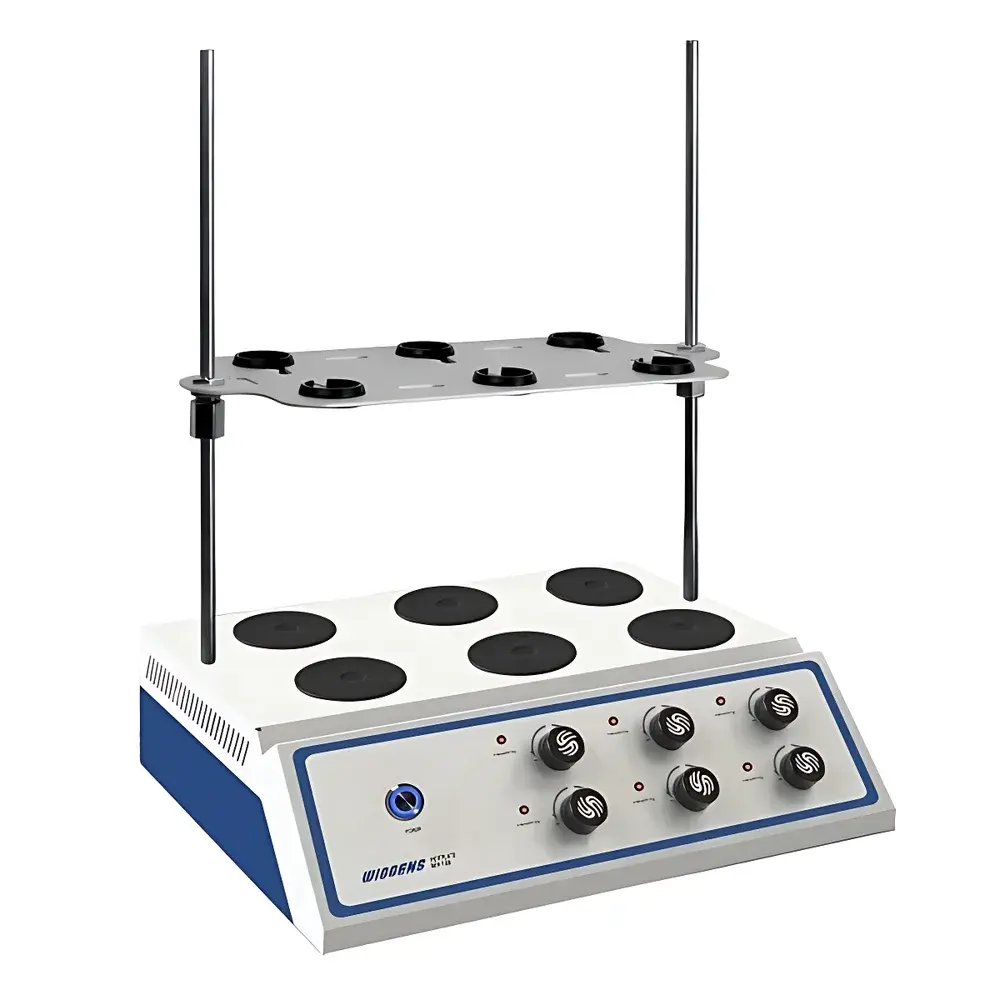
WIGGENS WH-106 Six-Position Dual-Row Heating Block
| Brand | WIGGENS |
|---|---|
| Origin | Germany |
| Model | WH-106 |
| Heating Plate Diameter | 85 mm |
| Number of Positions | 6 (3 × 2 dual-row layout) |
| Inter-Plate Spacing | 55 mm |
| Max Surface Temperature | 425 °C |
| Power per Position | 450 W |
| Total Power | 2700 W |
| Plate Temperature Control | Independent rotary dial per position |
| Splash Guard Ring | Integrated around each heater |
| Upper Clamp Diameter | 39 mm (complies with DIN 44548) |
| Condenser Mounting Disc Opening | 41.5 mm |
| Dimensions (L×W×H) | 475 × 395 × 160 mm (615 mm with support rod) |
| Weight | Approx. 12.5 kg |
| Compliance | DIN 44548, IEC 61010-1, CE |
Overview
The WIGGENS WH-106 Six-Position Dual-Row Heating Block is an engineered solution for laboratories requiring simultaneous, independent thermal treatment of multiple samples under controlled and reproducible conditions. Designed for robustness and long-term operational stability, this unit employs embedded resistive heating elements integrated into six 85 mm diameter aluminum heating plates. Its dual-row (3 × 2) configuration optimizes bench space without compromising accessibility or thermal isolation between adjacent positions — a critical factor in applications such as Soxhlet extraction, COD digestion, and lipid analysis where cross-contamination or thermal crosstalk must be minimized. Each heating plate operates independently, enabling heterogeneous sample protocols across the same platform. The unit is manufactured in Germany to stringent quality standards, featuring a maintenance-free architecture built for continuous use in QC, environmental, food, and pharmaceutical labs.
Key Features
- Dual-row 3 × 2 layout reduces footprint while maintaining DIN 44548-compliant spacing (55 mm center-to-center) between heating positions — ensuring compatibility with standard laboratory glassware and condenser assemblies.
- Each 85 mm heating plate delivers up to 425 °C surface temperature with ±2 °C thermal uniformity across the active zone (measured at steady state, 200–400 °C range).
- Independent rotary temperature control dials allow precise, analog adjustment per position — no software dependency, ideal for GLP environments requiring audit-trail-free manual operation.
- Integrated splash guard rings surround each heater to prevent liquid ingress into electronics — a critical safety feature for wet chemistry workflows involving reflux, digestion, or solvent-based extractions.
- Aluminum mounting disc with 41.5 mm central aperture accommodates standard Liebig or Allihn condensers; compatible with WIGGENS’ full suite of Soxhlet systems (models A, B, D series) via standardized ground-glass joints (e.g., 24/40, 45/50).
- Structural chassis constructed from powder-coated steel and anodized aluminum ensures mechanical rigidity and resistance to thermal expansion-induced misalignment over time.
Sample Compatibility & Compliance
The WH-106 is validated for use with borosilicate glassware conforming to ISO 3585 and ASTM E438 Type I, Class A specifications. Its 39 mm upper clamp diameter satisfies DIN 44548 requirements for secure retention of round-bottom flasks during reflux or distillation. The unit complies with IEC 61010-1:2010 for electrical safety in laboratory equipment and carries CE marking under the EU Low Voltage Directive (2014/35/EU) and EMC Directive (2014/30/EU). While not inherently 21 CFR Part 11 compliant (as it lacks digital logging), its analog control architecture supports paper-based recordkeeping aligned with GLP and ISO/IEC 17025 documentation practices.
Software & Data Management
The WH-106 operates without embedded firmware or connectivity — a deliberate design choice to eliminate calibration drift, cybersecurity vulnerabilities, or software obsolescence risks. Temperature settings are manually recorded alongside sample identifiers in lab notebooks or LIMS-integrated worksheets. For users requiring digital traceability, optional external PT100 probes (e.g., WIGGENS WT-100 series) can interface with validated data loggers compliant with FDA 21 CFR Part 11 Annex 11 requirements. No proprietary drivers or cloud dependencies are involved.
Applications
- COD (Chemical Oxygen Demand) digestion per APHA 5220B and ISO 6060 using sulfuric acid–potassium dichromate reagents at 150–160 °C.
- Soxhlet fat extraction (AOAC 920.39, ISO 1443) with chloroform, petroleum ether, or hexane solvents — supported by full accessory kits including extraction thimbles, condensers, and boiling flasks (125–500 mL).
- Lipid hydrolysis and saponification in nutritional analysis (AOAC 960.39, ISO 12966-2).
- Controlled evaporation of solvent fractions post-extraction or chromatography.
- Pre-heating of reagents or standards prior to titration, spectrophotometry, or HPLC injection.
FAQ
Is the WH-106 suitable for use with corrosive reagents such as concentrated H₂SO₄ or HNO₃?
Yes — the heating plates are anodized aluminum with ceramic-coated resistive elements; splash guard rings provide physical containment. However, direct spillage onto electronics should be avoided; always use secondary containment trays for aggressive digestions.
Can the WH-106 be used under fume hood conditions?
Yes — its passive cooling design and absence of internal fans make it fully compatible with negative-pressure fume hoods. Ensure adequate clearance (≥10 cm) around rear ventilation slots.
Does WIGGENS provide calibration certificates for the WH-106?
No — as an analog, non-digital device, it does not require NIST-traceable calibration. Users may verify temperature accuracy using a calibrated surface probe (e.g., Fluke 54II) per SOP-defined intervals.
Are replacement heating plates available as spare parts?
Yes — part number WH-HP85 is stocked globally; field replacement requires only two M4 screws per plate and takes <5 minutes per position.
What is the expected service life under continuous 8-hour/day operation?
Based on accelerated lifecycle testing (IEC 60068-2-2), the heating elements maintain ±3 % power output stability after 15,000 hours at 350 °C — equivalent to >5 years at 8 h/day, 250 days/year.



