
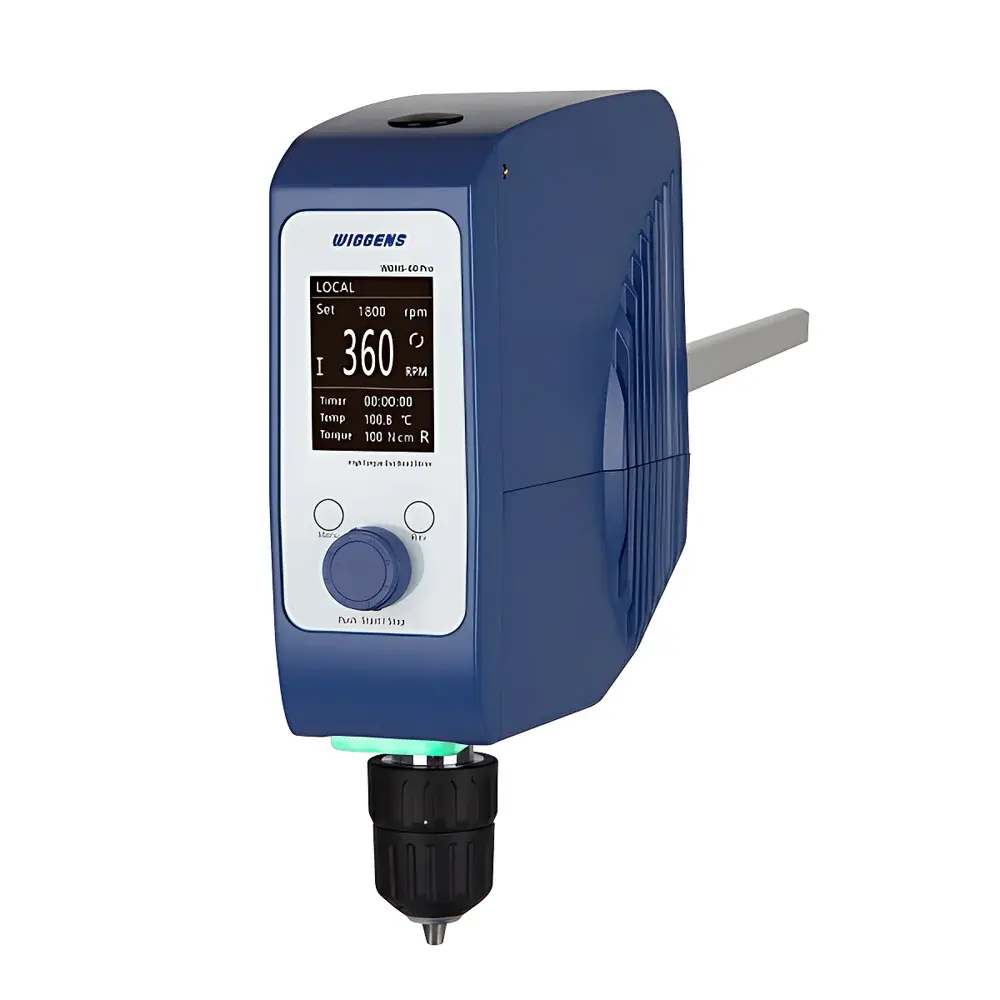
WIGGENS WOHS-100 Pro Overhead Stirrer
| Brand | WIGGENS |
|---|---|
| Origin | Germany |
| Model | WOHS-100 Pro |
| Stirrer Type | Overhead Stirrer |
| Max. Mixing Volume | ≤100 L (H₂O) |
| Speed Range | 30–1500 rpm |
| Speed Resolution | ≥1 rpm |
| Speed Accuracy | ≤±3% (at n > 300 rpm) |
| Torque Limit | ≤200 N·cm |
| Viscosity Range | ≤100,000 mPa·s |
| Temperature Measurement Range | −10 to 350 °C |
| Temp. Resolution | 0.1 °C |
| Motor Type | Brushless DC Motor |
| Power Input/Output | 200 W / 150 W |
| Clamp Shaft Diameter | 0.5–10 mm |
| Hollow Shaft ID | 10.2 mm |
| Dimensions (W×D×H, w/o support rod) | 100 × 241 × 295 mm |
| Support Rod | 16 × 220 mm |
| IP Rating | IP42 |
| Supply Voltage | 100–240 VAC, 50/60 Hz |
Overview
The WIGGENS WOHS-100 Pro Overhead Stirrer is an industrial-grade laboratory stirring system engineered for precision, repeatability, and operational robustness in demanding mixing and dispersion applications. Designed according to the principles of torque-controlled rotational agitation, it employs a brushless DC motor architecture to deliver consistent angular velocity across its full speed range (30–1500 rpm), with real-time current-to-torque conversion enabling dynamic load monitoring. Unlike magnetic stirrers limited by vessel geometry and heat transfer constraints, this overhead configuration supports scalable mixing in jacketed reactors, glass vessels, and stainless-steel tanks—enabling homogeneous blending of low- to high-viscosity fluids (up to 100,000 mPa·s) with volumes up to 100 L of water-equivalent media. Its integrated temperature sensing capability (−10 to 350 °C, 0.1 °C resolution) allows synchronized thermal feedback during exothermic or endothermic processes, supporting process-critical workflows in chemical synthesis, polymer formulation, and pharmaceutical suspension development.
Key Features
- Brushless DC motor ensures maintenance-free operation, high efficiency, and extended service life under continuous duty cycles.
- Intelligent torque monitoring via real-time motor current analysis provides insight into rheological resistance changes—critical for detecting phase transitions, gelation, or particle agglomeration.
- High-brightness TFT display with intuitive touch keys and rotary encoder enables precise parameter entry (speed, time, direction) and immediate visual status feedback (standby: blue; operation: green; fault: red).
- Self-locking chuck eliminates tool dependency for rapid impeller exchange; accommodates shaft diameters from 0.5 to 10 mm, including hollow-shaft compatibility (ID 10.2 mm) for thermocouple or pH probe integration.
- Programmable timer supports durations from 1 second to 99 h 59 min 59 sec, facilitating unattended long-term reactions or standardized batch protocols.
- IP42-rated housing offers protection against splashing liquids and solid ingress, suitable for use in general laboratory environments and fume hood installations.
Sample Compatibility & Compliance
The WOHS-100 Pro accommodates a broad spectrum of sample types—including aqueous solutions, organic solvents, viscous pastes, suspensions, and shear-thinning polymers—across standard laboratory glassware (e.g., round-bottom flasks, beakers, jacketed reactors) and custom reactor vessels. Its mechanical design complies with IEC 61010-1:2010 for electrical safety in laboratory equipment. While not intrinsically rated for explosive atmospheres, it may be deployed in ATEX Zone 2 environments when operated with certified explosion-proof motors or within ventilated enclosures. The device supports GLP/GMP-aligned documentation practices through traceable parameter logging (when paired with optional data acquisition modules) and meets essential requirements for ISO/IEC 17025-compliant method validation where stirring consistency is a critical control parameter.
Software & Data Management
The WOHS-100 Pro operates as a standalone instrument with embedded firmware; no proprietary software is required for basic operation. However, analog output (0–10 V) and digital RS-232 interface enable integration into centralized lab automation systems (e.g., LabVIEW, DeltaV, or custom SCADA platforms) for remote speed control, torque trending, and timestamped event logging. When connected to compliant data acquisition hardware, the system supports audit-trail-capable records per FDA 21 CFR Part 11 guidelines—provided user authentication, electronic signatures, and change history mechanisms are implemented at the host level. Exported datasets include RPM, torque %, elapsed time, and temperature readings at user-defined intervals.
Applications
- Chemical R&D: Controlled addition of reagents during multi-step syntheses requiring precise agitation intensity and thermal coordination.
- Pharmaceutical Manufacturing: Homogenization of oral suspensions, emulsions, and granulation binders under GMP-relevant mixing profiles.
- Materials Science: Dispersion of nanoparticles in polymer matrices, graphite in battery slurries, and ceramic precursors in colloidal suspensions.
- Food & Beverage QA/QC: Standardized viscosity testing of sauces, dressings, and dairy products using reproducible shear histories.
- Environmental Testing: Preparation of standardized sediment slurry samples for TCLP or leaching studies per EPA Method 1311.
FAQ
Can the WOHS-100 Pro be used with corrosive solvents such as concentrated acids or halogenated hydrocarbons?
Yes—provided appropriate impeller materials (e.g., Hastelloy, PTFE-coated SS) and sealed bearing configurations are selected. The base unit’s housing is chemically resistant but not immersion-rated; vapor exposure should remain within IP42 environmental limits.
Is calibration traceable to national standards available for this instrument?
Speed and temperature sensors can be externally verified using NIST-traceable tachometers and dry-block calibrators; WIGGENS provides factory calibration certificates upon request, though field recalibration requires authorized service centers.
Does the unit support bidirectional rotation for de-agglomeration tasks?
Yes—clockwise and counterclockwise operation is programmable and switchable during runtime, enabling alternating shear regimes for breaking weak flocs without damaging fragile structures.
What is the maximum permissible ambient temperature for continuous operation?
The unit is rated for continuous use at ambient temperatures up to 40 °C with adequate ventilation; derating is recommended above this threshold to maintain thermal stability of the motor driver and power electronics.



